In brief
The edelweiss grows in the alpine zone on calcareous, rocky soil, rarely, and its silvery-white “petals” are actually bracts protecting the true flower head, which blooms in July and August. The German Alpine Club’s own article calls it the first plant ever placed under strict nature protection, in 1886, and Bavaria’s own conservation group lists it as highly endangered on the state’s Red List. It shows up embroidered on Allgäu Lederhosen suspenders in a pattern traceable to a 1756 template, and it is not the same thing as the Edelweiss beer brand, which is Austrian. It is a small, rare, protected flower that souvenir shops have turned into an oversized icon.
Disclosure: some links on this page are affiliate links, marked by the products, tours and hotels they name. As an Amazon Associate, bavarianbistro.com earns from qualifying purchases. A purchase through these links may earn the site a commission at no cost to you, and it never affects what is recommended. How this works.
Almost every Bavarian souvenir shelf has an edelweiss on something, a pin, an embroidered patch, a keychain, and almost none of the tourists buying them have ever seen the actual flower growing wild, because it is rarer than the merchandise suggests. This page is the plant itself, its protected status, and where it genuinely belongs on Trachten, as part of my guide to Trachten and Bavarian customs.
The plant, and why you will probably never see it wild
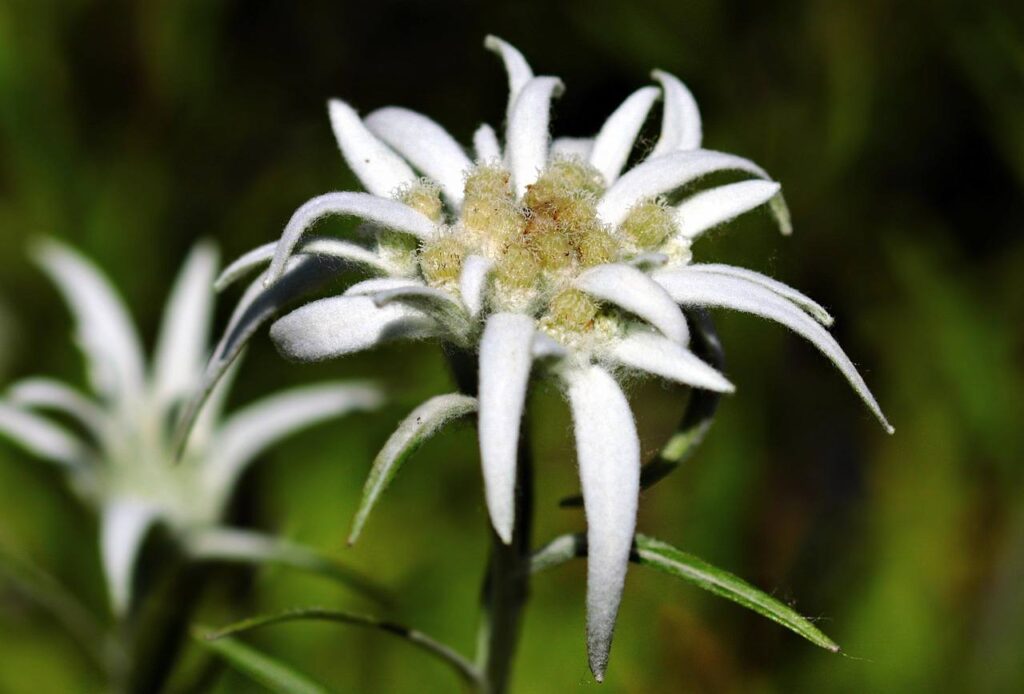
The German Alpine Club, the Deutscher Alpenverein, describes the edelweiss growing in the alpine zone on calcareous, stony-loamy or clayey soils, typically tucked into rock crevices or stony turf. It calls a sighting in the Central Alps comparable to “winning a lottery,” which tells you how rare an actual wild specimen is even to people who spend their lives in these mountains1.
Biologically, the plant grows up to 20 centimeters tall, with woolly stems and densely hairy leaves. What looks like a ring of white petals is technically a cluster of bracts surrounding the true flower head, and the plant blooms at peak in July and August. Its silvery-white hairs reflect sunlight, which protects it from drying out at altitude. Somewhat surprisingly for a flower this associated with the Alps, the Alpenverein’s own article traces its origin to the Himalayas1.
The first plant ever protected, and where it stands today
The same Alpenverein article states that the edelweiss was the very first plant placed under strict nature protection anywhere, in 1886, a genuinely early moment in the history of conservation, not a modern rule1. BUND Naturschutz, a Bavarian conservation organization, adds the current standing: the edelweiss sits in Category 2, “stark gefährdet,” or highly endangered, on Bavaria’s own Red List, and it has been strictly protected in Austria since 1886 with severe penalties for removal or damage2.
BUND Naturschutz’s own page identifies over-collection as souvenirs as a historical driver of the plant’s decline, alongside modern pressure from mountain agriculture, settlement, road construction and climate change more broadly. Its advice to readers is direct: buy cultivated edelweiss for a garden or balcony, never a wild-picked or transplanted one2. I could not confirm the exact German federal ordinance text covering the plant on a fetched page this session, so I am not quoting specific statute language here; the DAV and BUND Naturschutz sources above are what this article relies on for its protected status.
Resi says If you are hoping to press a real edelweiss into a scrapbook from your own Alpine hike, do not. It is protected, it is rare enough that a sighting counts as luck according to the people who study it, and the whole point of a souvenir pin is that nobody has to dig one up to get it.
On Lederhosen, and specifically the Allgäu
The edelweiss motif on Trachten is not a generic Bavarian tradition; it is regional. The Trachtenverband Bayern, Bavaria’s official traditional-dress association, states on its own page about the “Edelweißhosenträger,” the edelweiss suspenders, that the motif is a typical feature of the Allgäu mountain folk costume specifically. Its history traces to the 18th century, with an embroidery template dated 1756 preserved in the Oberstdorf local museum, used to guide the stitching3.
A pair of these suspenders carries roughly 13 to 15 embroidered edelweiss flowers, worked in leaf stitch for the petals and chain loops filled with wool for texture, with flower centers dotted in yellow, orange and black thread. The Trachtenverband names two artisans who continue and teach the craft today, Christl Metzler and Maria Kögel3. If you see the pattern on a pair of Lederhosen suspenders anywhere else in Bavaria, it has traveled from the Allgäu, not the other way around.
The Edelweiss you will find on a beer label is not Bavarian
One more correction worth making plainly: Edelweiss, the wheat-beer brand, is Austrian, not Bavarian, and it belongs nowhere on a Bavarian shopping list. The brewery’s own site states it is brewed under the heritage of Hofbräu Kaltenhausen, founded in 1475 in Kaltenhausen, near Salzburg, Austria, with the Edelweiss brand itself created in 1986 and marketed around a brewing tradition dating to 1646. The company is owned by Brau Union Österreich, part of Heineken, and the fetched site states no US distribution anywhere on the page4.
A souvenir worth the drawer it sits in
If you want the motif without the myth, look for something specific rather than a generic “Bavarian” trinket bin. Alpenflüstern, a family-run manufactory near Lake Starnberg in Bavaria’s Five Lakes region, sells a Bavarian Label Pin set of two bicolor edelweiss pins for $19.95, sized for a hat, a dirndl or a Lederhosen jacket, rated 4.6 stars from 48 buyers at the time I checked5. It is a small, honestly made accessory rather than the plant itself, which is exactly the point.
Frequently Asked Questions
Is it illegal to pick an edelweiss in the wild?
The edelweiss has been strictly protected in Austria since 1886 with severe penalties for damage or removal, per a Bavarian conservation organization’s own page, and Bavaria itself lists it as highly endangered on its state Red List.
Where does the edelweiss actually grow?
In the alpine zone, on calcareous, rocky or clay-rich soil, usually in rock crevices or stony turf, above where most hiking trails casually pass.
Is the edelweiss only found in Bavaria?
No. It grows across the Alps generally and, per the German Alpine Club’s own article, its ancestry traces back to the Himalayas.
Is Edelweiss beer a Bavarian brand?
No. It is Austrian, brewed under the heritage of Hofbräu Kaltenhausen near Salzburg and owned by Brau Union Österreich, part of Heineken.
Why is the edelweiss specifically linked to the Allgäu?
The embroidered edelweiss suspenders, a defining use of the motif on Trachten, trace to an 18th-century template from the Allgäu region, not to Bavaria as a whole.
Can I buy a real, legal edelweiss plant for my garden?
A Bavarian conservation group’s own advice is to buy only cultivated plants from a nursery, never a wild-collected or transplanted one.
Related Articles
 Dirndl, Lederhosen and the Bavarian Year: Trachten and Customs ExplainedTrachten and customs
 How to Wear Lederhosen: Socks, Straps, Shirt and ShoesTrachten and customs
 Haferlschuhe and Loferl: The Shoes and Socks That Finish the OutfitTrachten and customs
 Lederhosen: History, Types and What a Real Pair CostsTrachten and customs
 The Dirndl Explained: Blouse, Bodice, Skirt, Apron and How It Should FitTrachten and customs
 Bavarian Beer, Explained: Styles, Breweries, Beer Halls and Beer GardensBeer
Sources
- Das Alpen-Edelweiss — Deutscher Alpenverein. Accessed 2026-09-26.
- Alpenpflanzen — BUND Naturschutz. Accessed 2026-09-26.
- Der Edelweißhosenträger — Trachtenverband Bayern. Accessed 2026-09-26.
- Edelweissbier — Edelweiss (Brau Union Österreich). Accessed 2026-09-26.
- Alpenflüstern Bavarian Label Pins Edelweiss set of 2 — Amazon.com. Accessed 2026-09-26.