In brief
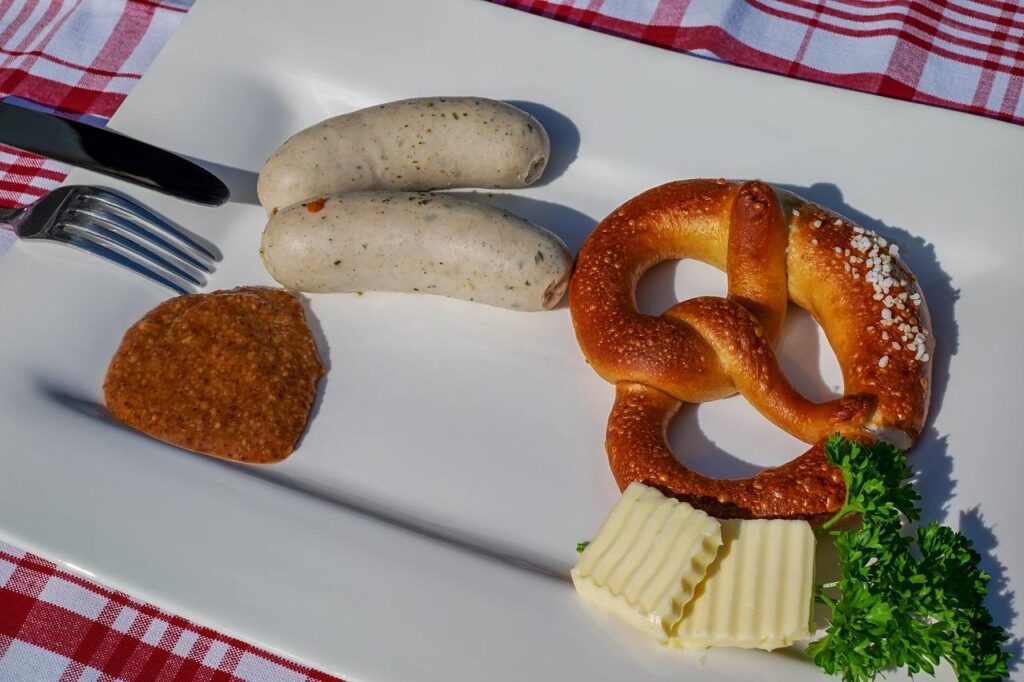
The Bavarian breakfast is called Frühschoppen, literally “early pint,” and one definition states it plainly: “Frühschoppen is a typical Bavarian Weisswurst and Weißbier breakfast”. The plate is Weißwurst, a pale poached veal sausage that Munich’s official register traces to 1857 at the earliest documented point, eaten with the skin removed. Alongside it sits a Bavarian pretzel, an EU-protected product with its own legal specification, and a spoonful of sweet Bavarian mustard, a recipe created in 1914 by Johanna Händlmaier in Regensburg. The drink is Weißbier, a wheat beer poured into a glass sized to leave room for its foam. The old rule for the sausage is that it “must not survive the noon bell,” a habit from before refrigeration that Munich restaurants no longer enforce as a safety rule.
Disclosure: some links on this page are affiliate links, marked by the products and tours they name. As an Amazon Associate, bavarianbistro.com earns from qualifying purchases. A purchase through these links may earn the site a commission at no cost to you, and it never affects what is recommended. How this works.
If a Munich waiter sets down a bowl of pale sausages swimming in hot water at ten in the morning, next to a pretzel, a pot of brown mustard and a full glass of wheat beer, nothing has gone wrong with your order, and nobody at the next table thinks it has either. This is Frühschoppen, the Bavarian breakfast, built from four things that each carry more history than a Tuesday breakfast has any right to. I cover the sausage itself in detail in my Weißwurst guide; this page is about the whole plate, and it sits inside my broader guide to Bavarian food.
What Frühschoppen actually means
The word breaks down as “früh,” early, and “Schoppen,” an old measure for a pint, and one directly fetched definition confirms the core of it: “Frühschoppen is a typical Bavarian Weisswurst and Weißbier breakfast”1. It names the meal, not a specific time or day of the week, and I am not going to claim a more specific ritual, such as a fixed weekend tradition, beyond what that source states.
The sausage: Weißwurst
The centerpiece is Weißwurst, a pale poached sausage of veal, pork belly, cooked veal head meat, egg white, parsley, onion, mace and lemon, in a pork casing about 4.7 inches (12 cm) long2. It is poached, never fried or grilled, because the thick casing would split under dry heat. Munich’s specialties register dates the sausage to February 22, 1857, at an inn on Marienplatz, while also noting a Munich historian’s find of an 1814 engraving showing Münchners already eating white sausages, meaning the dish is likely older than its most famous origin story.
The old rule attached to the sausage is that it “must not survive the noon bell,” a habit from the days before refrigeration when the sausages were made fresh each morning from perishable batter and had to be eaten the same day2. That rule is tradition now, not food safety: Munich restaurants serve Weißwurst into the afternoon. You do not eat the skin, the classic methods are to suck the meat out of the casing, zuzeln, or slit it open with a knife and lift the meat out with a fork. My Weißwurst guide walks through both methods step by step.
The bread: a Bavarian pretzel
The pretzel on the plate is not a generic one. “Bayerische Breze” has held Protected Geographical Indication status in the EU register since Commission Implementing Regulation (EU) No 161/2014, registered 21 February 20143. The legal specification describes a “deep-glazed, copper-coloured crust” with “rugged cracks that form during the baking process,” over a soft, fluffy interior. It is made from wheat flour, water, yeast, an optional malt-containing leavening agent, salt, sodium carbonate and fat, coated before baking in a lye solution of under 4% sodium hydroxide. The same specification distinguishes it from the Swabian pretzel by thicker arms set higher up, no standard middle split, and a lower fat content, 1.5 to 4 percent against the Swabian version’s 4 to 8 percent, and it states outright that the Bavarian pretzel is traditionally paired with Weisswurst and Leberkäse. If you want to bake one yourself, my lye-vs-baking-soda pretzel guide covers both methods.
The condiment: sweet Bavarian mustard
The third element is Süßer Senf, Bavarian sweet mustard, a coarse, brown, sweetened mustard chosen specifically because a sharp yellow mustard would fight the lemon and mace in the sausage. The best-known brand is Händlmaier, founded in Regensburg in 1910 as a butcher shop by Karl and Johanna Händlmaier; Johanna is credited with developing the sweet mustard recipe itself in 1914, and the company passed through the family for the next century, Joseph and Luise Händlmaier from 1949, Luise’s daughter Christa Aumer from 1981, and grandson Franz Wunderlich from 1988, who moved production to Haslbach in 19924.
Händlmaier’s own site states it still holds the position of market leader in sweet mustard in Germany, citing retail-tracking data through 2025, and in the US the same Sweet Bavarian Mustard is sold in a 13.4-ounce jar on Amazon6.
Resi says I could eat Händlmaier straight off the spoon, no sausage required, and camping friends have learned to expect a jar of it in my bag before they expect a tent. Nothing else in a mustard jar comes close, and I include the sharp yellow kind sitting right next to it on the shelf.
The drink: Weißbier
The glass matters as much as the beer. A traditional Weißbier glass holds half a liter of beer with extra room built in for the foam, and pouring it well takes some practice; poured badly, “the foam will otherwise likely overflow or be flat”5. The name itself, Weißbier, literally means “white beer,” a name that dates to when it was brewed by a different method than the lager style now known as Helles. Outside Bavaria, the same style is usually called Weizenbier or Weizen, and a darker version exists as Dunkelweizen. My Weißbier guide has more on the style itself.
What's on the table, at a glance
| Item | What it is |
|---|---|
| Weißwurst | Poached veal-and-pork-belly sausage, skin not eaten |
| Bavarian pretzel | EU-protected lye pastry, copper crust, soft interior |
| Sweet mustard | Coarse, brown, sweetened; Händlmaier is the leading brand |
| Weißbier | Wheat beer, poured into a half-liter glass with room left for the foam |
Source: Munich specialties register2; EUR-Lex PGI specification3; Händlmaier company history4; Munich Beer Gardens5.
Making the meal at home
Weißwurst is perishable enough that it is sold frozen and pre-cooked outside Germany. A mail-order kit from The Taste of Germany bundles two packs of Stiglmeier Weißwurst, ten 4-ounce Bavarian soft pretzels and a jar of sweet mustard for $48.95 as of September 2026, shipped quickly because the sausage cannot travel slowly7. Pair it with a Weißbier from a US import shelf or specialty grocer, poured into a tall glass with room left at the top for the head, and you have the same four elements Munich puts on the table, at a breakfast hour of your own choosing.
Frequently Asked Questions
What is Frühschoppen?
The Bavarian name for a Weißwurst-and-Weißbier breakfast; the word combines “früh” (early) and “Schoppen,” an old measure for a pint.
What do you eat for a Bavarian breakfast?
Weißwurst, a Bavarian pretzel, sweet Bavarian mustard, and a Weißbier.
Do you eat the skin of the Weißwurst?
No. It is a thick pork casing, removed either by sucking the meat out or by slitting the sausage and lifting the meat out with a fork.
Is the Bavarian pretzel legally protected?
Yes. “Bayerische Breze” has held EU Protected Geographical Indication status since 2014, with a legal specification distinguishing it from the Swabian pretzel.
Who created Bavarian sweet mustard?
Johanna Händlmaier, in Regensburg in 1914, working from the family butcher shop founded with her husband Karl in 1910.
Why is Weißbier served in a special glass?
A traditional Weißbier glass holds half a liter of beer plus extra room for the foam, and needs a careful pour to avoid the foam overflowing or falling flat.
Can you get a Bavarian breakfast outside Germany?
Yes. Weißwurst is sold frozen and pre-cooked by mail order; one kit with sausages, pretzels and mustard lists at $48.95 as of September 2026. Sweet Bavarian mustard is also sold on Amazon in the US.
Related Articles
Sources
- Frühschoppen — Munich Beer Gardens. Accessed 2026-09-24.
- Münchner Weißwurst — Genussorte Bayern, Bavarian State Ministry of Food, Agriculture and Forestry. Accessed 2026-09-24.
- Bayerische Breze / Bayerische Brezn — EUR-Lex, Official Journal of the European Union. Accessed 2026-09-24.
- Unternehmen (Company History) — Luise Händlmaier GmbH. Accessed 2026-09-24.
- Weißbier — Munich Beer Gardens. Accessed 2026-09-24.
- Händlmaier’s Sweet Bavarian Mustard, 13.4 oz — Amazon.com. Accessed 2026-09-24.
- The Taste of Germany Weisswurst & Pretzel Meal Kit — The Taste of Germany. Accessed 2026-09-24.