In brief
A real Bavarian pretzel, “Bayerische Breze,” is dipped in a lye solution before baking, and that dip is written directly into its EU legal specification: a solution of under 4% sodium hydroxide, giving the pretzel its “deep-glazed, copper-coloured crust” and “rugged cracks”. Baking soda is the substitute most home bakers reach for, since food-grade lye is caustic and needs real safety precautions; a tested baking soda bath uses about 57 grams of baking soda and 18 grams of salt per 2 quarts of water, boiled for 30 seconds a side. If you do use lye, the same source’s own method calls for 20 grams of food-grade lye dissolved in 500 grams of cold water, worn with eye protection and rubber or latex gloves, with a 10-to-15-second dip. A dedicated safety guide from the same baker adds the rest: work in a well-ventilated room, use a non-reactive bowl such as stainless steel or glass, and neutralize any spills with vinegar before rinsing diluted lye down the drain.
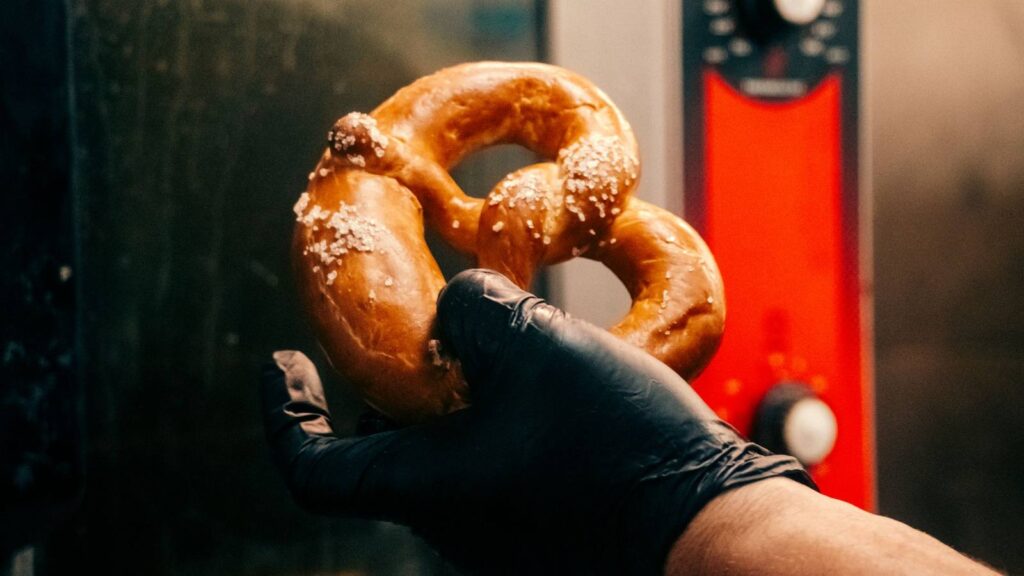
Every real Bavarian pretzel recipe hits the same fork in the road: dip the shaped dough in lye, the thing that gives a bakery pretzel its dark, glossy, cracked crust, or use baking soda, the thing that will not send you to urgent care. This page lays out both methods as they are actually documented, plus the lye safety rules that a vague memory of “be careful with chemicals” does not replace. It sits alongside my Bavarian breakfast guide, where the pretzel is one of four things on the plate.
What makes a pretzel "Bavarian" in the first place
“Bayerische Breze” is not a marketing name. It has held Protected Geographical Indication status in the EU register since Commission Implementing Regulation (EU) No 161/2014, registered 21 February 20141. The legal specification describes the finished pretzel as having a “deep-glazed, copper-coloured crust” with “rugged cracks that form during the baking process,” over a soft, fluffy interior, topped with coarse salt or, less traditionally, poppy seed, sesame, pumpkin seed, sunflower seed or cheese. The raw materials are wheat flour, water, yeast, an optional malt-containing leavening agent, table salt, sodium carbonate and fat. The dough itself is “kneaded thoroughly,” then “cut into pieces and rolled out right to the tip into thin strands,” before being shaped, dipped in the lye solution, salted and baked.
The same specification is what separates a Bavarian pretzel from its Swabian neighbor: thicker arms set higher up, no standard split down the middle, a lower fat content of 1.5 to 4 percent against the Swabian version’s 4 to 8 percent, and an evenly baked, crackled surface1. Its own historical note traces a popular lye-pretzel origin story to 11 February 1839, when a Munich baker, Anton Nepomuk Pfannenbrenner, is said to have mistakenly coated pretzels in a lye solution meant for cleaning baking sheets, a story the filing itself flags as the standard legend, not an independently verified event.
Resi says Among the Schmankerl, the treats a Bavarian actually pines for, a fresh Brezn was one I loved most back in Munich, and it earns that reputation honestly: warm, heavily salted, gone before you finish admiring the crust. What is verified beyond my own appetite: the specification states the pretzel is traditionally served with Weißwurst and Leberkäse, exactly where I put it in my Bavarian breakfast guide. The 1839 baking-sheet story is a good one. I would not repeat it as history.
Lye vs. baking soda: what each one actually does
Both baths raise the pH of the dough’s surface before baking, which is what produces the dark color and distinctive flavor of a pretzel crust instead of a plain bread crust. Lye (sodium hydroxide) is stronger and gets closer to a bakery’s result. Baking soda (sodium bicarbonate) is weaker, safe to handle in a normal kitchen, and gets a similar but lighter effect. A written recipe that tests both baths side by side gives the following methods2:
| Method | Bath | Time | Handling |
|---|---|---|---|
| Baking soda | 2 quarts (1,814g) water, 1 tablespoon (18g) table salt, ¼ cup (57g) baking soda | 30 seconds per side, boiling | No special gear needed |
| Lye | 20g food-grade lye dissolved in 500g cold water | 10 to 15 seconds | Eye protection and rubber or latex gloves required |
Source: King Arthur Baking, pretzel bun recipe2.
For the baking soda method, buns or pretzels go into the boiling bath a few at a time, seam-side down, cooked 30 seconds, flipped, and cooked 30 seconds more. For the lye method, the shaped dough is soaked in the cold lye solution for 10 to 15 seconds, then set on a stainless steel rack over parchment to drain before scoring, salting and baking.
Lye dipped for too long, or at too high a concentration, will over-darken and can leave a bitter, soapy edge. Baking soda is far more forgiving if you go a few seconds long, which is one more reason I would start a beginner there.
If you use lye: the safety rules, from a source that actually states them
Working with food-grade lye is not a step to guess your way through. A dedicated safety guide lays out the real precautions, and they are worth following exactly3:
- Wear the right gear. “Plastic or rubber gloves, eye protection such as goggles, clothing that protects your skin from splashes or spills, and closed-toed shoes.”
- Work somewhere with airflow. Mix and dip in “a room with good airflow and not a small, confined space in order to reduce the risk of inhaling concentrated lye fumes.”
- Use the right container. Lye should go into “a non-reactive bowl, such as stainless steel or glass,” never a reactive metal.
- Clean up with an acid. After you finish, “wipe your work surface with an acid such as vinegar to neutralize any lye that might have inadvertently come in contact.”
- Dispose of it safely. Diluted lye solution can be poured “directly down the drain, then followed with a few seconds of cold water from the sink faucet.”
None of this is optional if you are choosing lye over baking soda. If any of these steps feels like more than your kitchen setup can handle safely, that is the baking soda method’s whole reason for existing.
Which one should you actually use
If you want the closest possible match to a Bavarian bakery’s crust and you are comfortable following the safety steps above exactly, food-grade lye gets you there. If you want a pretzel that looks and tastes very close, without bringing sodium hydroxide into your kitchen, baking soda is the documented, tested substitute, using the ratios above2. Either way, buy food-grade lye specifically if you go that route, not a drain-cleaning or soap-making grade product, and my food-grade lye buying guide covers what to look for when you shop.
Frequently Asked Questions
What makes a pretzel officially "Bavarian"?
Its EU Protected Geographical Indication specification, which fixes the ingredients, the lye dip, the shape and a lower fat content than the Swabian version.
Is the lye pretzel origin story from 1839 true?
It is the standard legend recorded in the EU’s own filing, which explicitly notes it as the traditional story rather than an independently verified historical event.
What is the baking soda substitute for lye?
A boiling bath of about 2 quarts of water, 1 tablespoon (18g) of salt and ¼ cup (57g) of baking soda, with the dough boiled 30 seconds per side.
How much lye do I use for a real lye pretzel?
One tested method uses 20 grams of food-grade lye dissolved in 500 grams of cold water, with a 10-to-15-second dip.
What safety gear do I need to work with lye?
Rubber or plastic gloves, eye protection, clothing that covers your skin, and closed-toed shoes, in a well-ventilated room.
What container should I mix lye in?
A non-reactive bowl, such as stainless steel or glass.
How do I clean up after using lye?
Wipe surfaces with an acid such as vinegar to neutralize any residue, and pour diluted lye solution down the drain followed by cold water.
Is a Bavarian pretzel the same as a Swabian pretzel?
No. The Bavarian version has thicker arms set higher up, no standard middle split, and a lower fat content (1.5–4% versus 4–8%), per the EU specification for both.
Related Articles
 The Bavarian Breakfast: Weißwurst, Pretzel, Sweet Mustard and a Morning Wheat BeerFood
 Weißwurst: How to Eat Bavaria’s White Sausage (Skin, Mustard and the Noon Rule)Food
 The Bavarian Foods with EU Protection: Breze, Obazda, Rostbratwurst, Bier and MoreFood
 Food-Grade Lye for Pretzels: What to Buy and How to Handle It SafelyPantry and tools
 Bavarian Food: The Dishes, How Munich Eats Them, and What to Cook at HomeFood
 What Is Leberkäse? No Liver, No Cheese, and How Munich Eats ItFood
 Oktoberfest in Munich: Dates, Tents, Reservations, What to Wear and What It CostsOktoberfest
Sources
- Bayerische Breze / Bayerische Brezn — EUR-Lex, Official Journal of the European Union. Accessed 2026-09-24.
- Pretzel Buns Recipe — King Arthur Baking Company. Accessed 2026-09-24.
- A Baker’s Tips for Safely Working with Lye — King Arthur Baking Company. Accessed 2026-09-24.