In brief
Oktoberfest 2026 runs September 19 to October 4 on Munich’s Theresienwiese, the 191st edition of a festival that began as a royal wedding celebration in 1810. Entry to the grounds and to every one of the 14 large and 21 small tents is free; you pay only for what you eat and drink. A Maß, the one-liter mug, runs €14.80 to €15.90 depending on the tent in 2026, and every tent has to hold back a quarter of its seats on weekdays and 40 percent on weekends until 3 p.m. for people who never booked a table. About 6.5 million people came in 2025 and got through roughly 6.5 million Maß of beer over the 16 days. Oktoberfest 2027 is already on the calendar: September 18 to October 3.
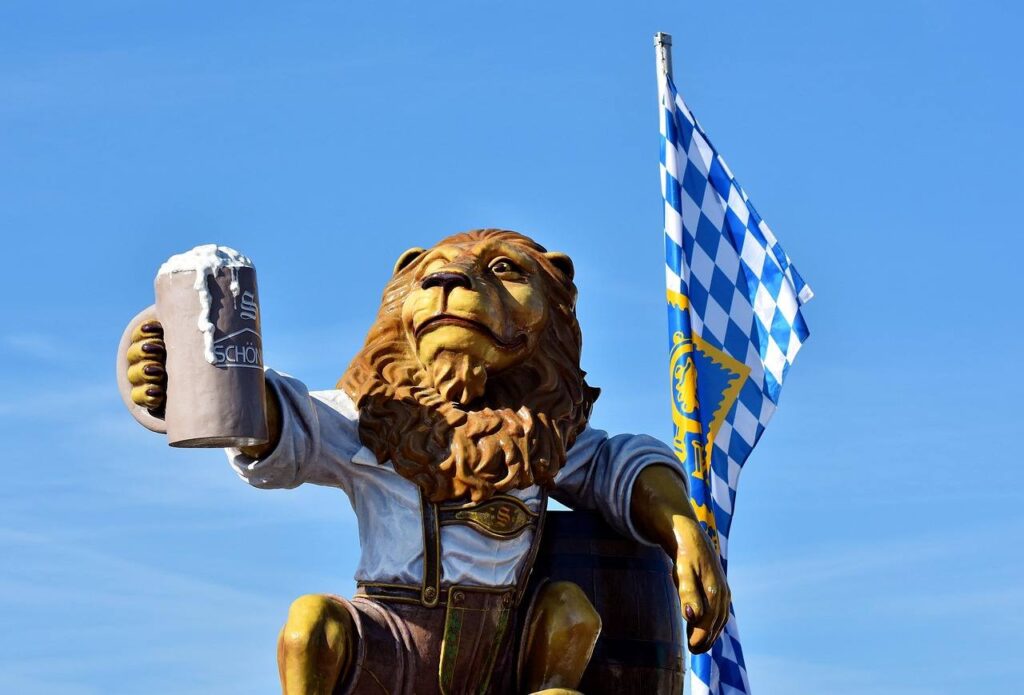
If someone just invited you to Oktoberfest and you are picturing one big tent with everyone in lederhosen, singing: you are half right, thirteen tents short, and nobody sings before the second liter. This page is the whole shape of the thing — what it costs, whether you need a reservation, what to wear, and where to sleep if you are coming from anywhere but Munich — settled in the order a newcomer actually asks it, with a longer guide waiting at the end of each answer. If you already know what you are looking for, the list under “Guides in this section” will get you there faster than I can.
Guides in this section
- Oktoberfest Dates: 2026, 2027 and Why It Starts in September
- Oktoberfest Tents: All 14 Big Tents, the Small Ones and the Oide Wiesn, Compared
- Oktoberfest Tent Reservations, Explained: Quotas, Minimum Spend and Release Dates
- Oktoberfest Without a Reservation: How the Unreserved Seats Work and When to Show Up
- How Much Does Oktoberfest Cost? A 2026 Budget in Euros and Dollars
- What to Wear to Oktoberfest, and Whether You Have To
- Oktoberfest for First-Timers: What Nobody Tells You
- Oktoberfest with Kids: Family Days, Tent Curfews and the Rides
- Where to Stay for Oktoberfest: Hotels Within Walking Distance of the Wiesn
- Springfest vs Oktoberfest: Munich’s Smaller Wiesn Compared
- Oktoberfest History: From a Royal Wedding in 1810 to Six Million Visitors
- Getting to Oktoberfest: U-Bahn, S-Bahn, Walking and Why Not to Drive
- Oktoberfest Rules: Bag Sizes, What Is Banned and How Security Works
- Oktoberfest Food: What to Eat in the Tents and at the Stalls
- The Oktoberfest Dictionary: Wiesn, Maß, O’zapft is and 40 More Words
- The Best Days and Hours to Go to Oktoberfest
- The Oktoberfest Parades: Brewers on Saturday, Costumes and Riflemen on Sunday
- Oide Wiesn: The Old-Fashioned Corner of Oktoberfest
- Oktoberfest Tours and Tent Packages: What You Get, What You Pay
- Oktoberfest in the US and Canada: The Big Ones, by Region
- Missed Oktoberfest? Bavaria’s Other Volksfeste, from Straubing to Erlangen
- An Oktoberfest Party at Home: The Menu, the Beer, the Glassware, the Playlist
- Prost, Ein Prosit and How to Hold a Maß
- Staying Safe at Oktoberfest: First Aid, Safe Space, Lost and Found
- Oktoberfest by the Numbers: Visitors, Beer, Chickens and Lost Items
- Oktoberfest Weather: What Late September in Munich Is Really Like
- Oktoberfest as a Day Trip: Staying in Augsburg, Salzburg or the Countryside Instead
- Oktoberfest Reservation Resellers: What Is Legitimate and What Is Not
What It Is and When
Oktoberfest is Munich’s annual folk festival on the Theresienwiese, a fairground on the southwest edge of the old city, and despite the name it is barely an October event anymore. The 2026 festival, the 191st, runs September 19 through October 4, and the 2027 dates are already fixed: September 18 to October 312.
The festival is always scheduled to end on the first Sunday in October, with one deliberate exception: German Unity Day, October 3, is a public holiday, and nobody wanted the Wiesn to end the day before it. “If it falls on a Monday, the Wiesn is extended by one day and therefore lasts 17 days instead of 16; if it is on a Tuesday, the Wiesn can end with it… and then lasts a full 18 days”1. Most years, 2026 included, run the standard 16 days.
About 6.5 million people came in 2025, down slightly from 6.7 million in 2024; the record was 2023’s 18-day run, which drew roughly 7.2 million, and on average about 21 percent of visitors come from outside Germany, rising to roughly 30 percent on the festival’s middle Saturday6. None of that requires a ticket. It requires showing up.
How Oktoberfest Actually Works
The mechanics trip up almost every first-time visitor, so here is the short version.
Entry is free. “Access to the festival grounds on the Theresienwiese is free. This also applies to the tents”1. There is no gate ticket and no festival wristband to buy on arrival. You pay for food and beer, and that is the entire transaction.
There are 14 large tents, 21 small ones, and three more at the Oide Wiesn, the old-fashioned corner of the grounds9. Each large tent is run by one of Munich’s breweries or a named restaurateur, seats several thousand people between its hall and its beer garden, and has its own opening act, menu emphasis and personality — the whole comparison is the subject of my tents guide.
A reservation, it turns out, is a voucher for a table, not an entry ticket: groups of eight to ten book directly with a tent, months ahead, for a minimum spend of about two beers and half a chicken each. The city requires every tent to hold back a share of seats nobody can reserve — 25 percent on weekdays, 40 percent on weekends and the public holiday until 3 p.m. and 25 percent after that, plus a further 10 percent for Munich residents with ID on weekends — and on the Oide Wiesn a third of the seats stay unreserved all day, every day5. Those seats go to whoever is sitting in them, which is the entire subject of my page on going without a reservation; the mechanics of booking one yourself are in tent reservations, explained.
| When | Share of seats that must stay unreserved |
|---|---|
| Monday to Friday | 25 percent |
| Saturday, Sunday and the public holiday, until 3 p.m. | 40 percent |
| Same days, after 3 p.m. | 25 percent |
| Oide Wiesn, all day | One third |
| Munich residents with ID, weekends and the holiday | An additional 10 percent |
Source: oktoberfest.de5.
What It Costs
Beer is the number everyone asks about first, and in 2026 a Maß — a one-liter mug, 33.8 fluid ounces — runs €14.80 to €15.90 depending on the tent, an increase of about 2.38 percent over 2025’s €14.50–€15.80 range, and averaging about €15.61 across all of them4.
| Drink | Price (2026) |
|---|---|
| Cheapest Festbier (Oide Wiesn’s Familienplatzl and Museumszelt) | €14.80 |
| Most expensive standard Festbier (Armbrustschützen-Festzelt, Bräurosl, Löwenbräu-Festzelt) | €15.90 |
| Kufflers Weinzelt wheat beer | €18.40 |
| Bottled water, one liter | €11.13 |
| Spezi, one liter | €12.84 |
Source: oktoberfest.de4.
None of that is set by the city — the tent operators price their own beer — though the city checks it against ordinary Munich prices, currently €7.70 to €13.40 a liter, “to ensure they are reasonable”4.
Beer, for what it is worth, was never mine to drink. At the Wiesn, and in every beer garden before it, my order was always a Radler — half beer, half lemon soda, which looks exactly like a Maß from three tables away and is considerably less potent up close. Nobody has ever noticed, and nobody who has noticed has minded. What goes in must come out regardless of which one you ordered, and I have watched a great many visitors forget to budget for the line at the toilets, or for what a liter of Festbier thinks about the walk home afterward.
Resi says That reservation minimum — two beers and half a roast chicken a head — is not a suggestion, it is the contract, which is why a Wiesn Hendl sits on every third table in the reserved section like a centerpiece nobody ordered as a centerpiece. Order the chicken. You were always going to order the chicken.
If you want a table of your own, budget around €350 for the voucher, which covers a table of eight to ten, plus €1.50 per person for wristbands; pit and gallery seating, rather than a main-aisle table, runs an €18 voucher per seat instead5. My cost and budget page works through a full day’s spending in euros and dollars.
Getting There
Do not drive. Munich’s own line on it could not be plainer: “there are no parking spaces available in the vicinity of the Oktoberfest for those traveling directly by car,” the surrounding residential streets are permit-only, and a car left on one gets ticketed and towed8.
The U4 and U5 stop directly at Theresienwiese, which is the shortest walk and also the most crowded, especially in the evening; the U3 and U6 to Poccistraße or Goetheplatz leave you about a ten-minute walk instead, on a calmer platform, which the city itself recommends “if you are travelling with children”7.
Every S-Bahn line also stops at Hackerbrücke, ten minutes on foot from the north entrance, and at the Hauptbahnhof, about fifteen minutes away; trams 16 and 17 run to Hackerbrücke, and several buses reach the grounds from other directions. Buy your ticket straight into your phone wallet through MVG’s ticket shop, “no app or registration required”7.
If you are driving into the city regardless, look for Park+Ride at a U-Bahn or S-Bahn station on the outskirts, or the dedicated car and motorhome lot at Ostbahnhof, open since April 2024, a six-minute walk from a station on the direct U4/U5 line8. Full detail, including which tram and bus lines serve which entrance, is on my getting there page.
What to Wear
You do not need a dirndl or lederhosen to get in. Munich’s own tourism FAQ is direct about it: “It is not compulsory to wear traditional costume, but many visitors choose to do so”9. In practice most of the crowd dresses up, in everything from an inexpensive polyester set to a family heirloom, and turning up in ordinary clothes marks you as a tourist rather than as someone doing anything wrong.
Resi says Nobody stops you at the gate in jeans, but the crowd around you will be dressed to the last button, down to toddlers in miniature lederhosen, and plain clothes just mark you as the visitor, not the criminal. If this is your one trip, buy the least expensive respectable version you can find and spend the difference on beer.
My what to wear page covers what locals actually wear, what a first dirndl or pair of lederhosen costs, and where to buy or rent one in Munich before you go.
The Parades and Family Days
Opening day, Saturday September 19, opens with the Parade of the Landlords and Breweries — tent operators and brewery wagons ahead of the noon keg-tapping — and the second Sunday, September 27, brings a landlords’ concert billed as the festival’s musical highlight10.
The day between them, Sunday September 20, brought the Trachten- und Schützenzug, the costume and riflemen’s parade through the city center; the 2026 edition drew more than 8,600 participants, with over 1,550 preschoolers separately taken on organized grounds tours11.
Both Tuesdays of the 2026 run — September 22 and September 29 — are official Familientage (Family Days), when rides, sideshows and snack bars run special prices until 7 p.m. and several tents offer discounted lunch menus12. Exactly how much each ride or menu is discounted is set by the individual operator rather than fixed citywide, so check a tent’s own page the week you go. My Oktoberfest with kids page covers curfews, stroller rules and which rides suit which ages.
Staying Safe
The festival runs its own mini-hospital, the Wiesn Outpatient Clinic — treatment rooms, operating theaters, CT scanning — which treated more than 7,000 patients in the most recent year cited, with an emergency-response target under four minutes. A panic-button app called “Safe Now,” in its fourth year for 2026, locates anyone who calls for help “accurate to within a metre” and covers eight of the larger tents13.
A dedicated women’s safe space runs out of the ambulance center for anyone facing harassment, theft or violence, part of a “Sichere Wiesn” (“Safe Wiesn”) initiative that also runs outreach before the festival opens. New for 2026, a security control center watches camera-fed, AI-generated “heat maps” for overcrowding, staffed by people the festival calls “crowdspotters,” and around 600 police officers work the festival13.
If it rains or snows, the festival still runs — “the festival also takes place in rain and snow” — though a tent may close its doors temporarily once it hits capacity9.
Lost something? During the festival, the lost-and-found office runs out of the Deutsches Museum Verkehrszentrum at Am Bavariapark 5, daily from 1 to 10 p.m.; items found on the grounds are not delivered to the office until the day after they turn up, so the advice is to wait a day or two before asking14. My safety and first aid page has the rest, including what the ambulance service saw on the 2026 opening weekend.
Where to Stay
You do not need to be within walking distance of the Theresienwiese to enjoy Oktoberfest, but it helps. The neighborhoods immediately around the grounds are Westend and Schwanthalerhöhe, home to the Bavaria statue that overlooks the fairground itself and to Augustiner-Bräu, Munich’s oldest brewery15.
Between the grounds and the main train station sits Ludwigsvorstadt, rebuilt after the war specifically with hotels and restaurants — the district takes in roughly two million overnight guests a year — and it is also where Theresienwiese’s own U4/U5 station sits16.
The Hauptbahnhof itself, a fifteen-minute walk from the grounds by the route the city signposts, is the other major transit and lodging hub, with a tourist information desk of its own alongside the one at Marienplatz in the Altstadt17. The Altstadt, Munich’s historic center, connects to Theresienwiese directly by U4/U5 from Karlsplatz/Stachus — not the shortest walk, but not the crowding at the Theresienwiese stop either7.
Farther out, the U3/U6 stops at Poccistraße and Goetheplatz put you about a ten-minute walk from the grounds, on a quieter platform than Theresienwiese station itself7. My hotels near the Wiesn page goes through each of these areas with the walking times and what is known about prices during the festival.
Resi says If I were booking today, I would take Ludwigsvorstadt over the streets that touch the fence itself: you give up four minutes of walking and gain a neighborhood that still has a reason to exist on the 350 days a year nobody is wearing lederhosen.
The Oide Wiesn
At the south end of the grounds, behind its own fence, the Oide Wiesn (“Old Wiesn”) recreates an earlier Oktoberfest: brass bands, historic rides including the 1919 Kettenflieger Kalb chain-swing and the 1939 Fahrt ins Paradies roller coaster, three tents — Festzelt Tradition, Schützenlisl and Boandlkramerei — plus a museum tent. Admission is €4 for anyone 15 or older, free for children under 14 and for disabled visitors with a valid pass, and free after 9 p.m.; rides cost €1.50 each18.
A third of its seats stay unreserved all day, which makes it the reliable option once the big tents are full5. It draws real crowds but fewer than it used to: 373,083 paying visitors in 2025, down from 447,356 in 202419.
It has also been a permanent fixture only since 2011, and it does not run every year: every fourth year it steps aside for the Central Agricultural Festival instead, next in 20281. My Oide Wiesn page covers all three of its tents in the same depth as the main tents guide.
A Short History
Oktoberfest began as a wedding party. On October 12, 1810, Bavarian Crown Prince Ludwig — later King Ludwig I — married Princess Therese of Saxe-Hildburghausen, and a National Guard officer named Andreas Michael Dall’Armi proposed marking the occasion with a horse race. The race ran on October 17 on a meadow outside the city gates, named Theresens-Wiese in the bride’s honor — today’s Theresienwiese, universally shortened to “the Wiesn.” Dall’Armi received Munich’s first gold citizens’ medal for the idea, fourteen years later20.
Most non-Germans, in my experience, keep Germany and Bavaria filed in the same drawer. The dirndl, the pretzel, this whole festival, and — famously, incorrectly — the cuckoo clock all read as Bavarian in people’s heads; the cuckoo clock is actually from the Black Forest, a good four hundred miles from here, and no Bavarian is ever in a hurry to correct a tourist on the point. Bavarians enjoy the distinction between themselves and everyone else in the country: the old line is that it is nice to be a Preiß — a Prussian, which around here means any German who is not Bavarian — but higher to be a Bayer, and the state still calls itself, with a straight face, a Free State. It has also never entirely gotten over losing its king; Ludwig I is the reason this festival exists at all, and Bavaria still misses him.
The city made it an annual event in 1819, added a chicken rotisserie in 1881 that introduced the Wiesnhendl, and got its first large beer tent in 1898, when showman Georg Lang built the “1. Bayerische Riesenhalle” to replace the old ring of small stalls; six brewery tents had replaced those stalls entirely by 190720.
The festival has been canceled outright several times: the Napoleonic Wars in 1813, cholera epidemics in 1854 and 1873, the Austro-Prussian War in 1866, both World Wars, the 1923 hyperinflation crisis, and the 2020–2021 coronavirus pandemic21.
The single darkest day in its history was September 26, 1980, when a bomb exploded at the main entrance, killing 13 people and injuring more than 200; a later investigation attributed the attack to right-wing extremist terrorism aimed at the 1980 federal election20.
The now-familiar ritual of the mayor tapping the first keg is comparatively modern: it was established in 1950 by then-Mayor Thomas Wimmer, who needed 17 strikes on his first attempt; the record, two strikes, has since been matched by several successors22. My full history page covers all of this in more depth, tent by tent and decade by decade.
Other Volksfeste, and Oktoberfest Beyond Germany
If your dates do not line up with Munich’s, Bavaria runs other folk festivals on a similar pattern. The Frühlingsfest, Munich’s spring version on the same Theresienwiese, ran April 17 to May 10, 2026 — its 60th anniversary and, for the first time, a three-week run, with two tents, Festhalle Bayernland and Hippodrom23.
Straubing’s Gäubodenvolksfest, Bavaria’s second-largest folk festival, runs seven tents and about 27,500 seats for roughly 1.3 million visitors a year; its organizer’s own site currently lists the 2027 dates, August 13 to 2324.
In Franconia, Fürth’s Michaelis-Kirchweih, “the largest street fair in southern Germany” with more than 900 years of tradition, ran October 3 to 14, 202625.
Outside Germany, several long-running North American Oktoberfests keep their own calendars. Kitchener-Waterloo, Ontario runs its main festival September 25 to October 17, 2026, with a downtown “Willkommen Platz” celebration October 9–11 and a Thanksgiving Day Parade on October 1226.
Oktoberfest Zinzinnati, in Cincinnati, marked its 50th anniversary September 17–20, 2026, at Sawyer Point on the riverfront, with free admission and a previous year’s attendance of 808,300 — “America’s largest Oktoberfest celebration” by its own description27.
Leavenworth, Washington spreads its festival across three weekends, October 2–3, 9–10 and 16–17, 202628, and La Crosse, Wisconsin’s Oktoberfest USA, continuously running since 1961, holds its main dates September 24 to 27, 202629.
Frankenmuth, Michigan also holds an annual Oktoberfest at the Harvey Kern Pavilion, on its usual slot of the third weekend of September, though the town’s own events listing did not give an exact 2026 date at the time of writing — worth confirming directly with the town before you plan around it30. My North America page covers all of these in full, and the other Volksfeste page covers Bavaria’s smaller festivals beyond the three above.
Frequently Asked Questions
Does Oktoberfest cost admission?
No. Entry to the Theresienwiese and to every tent is free; you only pay for food and drink.
Do I need a reservation for Oktoberfest?
No. Each tent must keep 25 percent of its seats unreserved on weekdays and 40 percent on weekends and the public holiday until 3 p.m., and those seats go to whoever sits in them.
What are the Oktoberfest opening hours?
Tents open at 10 a.m. on weekdays and 9 a.m. on weekends; beer service in the large tents ends at 10:30 p.m.
How much is a Maß of beer at Oktoberfest 2026?
Between €14.80 and €15.90, depending on the tent, averaging about €15.61 across all tents.
Is there a dress code for Oktoberfest?
No. “It is not compulsory to wear traditional costume, but many visitors choose to do so.”
When is Oktoberfest 2027?
September 18 to October 3, 2027.
Why is it called Oktoberfest if it happens in September?
Organizers moved the start earlier beginning in 1872 “because the weather in October was usually already cooler and the days are significantly shorter.”
Does the Oide Wiesn happen every year?
No. It has been a permanent part of the festival since 2011, but every fourth year it steps aside for the Central Agricultural Festival instead, next in 2028.
Related Articles
 Oktoberfest Without a Reservation: How the Unreserved Seats Work and When to Show UpOktoberfest
 Oktoberfest Tent Reservations, Explained: Quotas, Minimum Spend and Release DatesOktoberfest
 Oktoberfest Tents: All 14 Big Tents, the Small Ones and the Oide Wiesn, ComparedOktoberfest
 Where to Stay for Oktoberfest: Hotels Within Walking Distance of the WiesnOktoberfest
 Oktoberfest Food: What to Eat in the Tents and at the StallsOktoberfest
 Munich for a First Trip: What Is Worth It, What Is Not, and How the City WorksMunich
 Bavarian Beer, Explained: Styles, Breweries, Beer Halls and Beer GardensBeer
 Dirndl, Lederhosen and the Bavarian Year: Trachten and Customs ExplainedTrachten and customs
Sources
- FAQs for Wiesn visitors — oktoberfest.de, City of Munich. Accessed 2026-09-24.
- Oktoberfest — oktoberfest.de, City of Munich. Accessed 2026-09-24.
- Beer price — oktoberfest.de, City of Munich. Accessed 2026-09-24.
- Beer price — oktoberfest.de, City of Munich. Accessed 2026-09-24.
- Booking Oktoberfest: book a table — oktoberfest.de, City of Munich. Accessed 2026-09-24.
- Oktoberfest by the numbers and records — muenchen.de, City of Munich. Accessed 2026-09-24.
- How to get to Oktoberfest: routes, tickets, stations, apps — muenchen.de, City of Munich. Accessed 2026-09-24.
- Parking at Oktoberfest — oktoberfest.de, City of Munich. Accessed 2026-09-24.
- Oktoberfest FAQ — muenchen.de, City of Munich. Accessed 2026-09-24.
- Oktoberfest events — oktoberfest.de, City of Munich. Accessed 2026-09-24.
- Oktoberfest news — oktoberfest.de, City of Munich. Accessed 2026-09-24.
- Children and family at Oktoberfest — oktoberfest.de, City of Munich. Accessed 2026-09-24.
- Bag checks and safe spaces: how Munich aims to make Oktoberfest safer — The Local Germany. Accessed 2026-09-24.
- Lost and found at Oktoberfest — oktoberfest.de, City of Munich. Accessed 2026-09-24.
- Schwanthalerhöhe: what to know — muenchen.de, City of Munich. Accessed 2026-09-24.
- Ludwigsvorstadt: what to know — muenchen.de, City of Munich. Accessed 2026-09-24.
- Accommodation and hotels in Munich — muenchen.de, City of Munich. Accessed 2026-09-24.
- The Oide Wiesn — oktoberfest.de, City of Munich. Accessed 2026-09-24.
- Oktoberfest by the numbers and records — muenchen.de, City of Munich. Accessed 2026-09-24.
- The history of Oktoberfest — oktoberfest.de, City of Munich. Accessed 2026-09-24.
- War, bombs, cholera and the history of Oktoberfest — oktoberfest.de, City of Munich. Accessed 2026-09-24.
- Der Anstich — muenchen.de, City of Munich. Accessed 2026-09-24.
- Munich Spring Festival 2026 — muenchen.de, City of Munich. Accessed 2026-09-24.
- Gäubodenvolksfest — Ausstellungs-GmbH, Straubing. Accessed 2026-09-24.
- Michaelis-Kirchweih — Tourismus Fürth. Accessed 2026-09-24.
- Kitchener-Waterloo Oktoberfest — Oktoberfest.ca. Accessed 2026-09-24.
- Oktoberfest Zinzinnati — Oktoberfest Zinzinnati. Accessed 2026-09-24.
- Leavenworth Oktoberfest — Leavenworth, WA. Accessed 2026-09-24.
- Oktoberfest USA — Oktoberfest USA, La Crosse. Accessed 2026-09-24.
- Annual events — Frankenmuth, MI. Accessed 2026-09-24.