In brief
Schweinshaxe is the lower part of a pig’s leg, between the knee and the foot, roasted with the fatty rind left on until it turns to crackling. Bavaria’s own register of specialties keeps the seasoning to just salt, pepper and garlic, nothing that competes with the meat. It is never cured, which is the whole difference between this and Surhaxe, the pickled version of the same joint. Order it in Upper or Lower Bavaria and you get potato or bread dumplings under a dark-beer sauce built on Dunkel, the lager Munich drank before Helles took over in the 1890s; order it in Franconia and you get “Kraut und Knöchla,” sauerkraut with potato purée or bread, instead. The dish itself only goes back to the late 19th century, though the word “Haxe” is older, from Old High German for the Achilles tendon or knee joint.
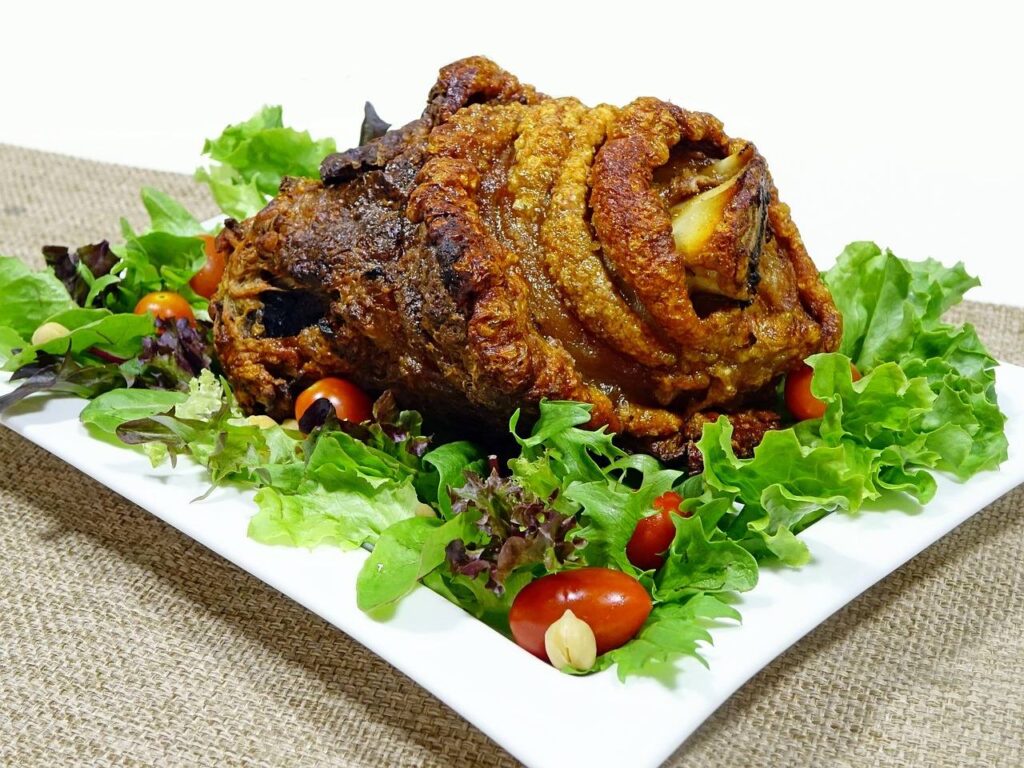
Order a Schweinshaxe expecting something delicate and you have made a specific kind of mistake, one every Bavarian waiter has watched a tourist make and enjoyed exactly once. What lands in front of you is a whole pork knuckle, skin on, and that skin is not garnish, it is the entire reason to order the dish. I cover where it sits next to the rest of the menu in my guide to Bavarian food; this page is about the only question that actually matters at the table, which is whether the rind shatters or chews, because there is no acceptable middle setting.
What cut this actually is
A Schweinshaxe is the part of the pig’s leg between the knee or elbow joint and the foot joints, and it keeps its fatty rind, the Schwarte, right where nature put it. It is a working joint, thick with connective tissue, which is exactly why it wants the long, slow cooking the dish is known for, and Bavaria’s official register of regional specialities is almost stern about the seasoning: salt, pepper and garlic, and nothing that would get between you and the meat1.
Know this before you order, or you will get the wrong knuckle. Surhaxe is the same cut, pickled before it cooks. Schweinshaxe skips the cure entirely; it goes into the oven or onto the grill raw, and it is the dry heat that turns the rind to crackling1.
Resi says If a menu lists both Schweinshaxe and Surhaxe, they are not the same word twice, and ordering on that assumption is how you end up with a soft, pickled knuckle when you wanted crackling. Surhaxe is the cured, gentler cousin. Schweinshaxe is the one that fights back a little, and it is the one I order.
Why the skin is the whole point
Nothing about a Schweinshaxe recipe is complicated on paper. The register’s own description keeps it short: roasted in the oven or grilled, long enough that the meat comes easily off the bone, hot enough at some stage to crisp the rind into a crust1. In a beer-hall kitchen that means two temperatures, not one: slow heat first, to render the fat and soften the connective tissue, then a hotter finish to blister the skin. The register does not publish exact times or temperatures, so any recipe you find online is one kitchen’s version of a very old dish, not the official method.
How Bavaria serves it: two regions, two plates
Two regional styles split the plate, and which one lands in front of you depends on where you are sitting.
| Style | Region | What comes with it |
|---|---|---|
| Bavarian classic | Upper and Lower Bavaria | Potato or bread dumplings and a dark-beer sauce |
| Kraut und Knöchla | Franconia | Sauerkraut with potato purée or bread |
Source: Genussorte Bayern, the Bavarian State Ministry of Food register1.
Outside those two, the register also lists potato salad or a green salad as pairings that turn up on menus1.
The dark-beer sauce itself is built on Dunkel, the dark lager that was Munich’s standard beer before the paler Helles style took over in the 1890s2. If a menu just says “dark beer sauce,” this is almost certainly what is meant, and my Bavarian beer styles guide has the rest of the lineup.
Whatever comes on the side is likely to be a dumpling. If you want the full rundown of which dumpling is which, my Knödel guide sorts the bread ones from the potato ones. If cabbage is on your plate instead, it is worth knowing Bavaria has two different cabbage dishes that get confused with each other, covered in sauerkraut vs Bayrisch Kraut.
Schweinebraten, the sliced Sunday roast from the shoulder, neck or ham, gets its own dark-beer gravy built into the pan rather than poured over crackling3, and I cover that dish in full in my Schweinebraten guide.
Where the dish comes from
The register puts the history in plain economic terms. The self-fattened family pig used to be the main source of meat, and pigs were heavier and fattier than today’s breeds, which made a joint like this an energy-dense meal for people doing manual labor. The rule was that every part of the animal got used1.
Schweinshaxe has counted as a typical regional dish only since the late 19th century, on that reading — younger, it turns out, than the story any beer hall will tell you1.
The name is older than the dish’s fame. “Haxe” traces to the Old High German “hahsina,” for the Achilles tendon or knee joint, with a competing theory pointing to the Latin “coxa,” for hip1. Either way, the word was naming the joint long before it became a beer-hall specialty.
Ordering one in a beer hall
A Schweinshaxe is usually a one-knuckle, one-plate order, sized to share or to leave you full for the rest of the day; it is not something beer halls expect you to order lightly alongside three other courses. Expect it plated with whichever dumpling the house serves, and in Upper or Lower Bavaria, a ladle of the dark-beer sauce poured over the meat rather than the crackling, so the skin stays crisp until your fork gets there1.
Resi says If the kitchen is Franconian, ask before you order, because “same thing, different name” badly undersells what happens when a dumpling becomes sauerkraut. Try the Kraut und Knöchla version once before you decide you are a dumpling loyalist. You might not be.
What you need to cook one at home
There is no substitute for time here: a Dutch oven or a roasting pan with a rack, room in the oven for a long, slow cook, and a way to blast the skin with dry heat toward the end, whether that is a hotter oven, a broiler, or a final pass on the grill. Beyond that, the register’s own ingredient list is short enough to shop for in one trip: a whole pork knuckle with the rind on, salt, pepper, garlic1. I do not have a specific pan I would send you to buy for this one; if you already own a heavy roasting pan with a rack, it will do the job. If you are stocking a Bavarian pantry for this and other roasts, my cooking Bavarian in North America pillar covers where the harder-to-find ingredients and tools come from.
Frequently Asked Questions
What part of the pig is a Schweinshaxe?
The lower leg, between the knee or elbow joint and the foot joints, with the fatty rind left on.
How is Schweinshaxe seasoned?
By the official description, just salt, pepper and garlic — the pork itself is meant to carry the dish.
What is the difference between Schweinshaxe and Schweinebraten?
Schweinshaxe is the knuckle, roasted whole with the skin on for crackling. Schweinebraten is a roast from the shoulder, neck or ham, sliced to serve, with a dark-beer gravy built into the pan. My Schweinebraten guide covers the roast version in full.
What is Kraut und Knöchla?
The Franconian name for Schweinshaxe served with sauerkraut and potato purée or bread, instead of the Bavarian dumplings-and-dark-beer-sauce plate.
Is Schweinshaxe cured like ham?
No. That is Surhaxe, a pickled version of the same cut. Schweinshaxe is cooked raw, and the dry heat is what crisps the rind.
Why does the skin get so crispy?
Because it is cooked uncured and dry, unlike a cured, boiled ham hock. The register describes the method as roasting or grilling specifically to develop that crust.
Where does the word "Haxe" come from?
From Old High German “hahsina,” for the Achilles tendon or knee joint, though some trace it instead to the Latin “coxa,” meaning hip.
Is a Schweinshaxe the same as a ham hock?
They are the same general cut, but not the same dish. “Ham hock” in English usually means a cured, boiled piece, closer to Bavaria’s own pickled Surhaxe than to an uncured Schweinshaxe roasted or grilled specifically to crisp the skin.
Related Articles
Sources
- Bayerische Schweinshaxe — Genussorte Bayern, Bavarian State Ministry of Food, Agriculture and Forestry (Kompetenzzentrum für Ernährung). Accessed 2026-09-24.
- Der Eisgalgen: Die Geschichte des Münchner Hellen — Bayerisches Bier. Accessed 2026-09-24.
- Bayerischer Schweinebraten — Genussorte Bayern, Bavarian State Ministry of Food, Agriculture and Forestry. Accessed 2026-09-24.