In brief
Any bag or rucksack brought to Oktoberfest may not exceed three liters or measure larger than 20 by 15 by 10 centimeters, and backpacks and large bags are “generally prohibited”. Glass bottles are not allowed on the grounds at all, and neither are gas spray cans, corrosive or coloring substances, or anything that could be used as a cutting, stabbing or thrusting weapon, even in a small bag. Strollers are banned all day on Saturdays and on October 3, and from 6 p.m. on every other day; baby carriers are always allowed. Bicycles, scooters and skateboards must be left outside, and animals are banned except assistance dogs. For 2026, the city has added roughly 600 police officers, a camera-based “heat map” system to flag overcrowding, and a fourth year of the Safe Now panic-button app across eight large tents.
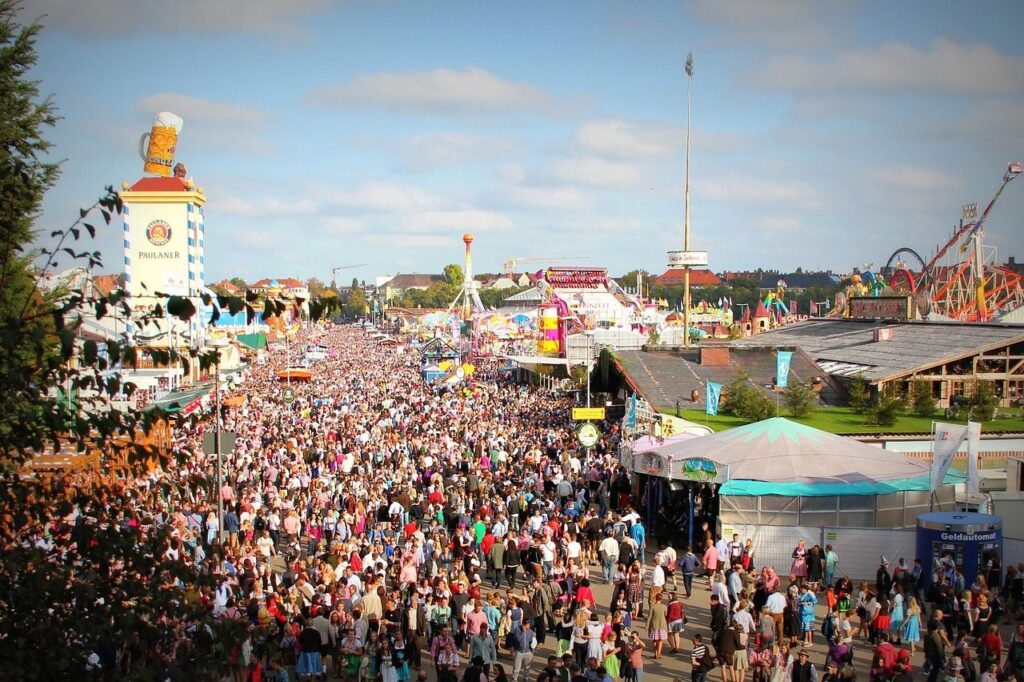
Security at the gate is the first Oktoberfest queue of your day, and the fastest way through it is knowing what gets waved in and what gets pulled out of your bag and held up for the guard behind you to see. This is part of my complete guide to Oktoberfest in Munich and covers the rules oktoberfest.de itself publishes, plus what changed for security in 2026.
None of these rules are strange for an event that crams a fenced field full for three weeks straight. What surprises people is how specific they are: a bag’s dimensions are spelled out to the centimeter, and a stroller ban has an exact hour attached to it. Read the specifics once before you pack, and the gate takes seconds instead of minutes.
Bags and what you can bring in
Oktoberfest’s own “10 golden rules” page sets the limit plainly: “Bags and rucksacks you bring with you may have a maximum volume of three litres and may not be larger than 20 cm x 15 cm x 10 cm,” and backpacks and large bags are “generally prohibited”1. That is roughly the size of a large clutch or a small crossbody bag, not a day pack.
Even inside a bag that fits, some things are never allowed:
| Not allowed at all | Notes |
|---|---|
| Glass bottles | Banned anywhere on the grounds |
| Gas spray cans with harmful contents | Includes items like pepper spray |
| Corrosive or coloring substances | — |
| Cutting, thrusting or stabbing objects | Any object usable as a weapon |
| Bicycles, scooters, skateboards | Must be left outside the entrance |
| Animals | Except assistance dogs |
Source: oktoberfest.de, 10 golden rules1.
Resi says “Generally prohibited” is doing a lot of quiet, lawyerly work in that sentence, and it is not the same as “always banned,” which is exactly the gap a hopeful backpack owner tries to walk through. I would not test it at the gate with a guard who has heard every argument already. Leave anything backpack-sized at the hotel and carry only what fits the three-liter limit; you lose nothing, and you skip a debate you were never going to win.
Strollers and children
Strollers are banned all day on Saturdays and on October 3, German Unity Day, and from 6 p.m. on every other day of the festival; baby carriers, known locally as Kraxen, are always permitted1. Beyond the stroller rule, children under 6 must leave the beer tents by 8 p.m., and unaccompanied minors under 16 need a guardian present on the fairground after 8 p.m.; 16- and 17-year-olds may stay until closing3.
Smoking and cannabis
Smoking is allowed on the grounds and in beer gardens, but a strict ban has been in place inside every beer tent since 2010, with violations risking fines up to €1,000; most tents provide a designated smoking area or balcony instead3.
Cannabis consumption is banned outright on the grounds under Bavaria’s Cannabisfolgenbegrenzungsgesetz, which prohibits cannabis consumption in beer gardens and at folk festivals. A first offense carries a €1,500 fine, rising past €5,000 for repeat violations; simply carrying up to the nationwide 25-gram adult limit remains legal, since only on-site consumption is banned3.
Drinking, e-scooters and driving
The same blood-alcohol limits that apply to cars apply to e-scooters and bicycles: starting at a blood alcohol concentration of 0.5 percent, you risk a €500 fine, two penalty points on your license, and a potential one-month driving ban3.
Drinking contests are explicitly unwelcome, and the festival says so without much diplomacy: guests egging each other on to down a Maß as fast as possible are not welcome, and disruptive behavior can get you ejected from a tent. Bavarians do not need the rule; it exists for everyone else3.
No rule on the books covers what happens next, but I will: budget time for the toilet line as seriously as you budget for the beer. What goes in must come out, and I have watched far more first-timers get blindsided by that wait, or by their own stomach on the way home, than by anything security actually confiscates at the gate.
How security works in 2026
Every visitor passes a bag check at the entrance, and all entrances are open and not blocked, so there is no single bottleneck gate to avoid1. For 2026, the city added roughly 600 police officers on the grounds, along with a new security control centre that uses AI-generated camera “heat maps” to flag overcrowding, watched by staff the festival calls “crowdspotters”2.
The Safe Now panic-button app, now in its fourth year, covers eight of the large tents and is designed to dispatch help “accurate to within a metre.” A dedicated women’s safe space operates from the ambulance centre for anyone experiencing harassment, theft or violence, and the Wiesn Outpatient Clinic, a fully equipped mini-hospital with surgical theatres and a CT scanner, treated over 7,000 patients the previous year with a response target under four minutes2.
Resi says None of this is decoration, and I say that as someone who finds most safety theater exactly that. A festival this size, running for weeks in the middle of Bavaria’s biggest city, genuinely needs a hospital with a CT scanner on-site, and I would rather know that than find out the hard way that it doesn’t.
Packing for the gate
- Bring a small bag or none at all. Three liters, no larger than 20 by 15 by 10 centimeters, and no backpack you would call a backpack.
- Leave the water bottle, if it is glass. Any glass container stays outside; a plastic or metal one is not addressed by the same rule, so when in doubt, leave it at the hotel.
- Plan strollers around the calendar. Not on a Saturday, not on October 3, and not after 6 p.m. any other day; a baby carrier sidesteps the whole rule.
- Skip the pocketknife, the multitool, the pepper spray. Anything that could double as a weapon is confiscated on sight, no matter how practical you think it is.
- Expect a bag check, not a bottleneck. Every entrance is open, so a longer line at one gate just means a shorter one at the next.
Frequently Asked Questions
What size bag can I bring to Oktoberfest?
No larger than three liters or 20 by 15 by 10 centimeters; backpacks and large bags are generally not allowed.
Are glass bottles allowed at Oktoberfest?
No. Glass bottles are banned from the grounds entirely.
Can I bring a stroller to Oktoberfest?
Not all day on Saturdays or on October 3, and not after 6 p.m. on other days. Baby carriers are always permitted.
Is smoking allowed at Oktoberfest?
Only outside the tents and in beer gardens; every tent has banned smoking indoors since 2010, with fines up to €1,000 for violations.
Is cannabis legal at Oktoberfest?
Possession up to Germany’s 25-gram adult limit is legal, but consuming it on the grounds is banned, with fines starting at €1,500.
What security changes are new for 2026?
About 600 additional police officers, an AI-assisted crowd “heat map” system, and the fourth year of the Safe Now panic-button app across eight large tents.
Related Articles
Sources
- 10 golden rules for Oktoberfest — oktoberfest.de, City of Munich. Accessed 2026-09-24.
- Bag checks and safe spaces: how Munich aims to make Oktoberfest safer — The Local Germany. Accessed 2026-09-24.
- Oktoberfest 2026: all the rules visitors need to know — Euronews. Accessed 2026-09-24.