In brief
There is no dress code at Oktoberfest: street clothes are allowed in every tent, and a dirndl or lederhosen is popular but entirely optional. A dirndl is a bodice, a blouse, a skirt and an apron tied with a bow; lederhosen are leather breeches worn with a shirt, socks and often a chain called a Charivari. The apron bow supposedly signals relationship status by which side it is tied on, but Munich’s own tourism office calls this “a rule of thumb, not a strict rule. There are no official regulations”. New Tracht from a Munich specialty shop runs from about €199 for a simple dirndl to well over €2,000 for an elaborate one, with lederhosen from about €99 to nearly €1,800 depending on the leather, and renting instead runs about €38 to €60 a day. Buying from home, US-based retailers ship a real dirndl or a pair of lederhosen without the trip to Munich.
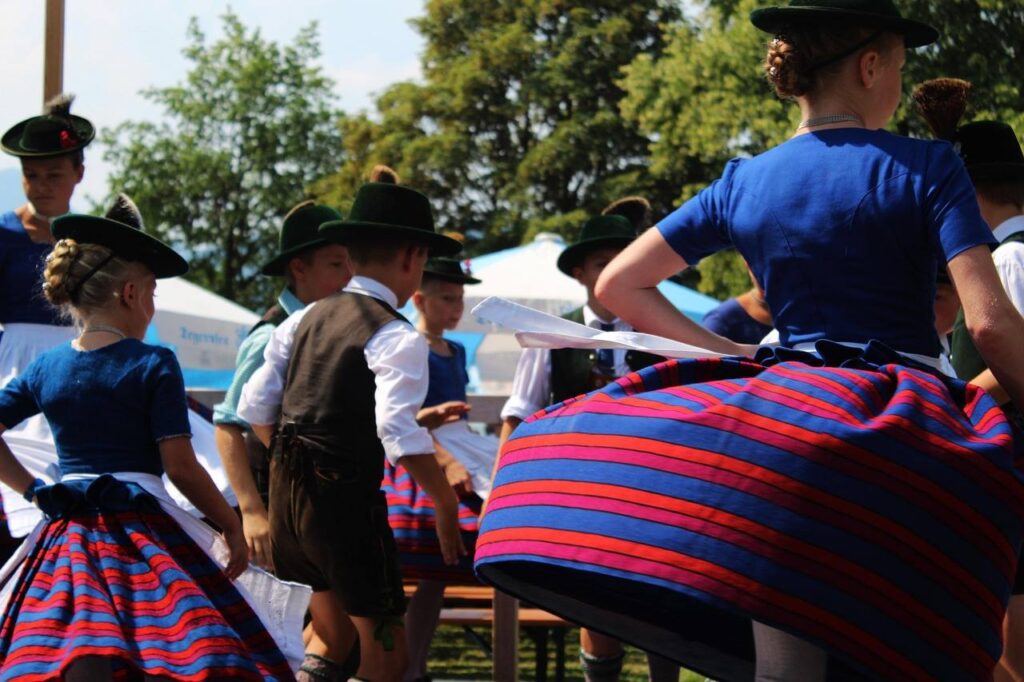
The honest answer to what you wear to Oktoberfest is: whatever you already own. Most non-Germans assume the dirndl and the lederhosen are simply “German,” filed next to sauerkraut and punctuality; they are not, they are distinctly Bavarian, and no Bavarian will let you forget it. This page is part of my complete Oktoberfest guide, and it covers what Tracht actually is, what the pieces are called, what the apron bow does and does not mean, what it costs to buy or rent one in Munich, and where to get one shipped if you would rather have it sorted before you fly.
No, a costume is not required
Munich’s own tourism office puts it plainly: there is no dress code at Oktoberfest, and “any outfit is permitted,” while the official visitor FAQ agrees that traditional costume “is not compulsory,” even though “many visitors choose to do so”12. Show up in jeans and a sweater and nobody at the gate or in the tent will say a word.
What locals do notice, per the city’s own dress guidance, is the gap between real Tracht and costume-shop gear: a printed beer-mug pattern and a plastic apron read as a Halloween costume, not traditional dress2.
A US retailer’s own buying-mistakes guide makes the same point from the other side: skip shiny polyester, flimsy zippers and the “mini dirndls that only cover the backside,” which the Tracht experts they cite call a big no-go13.
Resi says If you buy Tracht, the city’s own advice is the whole test: a proper bodice fit, natural fibers, clean seams and real buttons, not a printed pattern glued onto polyester. Show up in the costume-shop version and the locals will clock you as a Preiß in fancy dress before you have ordered your first Maß; Bavarians have never needed much encouragement to feel superior to the rest of the country, and a bad dirndl hands them the excuse. There is no better summary of the whole question than that.
The parts of a dirndl
| Part | What it is |
|---|---|
| Bodice (Mieder / Leiberl) | The tight-fitting top, often patterned or embroidered |
| Blouse | Worn underneath the bodice, usually white, generally puff-sleeved |
| Skirt | Full and wide, plain or patterned, knee-length to floor-length |
| Apron | Worn over the skirt, tied at the waist with a bow |
Source: retailer garment guides, consistent across sources3.
Lederhosen, the men’s side, are leather breeches, short, knee-length or full-length, in goatskin, deerskin (Hirschleder) or cowhide, worn with suspenders and often an embroidered front flap5.
The finishing pieces on either outfit are Loferl, the two-piece calf socks worn with short lederhosen, and a Charivari, the ornamental chain that oktoberfest.de calls “the most rustic costume accessory on the Wiesn outfit”14.
The apron bow: what the "rule" actually is
This is the single most-repeated claim about a dirndl, and the two most visible sources on it disagree on how firm it is. The popular version says: bow on the left means single, on the right means taken or married, centered in front can mean a girl, and centered in back means a waitress or, in an older telling, a widow.
Munich’s own tourism copy repeats a version of that code, left for single and open to flirting, right for in a relationship, engaged or married, but immediately qualifies it: “This is a rule of thumb, not a strict rule. There are no official regulations”2.
A Munich lifestyle outlet goes further, reporting that the bow was traditionally tied front- or back-center, and that tying it to the side only became common in the twentieth century, concluding that “not every explanation popular today can be documented as a centuries-old, uniform tradition”4.
Bavaria’s own Trachtenverband, the association whose job is documenting genuine Tracht custom, has detailed pages on Loferl, headdresses, suspenders and lace, but no page on the apron bow at all15. I treat the whole thing as the story tourists get told, not settled folklore, and I would tie mine however I liked.
What Tracht costs new in Munich
| Shop | Women’s dirndl | Men’s lederhosen |
|---|---|---|
| Angermaier (Rosental 10 and Sendlinger Straße 35) | €199–€599 | €169.90–€499 |
| Lodenfrey (Maffeistraße) | €599–€2,199 | €599–€1,799 |
| Trachten Rausch (near Theresienwiese) | Described as “affordable,” no published range | From €99, complete sets from €139 |
Source: each retailer’s own site56789.
Angermaier’s entry-level dirndl, the Alpenqueen/Spitzerl R60, starts at €199, and most of its styles sit between €269 and €409; its lederhosen start at €169.90 for the “Lederhose Luka,” with most sitting between €279 and €47978.
Lodenfrey’s budget dirndl line starts at €599 and its most elaborate velvet midi-dirndls reach €2,199 across 424 listed styles, while its lederhosen run €599 in goat leather up to €1,799 in deerskin56.
Trachten Rausch sits at the other end entirely, with individual lederhosen from €99 and a full outfit, lederhosen, shirt and socks, from €139, plus a 5 to 10 percent discount for buying the set together9.
Renting instead of buying
If you only need an outfit for a few days, a Munich rental shop makes more sense to me than a purchase that costs as much as the flight. Dirndl-leihen.de, part of the Bavarian Outfitters group, publishes its rates including VAT: lederhosen (knee-length or shorts, with braces) at €37.90 a day, a lederhosen set with shirt and socks at €59.90, and a dirndl with blouse and apron at €49.90, with a rental day running from 9 a.m. to 11 a.m. the next day and a second day at half price10. My renting in Munich page has more shops and the fit questions worth asking before you commit.
Buying from North America
If you would rather arrive with an outfit already in the suitcase, three US-based shops ship a real dirndl or lederhosen rather than a costume-store version, and this is where the site earns a commission on the products it names.
- Rare Dirndl (Chicago; handmade in the US and imported from Germany) sells dirndls such as the Brimstone Dirndl at $498, the Kaffeehaus Dirndl at $426 and “The Little Black Dirndl” at $398, with free shipping over $250 and free returns; it does not sell menswear11.
- Lederhosen Store prices lederhosen roughly $159.95 to $219.95 and dirndls roughly $139.95 to $219.99, with free shipping on orders of $299 or more, and stocks deerskin lederhosen among its premium items12.
- Traditional Lederhosen (Crafton, PA) carries 26 dirndl styles from $115 to $350, most around $150, with free US shipping on dirndl orders and a 14-day return policy16.
Resi says I would start with the Lederhosen Store range if you are outfitting a whole family on one budget, and the Rare Dirndl pieces if you want one dress that will outlast several Wiesns; the leather on a cheap pair of lederhosen is the part that tells on you first, so spend where it shows, because everyone at that table will eventually be looking at your knees. My where to buy a dirndl in the US and how to wear lederhosen pages go deeper on sizing and fit for each.
Frequently Asked Questions
Do you have to wear a dirndl or lederhosen to Oktoberfest?
No. There is no dress code, and traditional costume is popular but optional; regular clothes are allowed in every tent.
Does the side you tie the dirndl bow on actually mean something?
It is a widely repeated story, left for single, right for taken, but Munich’s own tourism office calls it “a rule of thumb, not a strict rule,” with no official regulation behind it.
How much does a dirndl cost in Munich?
Roughly €199 to €2,199 new, depending on the shop and the style, or about €49.90 a day to rent.
How much does a pair of lederhosen cost?
Roughly €99 to €1,799 new, depending on the leather and the shop, or about €37.90 to €59.90 a day to rent.
Where can you buy a dirndl or lederhosen in the US before your trip?
Rare Dirndl, Lederhosen Store and Traditional Lederhosen all ship real Tracht, not costume-shop versions, to US addresses.
What do locals consider a costume-shop mistake?
Printed beer-mug patterns, plastic aprons, shiny polyester, flimsy zippers, and dirndls cut too short; natural fabrics, real buttons and a proper bodice fit are what mark the real thing.
Related Articles
 Oktoberfest in Munich: Dates, Tents, Reservations, What to Wear and What It CostsOktoberfest
 The Dirndl Explained: Blouse, Bodice, Skirt, Apron and How It Should FitTrachten and customs
 Lederhosen: History, Types and What a Real Pair CostsTrachten and customs
 What the Dirndl Bow Means (Left, Right, Center, Back), and Where the Rule Comes FromTrachten and customs
 Renting a Dirndl or Lederhosen in Munich: Shops, Prices, FitTrachten and customs
 Where to Buy a Real Dirndl in the US and Canada, and What Real MeansTrachten and customs
 How to Wear Lederhosen: Socks, Straps, Shirt and ShoesTrachten and customs
 Oktoberfest for First-Timers: What Nobody Tells YouOktoberfest
Sources
- FAQs for Wiesn visitors — oktoberfest.de, City of Munich. Accessed 2026-09-24.
- Outfit, costumes, dresses, lederhosen — muenchen.de, City of Munich. Accessed 2026-09-24.
- What is a dirndl dress: decoding tradition, style and everything in between — eLederhosen. Accessed 2026-09-24.
- Dirndl-Schleife: Bedeutung — In München. Accessed 2026-09-24.
- Lodenfrey — Damen Trachten Dirndl — Lodenfrey. Accessed 2026-09-24.
- Lodenfrey — Herren Trachten Lederhosen — Lodenfrey. Accessed 2026-09-24.
- Angermaier — Damen Dirndl — Trachten Angermaier. Accessed 2026-09-24.
- Angermaier — Herren Lederhosen — Trachten Angermaier. Accessed 2026-09-24.
- Trachten Rausch — Trachten Rausch. Accessed 2026-09-24.
- Pricing — dirndl-leihen.de, Bavarian Outfitters. Accessed 2026-09-24.
- Rare Dirndl — Rare Dirndl. Accessed 2026-09-24.
- Lederhosen Store — Lederhosen Store. Accessed 2026-09-24.
- Common dirndl mistakes — Lederhosen Store. Accessed 2026-09-24.
- Dirndl & Tracht — oktoberfest.de, City of Munich. Accessed 2026-09-24.
- Trachtenpflege und Trachtenforschung — Trachtenverband Bayern. Accessed 2026-09-24.
- Dirndl Dresses — Traditional Lederhosen. Accessed 2026-09-24.