In brief
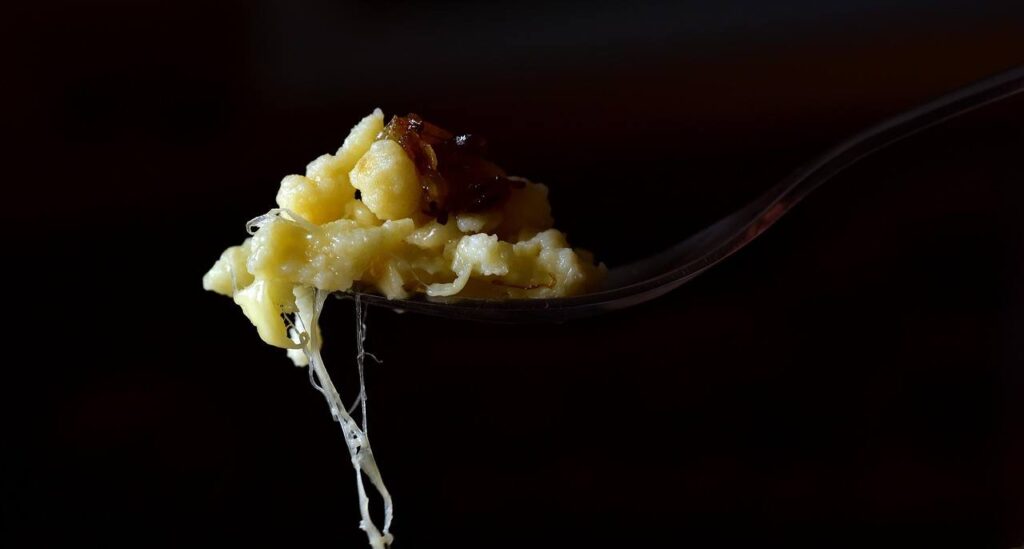
Kässpatzle is homemade Spätzle layered with Allgäu cheeses, typically Allgäuer Bergkäse, Allgäuer Emmentaler and Allgäuer Weißlacker, along with onions, melted together in the oven or a pan until it pulls into strings. It comes topped with Röstzwiebeln, crisply fried onions, and a scatter of chives, and Bavaria’s own culinary register calls it the Allgäu’s national dish. The name shifts with the local dialect, Kässpatzen, Kässchbätzle, Kässpätzli and Knöpfle among them, all describing the same plate. The noodles underneath are not Bavarian property either: “Schwäbische Spätzle / Schwäbische Knöpfle” has carried its own EU Protected Geographical Indication since the European Commission entered it into the register on 8 March 2012.
Disclosure: some links on this page are affiliate links, marked by the products, tours and hotels they name. As an Amazon Associate, bavarianbistro.com earns from qualifying purchases. A purchase through these links may earn the site a commission at no cost to you, and it never affects what is recommended. How this works. Product prices and availability shown are as of the date stated and can change; the Amazon price at checkout applies.
If mac and cheese had a Bavarian cousin who grew up somewhere colder and closer to the Alps, it would be Kässpatzle, and it would not thank you for the comparison. This is the dish the Allgäu, the alpine corner of Bavarian Swabia, is proudest of, built from three things done properly: homemade egg noodles, real mountain cheese, and onions fried until they nearly burn. It has its own place in my guide to Bavarian food, not as a footnote to Spätzle but as the reason people go looking for Spätzle in the first place.
What actually goes into it
It starts with homemade Schwäbische Spätzle, the soft egg noodle Swabia holds the recipe for, layered while hot with a mix of Allgäu cheeses: Allgäuer Bergkäse, a firm mountain cheese; Allgäuer Emmentaler, the holed cousin of the Swiss original; and Allgäuer Weißlacker, a sharp, pungent washed-rind cheese not everyone loves on the first try1. Onions go in with the layering, and the whole thing is melted together, either in the oven or in a pan, until the cheese pulls into strings and the noodles underneath have gone soft and rich.
Not a garnish: the fried onions
The dish is not finished without Röstzwiebeln, onions fried until dark and crisp, scattered over the top along with chives right before it reaches the table1. Skip the onions and you have cheese noodles; add them and you have Kässpatzle, and that contrast is most of the reason a dish this simple manages to taste finished rather than plain. There is a reason the onions show up twice: raw or gently cooked with the layers for sweetness, and fried hard on top for crunch, and that difference in texture is doing more work than any spice would.
Whose dish is it, really
Bavaria’s own register calls Kässpatzle the Allgäu’s national dish, and quotes its own line about the boundary the cheese and noodles sit on: if there is a Weißwurst equator, there is also a Spätzle latitude line, running from Swabia into Austria and Switzerland1.
That line matters, because the noodles themselves are not, strictly, a Bavarian invention. “Schwäbische Spätzle / Schwäbische Knöpfle” has held its own EU Protected Geographical Indication since the European Commission entered it into the register under Class 2.7, Pasta, credited to Germany’s Swabian region, on 8 March 20122. The Allgäu is Bavaria’s own slice of that Swabian world, which is how a Bavaria-based kitchen can claim a Swabian noodle without actually taking anything away from Swabia. My page on whether Spätzle is Bavarian or Swabian makes that argument properly.
Bavaria’s own register is upfront that the Allgäu does not have the idea to itself, either: it lists recognized variants of the same dish across Schwaben, Austria and Switzerland, all working the same three elements, noodles, cheese and onions, into slightly different proportions1. What actually sets the Allgäu’s version apart is the specific trio of cheeses, not the technique, which every alpine kitchen within a few hundred kilometers seems to have landed on independently.
How it comes together at home
None of this takes more than an hour, and most of that hour is the onions, which do not reward being rushed. Get the Spätzle and the cheese ready first, then let the onions have the pan to themselves.
- Cook the Spätzle. Fresh or dried, boil it until it floats, then drain it well; wet noodles water down the cheese instead of melting into it.
- Grate three cheeses. A firm Bergkäse for body, Emmentaler for stretch, and a little Weißlacker for the sharp edge, or a young Limburger if you cannot find the real thing.
- Layer and melt. In an ovenproof dish or a wide pan, alternate Spätzle and grated cheese in two or three layers, finishing with cheese on top, then melt it under a broiler or over low heat until it pulls into strings.
- Fry the onions separately. Sliced onions in butter over medium heat, stirred often, until they are properly dark, not just soft; this takes longer than most recipes admit.
- Finish and serve. Scatter the fried onions and chopped chives over the top just before serving, so they stay crisp instead of steaming soft in the cheese.
For anyone who wants to press the noodles instead of scraping them off a board, the Goldspatz Spätzle Press No. 2190 lists on Amazon at $89.50, stainless steel, about 15.6 inches long, with a 4.6-star average across 382 ratings as of September 20263.
Resi says The noodles are the part people give up on, not the cheese, and a good press fixes that. I would buy the Goldspatz, built with a locking support so it does not slide off the pot while you work. The one honest limit is the price, which is closer to a tool you keep for decades than one you replace next year; if you only want to try the dish once, a wide-holed colander and a spatula will get the batter into the water almost as well. My Spätzle makers compared page covers the board-and-scraper method too, for anyone who would rather not own another single-purpose gadget.
Frequently Asked Questions
What is Kässpatzle?
Homemade Spätzle layered with Allgäu cheeses and onions, melted together and topped with crispy fried onions and chives. Bavaria’s own register calls it the Allgäu’s national dish.
What cheese goes in Kässpatzle?
Traditionally a mix of Allgäu cheeses: Allgäuer Bergkäse, Allgäuer Emmentaler and the pungent Allgäuer Weißlacker.
Is Kässpatzle the same as Käsespätzle?
Yes, just different spellings and dialect names for the same dish; Kässpatzen, Kässchbätzle and Kässpätzli all describe it too.
Is Spätzle Bavarian or Swabian?
Legally, Swabian: “Schwäbische Spätzle / Schwäbische Knöpfle” has held its own EU Protected Geographical Indication since 2012. Bavaria’s claim runs through the Allgäu, its own corner of the Swabian dialect and cooking region.
What do you serve with Kässpatzle?
On its own as a main dish, often with a simple green salad on the side to cut the richness; it is not usually served as a side dish itself.
Can I make Kässpatzle without a Spätzle press?
Yes. A wide-holed colander and a spatula, or a cutting board and a knife scraping the batter directly into the water, both work; a press is a convenience, not a requirement.
What can I use instead of Allgäuer Weißlacker?
A young Limburger or another mild washed-rind cheese gets close to the sharpness without needing a specialty importer.
Is Kässpatzle only made in the Allgäu?
No. Bavaria’s own register lists recognized versions of the same idea across Schwaben, Austria and Switzerland; the Allgäu’s version is defined mainly by its specific choice of cheeses.
Related Articles
 Bavarian Food: The Dishes, How Munich Eats Them, and What to Cook at HomeFood
 Spätzle: Swabian by Law, Bavarian by AppetiteFood
 Spätzle Makers Compared: Press, Hopper, Board or ColanderPantry and tools
 Knödel: Bread Dumplings, Potato Dumplings and Which Goes with WhatFood
 Obatzda: The Bavarian Beer-Cheese Spread, What Goes in It and How to Make ItFood
 Cooking Bavarian in North America: Where to Buy the Ingredients and the Tools That MatterPantry and tools
 The German Pantry: Staples to Stock for Bavarian CookingPantry and tools
Sources
- Allgäuer Käsespätzle — GenussErbe Bayern, Bavarian State Ministry of Food, Agriculture and Forestry. Accessed 2026-09-26.
- Commission Implementing Regulation (EU) No 186/2012 — Official Journal of the European Union. Accessed 2026-09-26.
- Goldspatz Spätzle Press No. 2190 — Amazon.com. Accessed September 2026.