In brief
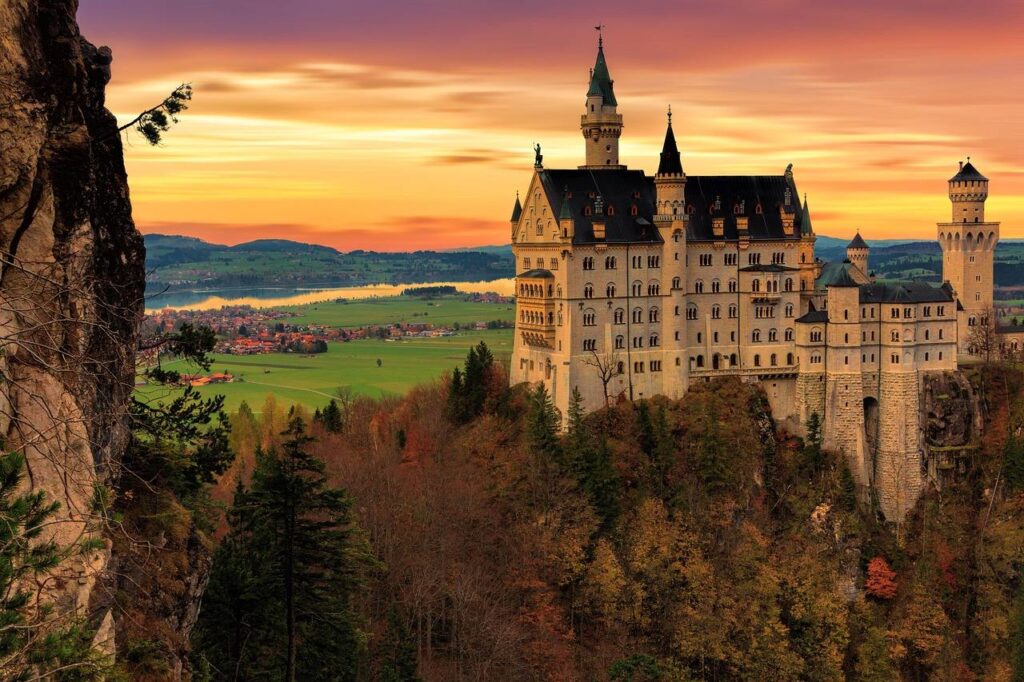
Munich sits within a single regional day pass of nearly every famous Bavarian sight, and the trains get you to almost all of them without a rental car. The Bayern-Ticket, Bavaria’s own day pass for regional trains, trams and buses, runs from €34 for one traveler up to €74 for a group of five, and it will get you to Regensburg, Nuremberg, Bamberg and even over the border into Salzburg on the same ticket. Neuschwanstein, Bavaria’s most photographed castle, is a timed guided tour only, and the castle’s own advice is to arrive in Hohenschwangau one and a half to two hours before your entry slot. Seventeen more destinations round out this cluster below, from the medieval Danube city of Regensburg to the Zugspitze, Germany’s highest peak. A guided coach day trip covering Neuschwanstein and Linderhof together runs 10 hours 30 minutes and starts around $128 a person.
Disclosure: some links on this page are affiliate links, marked by the products, tours and hotels they name. A purchase through these links may earn the site a commission at no cost to you, and it never affects what is recommended. How this works.
If you land in Munich thinking you’ll need a rental car to see the rest of Bavaria, you can mostly put that thought away. Regional trains and one flat-rate day pass reach nearly every famous name on a Bavaria itinerary, and my arriving in Munich and Munich for a first trip pages cover the city end of that before you go anywhere else. This page is the map: the Bayern-Ticket logic that makes it all cheap for a group, one paragraph on each of the destinations worth the trip, and a table for deciding which one fits the day you actually have.
The Bayern-Ticket logic
Nearly everything below runs on the same ticket. The Bayern-Ticket covers regional trains, S-Bahn, U-Bahn, trams and almost every bus line in Bavaria for one calendar day, and it explicitly excludes the fast ICE and IC trains, which is the one rule that decides whether your connection qualifies1. On a weekday it starts at 9 a.m. and runs to 3 a.m. the next morning; on weekends and public holidays it’s valid from midnight, which matters if your plan involves an early fixed-entry ticket like Neuschwanstein’s1. My full Bayern-Ticket guide has the price table and the children’s and pet rules; my Munich transit guide covers the city-only MVV system this connects to. If a day trip doesn’t fit the train network well, or you want to string several Alpine villages together without doubling back to Munich each time, my guide to renting a car in Bavaria covers when that’s worth it instead.
Neuschwanstein, Hohenschwangau and Füssen
King Ludwig II’s fantasy castle above the village of Hohenschwangau is the reason most people put Bavaria on the map, and it’s run strictly: both Neuschwanstein and the yellow Hohenschwangau Castle below it can only be toured as part of a guided, fixed-time tour, with groups capped at 35 and 34 people respectively2. Book the Neuschwanstein tickets ahead, plan the trip step by step, and see King Ludwig’s castles for its place among the four sites in Bavaria’s 2025 UNESCO inscription.
Linderhof Palace
Ludwig’s smallest palace, and the only one he lived to see finished, sits in a formal park near Ettal, about 20 minutes from Oberammergau. It opens 9 a.m. to 6 p.m. from mid-April to mid-October, and 10 a.m. to 4:30 p.m. the rest of the year, with tours running every 5 to 10 minutes4. It’s one of the four sites in Bavaria’s July 2025 UNESCO World Heritage inscription for the castles of King Ludwig II5.
The Romantic Road
Germany’s oldest signposted holiday route runs 460 kilometers through 29 towns from Würzburg to Füssen, strung together since 19506. My Romantic Road itinerary breaks it into 2, 4 or 7-day versions, and Rothenburg ob der Tauber is the single stop most people build the whole route around.
Nuremberg
The Kaiserburg, one of the most important fortified imperial palaces of the Holy Roman Empire, dates to 1105 and was the seat of Imperial Diets from 1050 to 15717. It’s open daily, 9 a.m. to 6 p.m. April through September and 10 a.m. to 4 p.m. the rest of the year8. My Nuremberg guide covers the castle, the WWII history and the sausage.
Regensburg
Germany’s best-preserved medieval city calls itself, on its own tourism site, a “double UNESCO World Heritage” city, with its old town listed since 2006 and the Danube Limes added as a second title in 20219. The 12th-century Stone Bridge is the city’s signature landmark. My Regensburg day trip guide has the route from Munich.
Bamberg
A UNESCO World Heritage old town spread across three hills and an island in the Regnitz, Bamberg splits into the hill city, the island city (including the postcard row known as Little Venice) and the market gardeners’ district10. It’s also the historic home of smoked Rauchbier, most famously from the Schlenkerla brewery. My Bamberg day trip guide covers the route from Munich or Nuremberg.
Würzburg and Franconian wine country
Beyond its Baroque Residenz, Würzburg anchors Franconia’s wine region, known for Silvaner, Riesling and Weißburgunder grapes from protected vineyard sites including the Würzburger Stein-Berg11. My Würzburg guide covers the Residenz and the wine both.
Augsburg
One of Germany’s oldest cities is home to the Fuggerei, described by the city’s own tourism site as “the oldest social settlement in the world,” founded by the banker Jacob Fugger the Rich, and to a newly UNESCO-recognized water management system12. My Augsburg guide has the details.
Passau
Where the Danube, Inn and Ilz rivers meet, in different colors, at the Dreiflüsseeck13. St. Stephen’s Cathedral is known for its organ, though exact specifications need sourcing before you repeat them as fact — my Passau guide has what’s confirmed.
Berchtesgaden and the Königssee
An Alpine resort town on the Austrian border, framed by the Watzmann massif and Lake Königssee. Electric boats cross the lake, and the boatman plays a trumpet to draw an echo off the cliffs; the run to the pilgrimage church at St. Bartholomä takes about 35 minutes, and on to Salet about an hour, though the Salet run only operates from the end of April to mid-October14. My Berchtesgaden and Königssee guide has the full day, and the Eagle’s Nest without a tour covers Hitler’s mountaintop retreat above the town, whose access road runs roughly early or mid-May to mid or late October, weather permitting, and closes outright in snow and ice15.
Garmisch-Partenkirchen and the Zugspitze
Bavaria’s 1936 Olympic winter-sports town is also the gateway to the Zugspitze, Germany’s highest peak, plus the Partnach Gorge and the Olympic ski jump16. The Bayerische Zugspitzbahn runs the cog railway and cable cars to the summit; a round-trip ticket runs €78 for an adult, or €46 one-way, and a combined “2 Peak Pass” with Garmisch-Classic or Mount Wank costs €93.5017. My Zugspitze guide compares the cogwheel train against the cable car, and my Garmisch-Partenkirchen guide covers the rest of the town.
Oberammergau
A woodcarving village known for painted house facades and the Passion Play, performed roughly every ten years since 1634 after a plague-era vow made in 163318. My Oberammergau guide has the play’s schedule and the village itself.
Mittenwald
At the foot of the Karwendel range, Mittenwald is known for its violin-making tradition, presented on the region’s own tourism site as a living craft, not a museum piece, plus its own painted facades19. My Mittenwald guide pairs it naturally with a Garmisch-Partenkirchen day.
Chiemsee and Herrenchiemsee
Bavaria’s largest lake, nicknamed “the Bavarian Sea,” has two main islands reached by boat from Prien20. Herrenchiemsee Palace, Ludwig II’s unfinished attempt at a Bavarian Versailles, is another of the four sites in the 2025 UNESCO inscription. My Chiemsee and Herrenchiemsee guide has the boat and palace details.
Lindau
A small island town on the Bavarian shore of Lake Constance, with a historic harbor guarded by a lighthouse and a Bavarian Lion statue21. My Lindau guide covers the town and onward day trips into Austria or Switzerland across the lake.
The Bavarian Forest National Park
Germany’s oldest national park centers on two visitor hubs, one of which, Nationalparkzentrum Falkenstein, includes a wolf enclosure among its animal displays22. My Bavarian Forest guide has the treetop walkway and the rest of the park.
Altötting
Germany’s most important Marian pilgrimage site for more than 500 years, and, per Pope emeritus Benedict XVI as quoted on the town’s own tourism page, “the heart of Bavaria and one of the hearts of Europe”23. My Altötting guide has the pilgrimage site itself.
Which day trip for whom
Not every destination above suits every traveler or every day you have available. If you’re deciding between two, or wondering whether to add a second country to the list with Salzburg or weigh it against a full Bavaria-versus-Austria trip, this is a place to start.
| If you want | Go to |
|---|---|
| The fairy-tale castle everyone pictures | Neuschwanstein |
| Germany’s highest mountain | The Zugspitze |
| WWII history and a mountaintop retreat | Berchtesgaden and the Eagle’s Nest |
| A medieval old town with the least crowding | Regensburg |
| Beer culture and a UNESCO old town | Bamberg |
| Half-timbered towns and a night watchman | Rothenburg, via the Romantic Road |
| A second country on the same train ticket | Salzburg |
| An Alpine lake with a Ludwig palace on an island | Chiemsee and Herrenchiemsee |
| A quiet forest with wolves | The Bavarian Forest |
Guided tours worth the money
Two Viator tours worth knowing about even if you plan to do most of this independently. The Neuschwanstein Castle and Linderhof Day Tour from Munich runs 10 hours 30 minutes, is rated 4.4 stars from 7,579 reviews, and starts from $128 a person as of September 20263. The Zugspitze day tour from Munich runs 8 hours, is rated 4.5 stars from 265 reviews, and starts from $16224. Both cover a destination that’s genuinely awkward to reach independently in a single day, which is exactly when a guided tour earns its price over a Bayern-Ticket and a timetable.
Resi says The castles get the postcards, but Regensburg and Bamberg are where I’d send a friend who already did the classic itinerary once and wants the version without the tour buses.
Timing it right
A few of the destinations above are shoulder-season-fragile, and it’s worth checking before you build a day around them, especially outside summer. The Eagle’s Nest road and Neuschwanstein’s local shuttle bus both close or reduce service in snow and ice, the shuttle explicitly running “only in suitable weather conditions (no snow or ice)”15. Herrenchiemsee’s boat landing stages can become inaccessible in low water in dry summers. My Bavaria in winter page covers what’s actually open in the cold months, and the best time to visit goes through the climate records month by month.
Planning more than a day
If one destination isn’t the plan and a week is, my one week in Bavaria by train itinerary strings several of these together with three changes of base, and how many days you need in Bavaria sizes the trip up or down from there. Traveling with children changes the math on how many stops fit in a day, which my Bavaria with kids page gets into, and is Bavaria expensive prices out what a week like this actually costs in 2026.
Frequently Asked Questions
Do I need a car to see Bavaria beyond Munich?
No, not for most of the destinations on this page. Regional trains and the Bayern-Ticket reach nearly all of them; a car only pays off on specific legs the trains don’t cover directly.
What is the Bayern-Ticket and do I need one?
Bavaria’s regional day pass, covering trains, trams and buses for a group at a flat daily rate. It’s the ticket behind most of the day trips on this page.
Do you need to book Neuschwanstein tickets in advance?
Yes. Entry is timed and guided-tour only, and tickets can sell out, so book before you travel rather than on arrival.
How do I get from Munich to Neuschwanstein Castle?
By train to Füssen, then a short regional bus to Hohenschwangau village, where the castle ticket center and the walking routes up to both castles begin.
Is the Zugspitze the highest mountain in Germany?
Yes, and it’s reached from Garmisch-Partenkirchen by cogwheel train or cable car.
Are Neuschwanstein and Linderhof UNESCO World Heritage Sites?
Yes, along with Herrenchiemsee and Schachen, as part of a July 2025 inscription covering four of King Ludwig II’s sites.
What's the best single day trip for a first-time visitor?
Neuschwanstein, for the castle itself; Regensburg, if you’d rather skip the crowds and still get a genuine medieval old town.
Guides in this section
- Regensburg Day Trip from Munich
- Neuschwanstein from Munich by Train, Step by Step
- Neuschwanstein Tickets Explained
- King Ludwig’s Castles: Neuschwanstein, Linderhof, Herrenchiemsee and Schachen
- Eagle’s Nest Without a Tour
- Berchtesgaden and the Königssee
- Zugspitze: Cogwheel Train or Cable Car?
- Garmisch-Partenkirchen: The Partnach Gorge, the Ski Jump and the Zugspitze Base
- Romantic Road Itinerary
- Rothenburg ob der Tauber from Munich
- Bamberg Day Trip
- Nuremberg Beyond the Christmas Market
- Is Salzburg Worth a Day Trip from Munich?
- One Week in Bavaria by Train
- Bavaria in Winter
- Bavaria with Kids: A Realistic Itinerary
- Bavaria or Austria for a First Alpine Trip?
- Is Bavaria Expensive? Real 2026 Prices for a Week
- How Many Days Do You Need in Bavaria?
- The Best Time to Visit Bavaria, Month by Month
- The Bayern-Ticket, Explained
- Chiemsee and Herrenchiemsee
- Würzburg: The Residenz and Franconia’s Wine
- Augsburg: The Fuggerei
- Passau: Three Rivers, One Cathedral Organ
- Lindau: Bavaria’s Corner of Lake Constance
- Oberammergau: The Passion Play, the Painted Houses and the Woodcarvers
- The Bavarian Forest National Park
- Mittenwald and the Alps by Train
- Renting a Car in Bavaria
- Altötting: Bavaria’s Pilgrimage Town
Related Articles
 Munich for a First Trip: What Is Worth It, What Is Not, and How the City WorksMunich
 Munich Public Transport ExplainedMunich
 Arriving in Munich: Airport to CityMunich
 Bavarian Beer, ExplainedBeer
 Oktoberfest in Munich: Dates, Tents, Reservations, What to Wear and What It CostsOktoberfest
 Bavarian Food: The Dishes, How Munich Eats Them, and What to Cook at HomeFood
Sources
- Regional day ticket Bavaria (Bayern-Ticket) — Deutsche Bahn. Accessed 2026-09-27.
- Visitor information — Hohenschwangau/Neuschwanstein official visitor information. Accessed 2026-09-24.
- Neuschwanstein Castle and Linderhof Day Tour from Munich — Viator, product d487-285016. Accessed 2026-09-24.
- Opening hours — Schloss Linderhof, Bavarian Palace Department. Accessed 2026-09-24.
- Inscription of the castles of King Ludwig II of Bavaria to the UNESCO World Heritage list — German Federal Foreign Office. Accessed 2026-09-24.
- Romantische Straße — Romantic Road tourism association. Accessed 2026-09-24.
- Kaiserburg (Imperial Castle) — Tourismus Nürnberg. Accessed 2026-09-24.
- Opening hours — Kaiserburg Nürnberg, Bavarian Palace Department. Accessed 2026-09-24.
- Regensburg — Tourismus Regensburg. Accessed 2026-09-24.
- Bamberg — Bamberg Tourismus. Accessed 2026-09-24.
- Würzburg — Romantic Road tourism association. Accessed 2026-09-24.
- Augsburg — Augsburg Tourismus. Accessed 2026-09-24.
- Passau — Tourismus Passau. Accessed 2026-09-24.
- Königssee — Bayerische Seenschifffahrt. Accessed 2026-09-24.
- Das Kehlsteinhaus / Eagle’s Nest — Berchtesgaden tourism; shuttle-bus weather note confirmed on How to reach the castles — Hohenschwangau/Neuschwanstein. Accessed 2026-09-27.
- Garmisch-Partenkirchen — GaPa Tourismus. Accessed 2026-09-24.
- Zugspitze tickets and rates — Bayerische Zugspitzbahn. Accessed 2026-09-24.
- Oberammergau Passion Play — Passionsspiele Oberammergau. Accessed 2026-09-24.
- Alpenwelt Karwendel — Alpenwelt Karwendel tourism. Accessed 2026-09-24.
- Chiemsee-Alpenland — Chiemsee-Alpenland Tourismus. Accessed 2026-09-24.
- Lindau — Stadt Lindau. Accessed 2026-09-24.
- Nationalpark Bayerischer Wald — Bavarian Forest National Park. Accessed 2026-09-24.
- Altötting — Stadt Altötting. Accessed 2026-09-24.
- Zugspitze: Germany’s Highest Mountain Day Tour from Munich — Viator, product d487-285014. Accessed 2026-09-24.