In brief
Tracht is Bavaria’s traditional dress, the Dirndl for women and the Lederhosen for men, and its life as a badge of Bavarian identity dates to the early 19th century and the founding of the Kingdom of Bavaria. A real Dirndl at a Munich shop runs roughly €199 to €2,199 depending on the maker, and a real pair of Lederhosen runs roughly €99 to €1,799. The apron bow’s supposed left-right-center-back meaning is, by Munich’s own tourism office’s description, “a rule of thumb, not a strict rule,” with no official version. North Americans without a trip to Munich can still buy the real thing online, from a handmade Dirndl in Chicago to a full Lederhosen outfit shipped from a US-based specialist. The Bavarian calendar runs from Fasching in February to the Christkindlmarkt in December, and Oktoberfest is only the loudest three weeks of it.
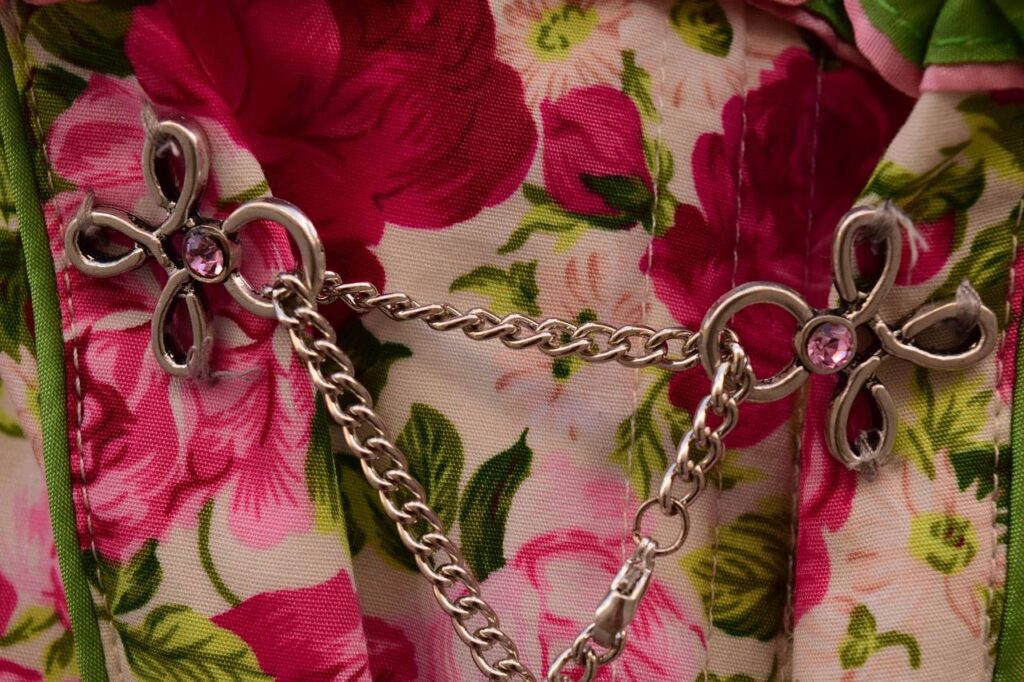
If someone has told you to wear “something Bavarian” to a party, or you are two weeks out from a first trip to Munich and wondering whether you need to buy a costume: you do not, and please do not call it a costume where anyone from here can hear you. Tracht is the traditional dress of this region, and the difference between it and a costume is most of what this page is about.
This is the front door to everything this site has on Trachten and the customs wrapped around it: what a Dirndl and a pair of Lederhosen actually are, whether the apron bow means what everyone claims it means, what the real thing costs against what a costume shop charges, and how the Bavarian year runs from Fasching to the Christkindlmarkt. Read this page first, then follow whichever link below actually answers your question.
What Tracht actually is
Tracht is simply the German word for traditional or regional dress, and in Bavaria it means the Dirndl and the Lederhosen above all else, though it covers plenty besides. Its modern role as a marker of Bavarian identity, rather than just practical clothing, dates to the early 19th century and the founding of the Kingdom of Bavaria, kept alive since by regional Trachten associations that are still active today1.
Historians do not agree on where the Dirndl itself started, and both sourced accounts hold up well enough that neither should be dropped in favor of the other. One traces its tight bodice, low neckline and full skirt to 18th-century court and city fashion: aristocratic and bourgeois women wore it first as summer country dress, and servants copied it later in cheaper fabric for their day off1. The other, from the Bezirk Oberbayern’s own Tracht collection, holds that the 19th-century Dirndl most people picture today started as rural maids’ workwear, plain linen or cotton with aprons sometimes cut from old bedding, and only moved up the social ladder into finer fabric from the late 1800s onward2. Both come from sourced, non-Wikipedia German regional sources, and they disagree, so the honest way to present it is as two origin threads rather than one tidy story.
The men’s side has a more settled history. Lederhosen correspond to alpine hunting garb from around 1850, and Bavarian royals such as King Maximilian II Joseph and later Prince Regent Luitpold were known Tracht-wearers, regularly seen in leather hunting trousers1. Bavaria’s Trachtenverband recognizes six sub-regional mountain styles today, the Berchtesgadener, Chiemgauer, Isartaler, Inntaler, Werdenfelser and Miesbacher Tracht, each cut and patterned a little differently, which is why an outfit from Bad Tölz does not quite match one from Berchtesgaden1.
Resi says The mix-up I hear most from North Americans has nothing to do with the bow or the leather. It is that “German” and “Bavarian” get treated as the same costume. They are not: the Dirndl, the Lederhosen and Neuschwanstein are distinctly Bavarian, and Bavarians will let you know it, generally while affectionately calling the rest of the country Preißn. Even the cuckoo clock everyone pictures alongside them is from the Black Forest, nowhere near Bavaria, and I enjoy correcting that more than is strictly polite.
The Dirndl, in short
Four pieces make a Dirndl, not one dress: a fitted bodice, a blouse worn underneath it, a full skirt, and an apron tied over the top with a bow3. Lengths run from a short mini to floor-length, fabric runs from cheap polyester to silk, and the fit a Munich shop assistant will actually check before saying yes is stricter than most first-time buyers expect. My dirndl guide walks through all four pieces, the lengths, and the fit rules in full.
The Lederhosen, in short
There are three traditional lengths, sold as separate lines by the Munich shops that carry them: the short kurze Lederhose (Krachlederne), which ends above the knee and is finished with a small cuff, the Kniebundhose, which extends past the knee and closes there, and long Lederhosen4. Deerskin is the premium material, prized for being soft and breathable while still holding up; goat and cowhide are lighter on the wallet and need more of a break-in. My Lederhosen history and buying page covers where they came from and what a real pair costs, and my how-to-wear guide covers the socks, the shirt and the shoes that go with them.
The bow question, briefly
The apron bow is the single most-repeated “fact” about the Dirndl, and it deserves two paragraphs of caution rather than one confident sentence. As it is usually told: tied on the wearer’s left means single, right means taken, center-front means virgin, and back means widowed or a waitress at work.
Munich’s own tourism office addresses the claim directly and does not back it: “this is a rule of thumb, not a strict rule. There are no official regulations”5. A Munich lifestyle outlet adds that the bow was traditionally tied front- or back-center, and only in the 20th century did tying it to the side become common, noting that “not every explanation popular today can be documented as a centuries-old, uniform tradition”6. My full page on the bow goes through what holds up and what does not.
What a real one costs versus a costume
Four Munich shops span the range, and their own prices make the point better than any adjective could. Lodenfrey, in business since 1842, lists women’s Dirndl from €599 up to €2,199 across more than 400 styles, and men’s Lederhosen from €599 for goat leather up to €1,799 for deerskin or lambskin47. Angermaier, a family-run manufacturer with two Munich shops, runs cheaper: Dirndl from €199 to €599, Lederhosen from €169.90 to €49989. Trachten Rausch, near the Theresienwiese, positions itself as the budget-to-mid option, with individual Lederhosen from €99 and complete outfits, trousers, shirt and socks, from €13910.
A printed beer-mug pattern, a plastic apron or a zipper standing in for real buttons is what a Bavarian reads as costume rather than Tracht, and Munich’s own tourism copy says as much when it advises buyers to look for natural fibers, a proper bodice fit, clean seams and real buttons5. On the costume end of that spectrum, my page on Oktoberfest costumes, honestly rated has the range, from the $30 party-store version up.
The price gap is not just markup. Munich’s own guidance singles out glued, rather than stitched, Lederhosen as the tell of a cheap pair: they feel rubbery and never break in the way real stitched leather does5. A costume Dirndl is built to survive one party and get thrown out; a real one, properly stitched, is built to be handed down. That is the whole case for spending more once instead of less every year, and it is a case I am happy to make without owning either garment myself.
Where a North American buys one
You do not need to fly to Munich to own the real thing. Rare Dirndl, a women-owned studio in Chicago that has been handmaking and importing Dirndl since 2010, sells current styles from roughly $389 to $498 with free shipping over $250 and a free-alterations program11. Lederhosen Store carries both sides of the outfit, Lederhosen from about $159.95 to $219.95 and Dirndl from about $139.95 to $219.99, with free shipping over $29912. Neither is the cheapest option on the internet, and that is rather the point of this page.
The Bavarian year
Oktoberfest gets the attention, but it is three weeks out of a year that has its own rhythm the rest of the time. Here is the shape of it, month by month, with the full page for each stop.
| When | What happens |
|---|---|
| February | Fasching, Bavaria’s carnival season, runs up to Ash Wednesday, when Munich’s mayor dips the city’s ceremonial purse into the Fischbrunnen at Marienplatz for financial luck (Geldbeutelwaschen). See Fasching in Bavaria and the full year. |
| May | Villages raise their Maibaum, and keep watch on it, since a slow neighboring village can lose theirs overnight. See the Maibaum. |
| September | The Almabtrieb brings cattle down from the high pastures for winter, decorated for the trip. See Almabtrieb and Viehscheid. |
| Late September–October | Oktoberfest itself; the 2026 edition runs 19 September to 4 October. See Oktoberfest in Munich. |
| Late November–December | Christkindlmarkt season opens across the region; Nuremberg’s, among the best known, runs from its own opening ceremony through Christmas Eve. See Christmas Markets in Bavaria and Munich’s Christmas Markets. |
| December | Nikolaus, Krampus and the Perchten make their rounds before Christmas itself. See Krampus, Nikolaus and the Perchten and Bavarian Christmas Traditions. |
Source: Munich’s own Oktoberfest page13; a German public-holiday reference for 2027 Fasching dates14; Munich’s Geldbeutelwaschen page15; Nuremberg’s Christkindlesmarkt site16.
A word or two, and a little manners
Bavaria says hello differently than the rest of Germany, starting with Grüß Gott and Servus, and a visitor who tries either earns more goodwill than one who defaults to a flat Hallo. My words page keeps the longer list, with when each one fits and which is too familiar for a shopkeeper who does not know you.
The manners that actually trip people up are quieter than any single word: what to do with your hands at a crowded Biergarten table, what closes on a Sunday, and how a handshake works here compared to at home. My manners page has the specifics; the short version is that Bavaria notices far more than it ever says out loud.
Schuhplattler and Blasmusik
The slap dance most visitors see once and remember forever is Schuhplattler, named for the dancers slapping (“platteln”) the soles of their shoes with their hands; it began among farmers, hunters and loggers, and was standardized when Miesbach founded a dedicated Schuhplattler society in 1861. Roughly 150 distinct regional variations exist across the Alpine region between Lake Constance and the Königssee, and the style itself splits by region, from the strict, upright Oberbayern version to the looser, heel-led Oberland one17. Brass bands, Blasmusik, provide the soundtrack, played on arrangements composed specifically to sound Alpine and workable with as few as four musicians, alongside the accordion players (Ziachspieler) who show up at informal pub-singing gatherings the rest of the year18. My Schuhplattler and Blasmusik page has the full history and where you can actually see either performed.
Guides in this section
- What the Dirndl Bow Means (Left, Right, Center, Back), and Where the Rule Comes From
- How to Wear Lederhosen: Socks, Straps, Shirt and Shoes
- Where to Buy a Real Dirndl in the US and Canada, and What Real Means
- The Dirndl Explained: Blouse, Bodice, Skirt, Apron and How It Should Fit
- Lederhosen: History, Types and What a Real Pair Costs
- Renting a Dirndl or Lederhosen in Munich: Shops, Prices, Fit
- Haferlschuhe and Loferl: The Shoes and Socks That Finish the Outfit
- Bavarian Words for Visitors: Servus, Grüß Gott, Prost and Twenty More
- Bavarian Manners: Tipping, Quiet Hours, Sundays, Pfand and the Handshake
- The Bavarian Year: Fasching to Christkindlmarkt, Month by Month
- Bavarian Christmas Traditions: Advent, Krampus, Christkind and the Foods
- Christmas Markets in Bavaria: Munich, Nuremberg, Regensburg, Rothenburg and the Dates
- The Maibaum: Why Bavarian Villages Raise a Tree on May 1 and Steal Each Other’s
- Krampus, Nikolaus and the Perchten: Bavaria’s December Frights
- Almabtrieb and Viehscheid: When the Cows Come Down the Mountain
- Fasching: Bavaria’s Carnival Season and What Happens in Munich
- Bavaria the Free State: The Lion, the Flag, the Seven Regions and What Freistaat Means
- Schuhplattler and Blasmusik: Bavaria’s Slap Dance and Brass Bands
- The Edelweiss: The Alpine Flower on Every Bavarian Souvenir
Frequently Asked Questions
What does "Tracht" mean?
It is the German word for traditional or regional dress. In Bavaria it means the Dirndl and the Lederhosen above all, though the word covers other regional clothing too.
Do you have to wear a Dirndl or Lederhosen to Oktoberfest?
No. There is no dress code at Oktoberfest, and ordinary street clothes are worn in the tents alongside Tracht. Plenty of visitors and plenty of Bavarians show up in neither.
What is the difference between a Dirndl and a costume?
Fabric, construction and fit. A real Dirndl is natural fiber, cotton, linen or silk, with a properly fitted bodice, real buttons and clean seams. A costume version tends to be shiny polyester with a printed pattern and a zipper standing in for buttons.
Does the dirndl bow really mean something?
Munich’s own tourism office calls the left-right-center-back convention a rule of thumb, not an official rule. Treat it as a fun thing people say, not a code anyone is required to know.
How much does a real pair of Lederhosen cost?
At Munich shops, roughly €99 at the budget end up to €1,799 for deerskin. In North America, a full outfit from a specialist retailer typically runs $160 to $220.
Can Americans buy an authentic Dirndl or Lederhosen without traveling to Munich?
Yes. US-based retailers sell handmade or imported Tracht with domestic shipping, at a real Munich price rather than a costume-shop one.
What is Schuhplattler?
A traditional Bavarian dance in which performers slap the soles of their shoes, their knees and their thighs in time with the music. It was standardized in the mid-19th century and has roughly 150 regional variations.
Is "Bavarian" the same as "German"?
Not to a Bavarian. Bavaria is one of Germany’s states, with its own dress, its own dialect and its own opinion of the rest of the country, which it has been known to call Preißn.
Related Articles
 Bavarian Food: The Dishes, How Munich Eats Them, and What to Cook at HomeFood
 Bavarian Beer, Explained: Styles, Breweries, Beer Halls and Beer GardensBeer
 Oktoberfest in Munich: Dates, Tents, Reservations, What to Wear and What It CostsOktoberfest
 What to Wear to Oktoberfest, and Whether You Have ToOktoberfest
 Oktoberfest Costumes, Honestly Rated: From the $30 Costume Dirndl to the Real ThingParty
 The Dirndl Explained: Blouse, Bodice, Skirt, Apron and How It Should FitTrachten and customs
 How to Wear Lederhosen: Socks, Straps, Shirt and ShoesTrachten and customs
 Munich for a First Trip: What Is Worth It, What Is Not, and How the City WorksMunich
Sources
- Geschichte: Was Tracht in Bayern bedeuten — Wochenblatt. Accessed 2026-09-24.
- Trachten-Informationszentrum — Bezirk Oberbayern. Accessed 2026-09-24.
- What Is a Dirndl Dress — eLederhosen. Accessed 2026-09-24.
- Herren Trachten: Lederhosen — Lodenfrey. Accessed 2026-09-24.
- Oktoberfest Outfits: Dirndl and Lederhosen — muenchen.de. Accessed 2026-09-24.
- Dirndl-Schleife: Was die Schleife bedeutet — In München. Accessed 2026-09-24.
- Damen Trachten: Dirndl — Lodenfrey. Accessed 2026-09-24.
- Damen: Dirndl — Angermaier. Accessed 2026-09-24.
- Herren: Lederhosen — Angermaier. Accessed 2026-09-24.
- Trachten Rausch — Trachten Rausch. Accessed 2026-09-24.
- Rare Dirndl — Rare Dirndl. Accessed 2026-09-24.
- Lederhosen Store — Lederhosen Store. Accessed 2026-09-24.
- muenchen.de — muenchen.de. Accessed 2026-09-24.
- Feiertage 2027 — schulferien.org. Accessed 2026-09-24.
- Geldbeutelwaschen 2026 — muenchen.de. Accessed 2026-09-24.
- Nuremberg Christkindlesmarkt — City of Nuremberg. Accessed 2026-09-24.
- Volkstanz und Schuhplattler — Trachtenverband Bayern. Accessed 2026-09-24.
- Volkslied und Volksmusik — Trachtenverband Bayern. Accessed 2026-09-24.