In brief
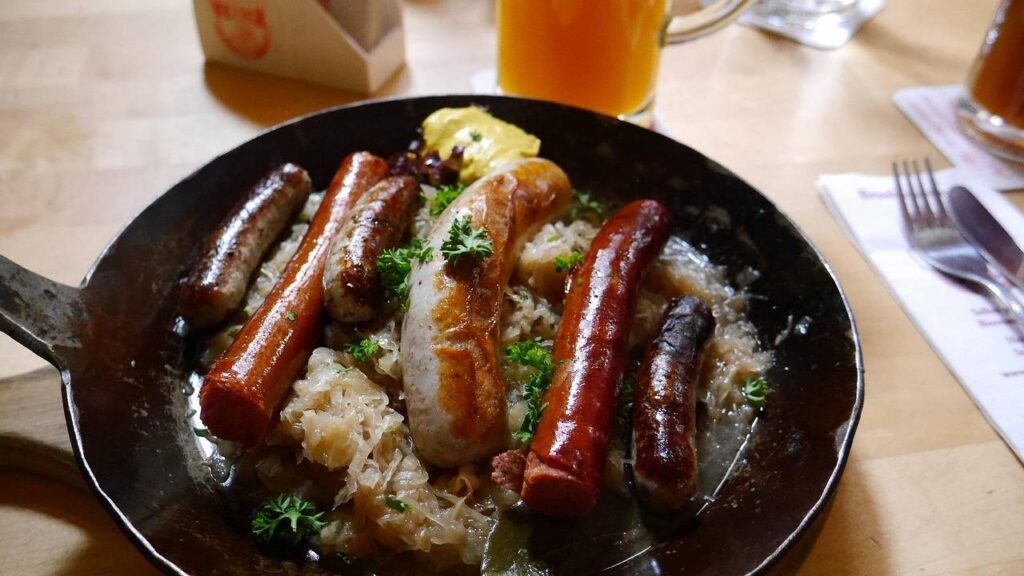
The Nürnberger Rostbratwurst is a small grilling sausage, 7 to 9 centimeters long and about 20 to 25 grams raw, made from lean pork and pork fat, seasoned heavily with marjoram and stuffed into a thin sheep casing. It is one of the few sausages with its own European Union protection: “Nürnberger Bratwürste” and “Nürnberger Rostbratwürste” have been a registered Protected Geographical Indication since Commission Implementing Regulation (EU) No 973/2013 took effect on 10 October 2013, with every step of production required to happen inside Nuremberg itself. The tradition goes back to 1313, and the sausage’s small size specifically to 1573. A 1941 description still nails the size, “so lang wie ein kleiner Finger und auch so dick,” as long as a small finger, and just as thick. Order it the classic way and you get “drei im Weggla,” three sausages in a split roll, usually with sauerkraut, farmer’s bread, potato salad or horseradish.
Disclosure: some links on this page are affiliate links, marked by the products and tours they name. A purchase through these links may earn the site a commission at no cost to you, and it never affects what is recommended. How this works.
Order a Nürnberger and you get three sausages roughly the length of your finger, and that is not a loose figure of speech: a 1941 description compares it to exactly that, as long as a small finger and just as thick. It also happens to be my favorite sausage in Bavaria, tied with the Wienerle, though only one of the two comes with its own EU paperwork. It is the smallest of Bavaria’s well-known sausages and, for its size, the most heavily protected one on the books. This page covers what is actually in it, why the European Union has an opinion about where it can be made, and how to get something close to it in North America. It sits alongside the rest of my guide to Bavarian food, and if you want the wider bratwurst lineup first, that page covers the others.
What is in a Nürnberger Rostbratwurst
The official EU product specification describes a sausage made from roughly defatted pork meat and fatty pork, specifically pork belly, belly fat, jowl and back fat, with no fillers added. The seasoning is built around marjoram, and the finished sausage has to meet minimum and maximum limits: at least 12 percent meat protein free of connective tissue, no more than 35 percent fat, stuffed into a natural sheep casing about 2 centimeters across, coming out to 7 to 9 centimeters long and 20 to 25 grams raw2.
That is small on purpose, and it was not always this size. Bratwurst-making in Nuremberg goes back to at least 1313, but the specifically small, finger-length form that defines the Nürnberger today is traced to 1573, so somewhere in those 260 years Nuremberg’s sausages got shorter, and they never got longer again12.
Compare that to a standard German bratwurst, which typically runs closer to 15 centimeters, and the Nürnberger looks almost like a snack size next to it. That is the point: three of them fit in one small roll with room to spare, which is exactly the serving format the city built around the sausage rather than the other way around.
An EU-protected name, not just a local one
Most regional sausages are only as protected as local pride can make them; the Nürnberger is different. Under Commission Implementing Regulation (EU) No 973/2013, effective 10 October 2013, “Nürnberger Bratwürste” and “Nürnberger Rostbratwürste” are registered as a Protected Geographical Indication, filed originally under registration number DE-PGI-0105-0184-28.09.2010, and every stage of production has to take place within the city of Nuremberg itself. The regulation credits the city’s position on historic spice trade routes for why marjoram, ginger and the other seasonings in Nuremberg sausages were available there centuries before they were common elsewhere2.
Resi says A sausage labeled simply “Nuremberg-style” outside the EU, including most of what is sold in the US, is not covered by this protection and can be made anywhere, by anyone, out of anything vaguely finger-shaped. Inside the EU, a real Nürnberger Bratwurst has to have actually come from Nuremberg, which is exactly as it should be, and exactly the sort of rule Bavaria enjoys having on the books.
Here is the sausage reduced to its specification sheet:
| What it is | Detail |
|---|---|
| Length | 7–9 cm (about 3 inches) |
| Raw weight | 20–25 g per sausage |
| Casing | Natural sheep casing, about 2 cm across |
| Fat content | Maximum 35% |
| Protected since | 10 October 2013 (Regulation (EU) No 973/2013) |
| Documented since | 1313 (small size since 1573) |
Source: Bavarian State Ministry of Food, Agriculture and Forestry1; European Commission2.
Where the sausage and the name come from
Nuremberg’s own record of the sausage points to two dates worth remembering: first mention in 1313, and the city’s famous sausage tavern, the Bratwurstglöcklein, recorded from 1487 with its own exclusive rights to slaughter animals and serve beer alongside its sausages, a sign of how tied the two trades already were. The register also passes along a claim that Goethe liked the sausages enough to have them shipped by post from Nuremberg to Weimar, which, whether or not you take it at face value, tells you the sausage’s reputation was already traveling well beyond Franconia1.
How to order it: drei im Weggla
The standard order is three sausages in a split bread roll, drei im Weggla, usually with a smear of mustard and, depending on where you order it, sauerkraut, farmer’s bread, potato salad or fresh horseradish on the side, with a spiced beer as the traditional pairing1. It is street food built for eating with one hand while you keep walking, which is more or less the same job Munich’s Leberkässemmel does; my Leberkäse page covers that one.
Getting it in North America
You will not find a true, EU-protected Nürnberger Rostbratwurst outside the European Union, because the protection itself is what stops that. What you can find is a Nuremberg-style sausage made the same way, and one option sold in the US is the Stiglmeier brand’s Nuernberger Bratwurst, fully cooked and sold in a 16-ounce, four-sausage pack, as of September 20263.
Resi says The Stiglmeier is the stand-in I would buy for a drei-im-Weggla night at home. It will not carry the PGI seal, since that badge only means something inside the EU, but it follows the same small, marjoram-forward recipe closely enough that nobody at your table is going to file a complaint with Brussels.
To do it properly, warm three small rolls, split them most of the way through without cutting all the way to the base, and grill or pan-fry the sausages until the casing is browned rather than just heated through; the whole appeal of a Rostbratwurst is in the word “rost,” roasted, not simmered. Tuck three sausages into each roll, add mustard, and put the sauerkraut or potato salad on the side rather than in the roll, the way it is served in Nuremberg itself.
Frequently Asked Questions
Are Nürnberger sausages protected outside Nuremberg?
Within the EU, yes: “Nürnberger Bratwürste” and “Nürnberger Rostbratwürste” are a registered Protected Geographical Indication, and every production step has to happen in Nuremberg. Outside the EU, including in the US, the name is not legally restricted.
What does "drei im Weggla" mean?
“Three in a small bread roll,” the standard way to order Nürnberger Rostbratwürste: three sausages in a split roll, usually with mustard and a side of sauerkraut or potato salad.
How big is a Nürnberger Rostbratwurst?
About 7 to 9 centimeters (roughly 3 inches) long and 20 to 25 grams raw, stuffed into a thin sheep casing about 2 centimeters across.
When did the Nürnberger get its EU protection?
Commission Implementing Regulation (EU) No 973/2013 took effect on 10 October 2013, registering the name as a Protected Geographical Indication.
How old is the Nürnberger Rostbratwurst?
Bratwurst-making in Nuremberg is documented from 1313, with the specifically small, finger-length size traced to 1573.
Can you buy real Nürnberger sausages in the US?
Not the EU-protected version, since the protection is tied to production in Nuremberg itself. Nuremberg-style versions made in the US, such as the Stiglmeier brand’s four-pack, are sold as of September 2026.
Related Articles
Sources
- Nürnberger Rostbratwürste — Genussorte Bayern, Bavarian State Ministry of Food, Agriculture and Forestry. Accessed 2026-09-24.
- Commission Implementing Regulation (EU) No 973/2013 — EUR-Lex, Official Journal of the European Union. Accessed 2026-09-24.
- Stiglmeier Nuernberger Bratwurst, 16 oz (4 Pack) — Amazon.com. Accessed 2026-09-24.