In brief
“Bratwurst” is not one sausage in Bavaria; it is a category, and the region’s own culinary register catalogues several distinct types, each tied to a place and a specific way of cooking it. The Nürnberger Rostbratwurst is small, 7 to 9 centimeters, sheep-cased and marjoram-forward, grilled, and EU-protected since 2013. The Ansbacher Bratwurst goes into a pork intestine casing rather than sheep casing and gets pan-fried rather than grilled. The Fränkische Bratwurst runs about 15 centimeters, leans harder on marjoram, pepper and a pinch of nutmeg, and is traditionally eaten without mustard. Krautwurst, a Franconian specialty, is not a pure meat sausage at all: it is liver sausage mixed with pressed cabbage, and it has nothing to do with the boiled Regensburger, which is not a bratwurst in the first place.
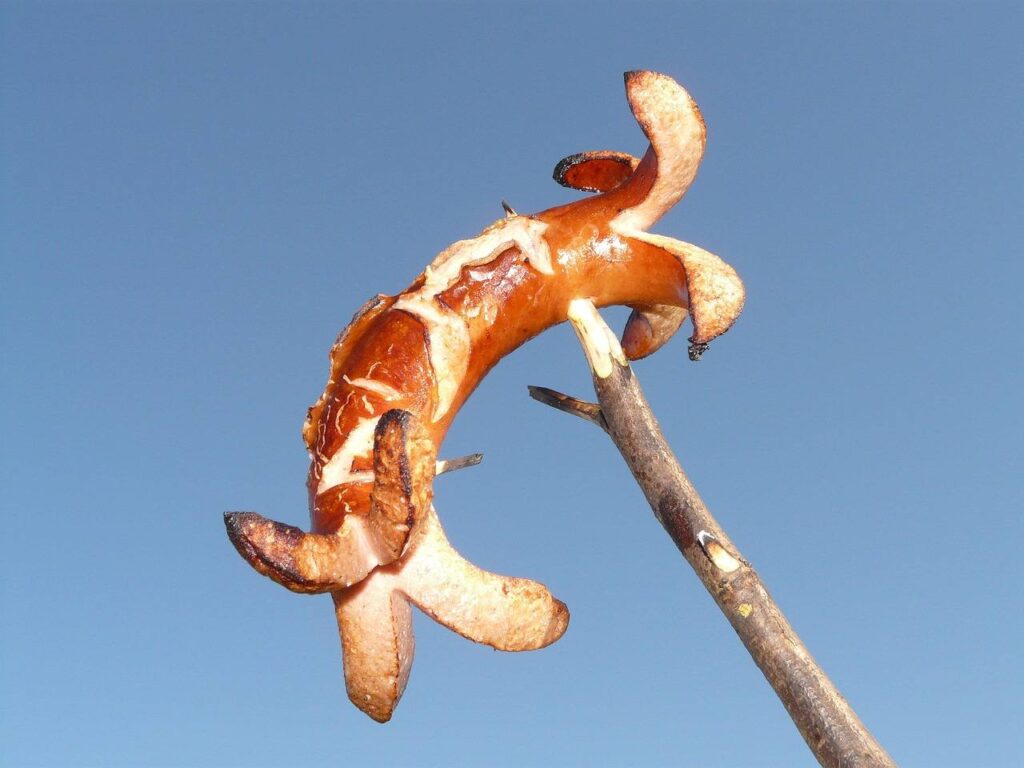
Ask for “a bratwurst” in Franconia and the follow-up question is which one, because the region treats bratwurst the way a wine list treats red: a broad word covering several specific things that do not taste or cook the same way. My own two favorite Bavarian sausages are the Rostbratwürstl and the Wienerle, and writing this page is how I found out that only one of them technically qualifies for it. This page is the companion to my Nürnberger Rostbratwurst page, part of my guide to Bavarian food, and it covers the varieties beyond the famous one: what each is made of, how each is cooked, and where each comes from.
Nürnberger Rostbratwurst: the small, protected one
Nuremberg’s sausage is the smallest and the most legally defined of the group. It runs 7 to 9 centimeters long, weighs about 20 to 25 grams raw, and is stuffed into a thin sheep casing about 2 centimeters across. The seasoning leans hard on marjoram, and the recipe is registered as a Protected Geographical Indication under EU law since 2013, meaning production has to happen in Nuremberg itself1. It is grilled, never boiled, and the standard order is three in a split roll, drei im Weggla. My full page on the Nürnberger covers the EU protection and the history in more detail.
Ansbacher Bratwurst: the pan-fried one
Ansbach, also in Franconia, makes a bratwurst that differs from Nuremberg’s in a detail easy to miss on a menu: the casing. Where the Nürnberger uses sheep casing, the Ansbacher traditionally uses pork intestine, specifically the Bändeldarm or Schäldarm, which local producers treat as a marker of proper Ansbach production. The filling is lean pork shoulder and well-marbled pork belly, with tendons, cartilage and skin trimmed out; the base seasoning is salt, pepper, pimento and marjoram, though individual butcher families vary the mix in their own house recipes2.
The bigger difference is how it is cooked. Ansbach bratwurst is traditionally “knusprig gebraten,” crisply pan-fried, rather than grilled over an open flame the way a Nürnberger is. It is served with sauerkraut, black bread, potatoes or potato salad, and the local specialty “Blaue Zipfel” poaches it in a soured broth with onions instead of frying it at all. The sausage is documented in Ansbach’s city records back to 1430, with weight and purity rules on record from the 15th and 16th centuries, predating the Reinheitsgebot beer purity law by decades2.
Fränkische Bratwurst: the one eaten without mustard
The broader Franconian bratwurst, found across Middle, Upper and Lower Franconia, is built from pork shoulder with a heavy hand of marjoram, black pepper, salt and a pinch of nutmeg, in a casing about 15 centimeters long, noticeably longer than the Nürnberger. It can be pan-fried, poached as “Blaue Zipfel” in a vinegar-onion broth, or smoked, and it is traditionally eaten without mustard, with sauerkraut, potato salad, black bread and horseradish standing in instead3.
Resi says Order a Fränkische Bratwurst with mustard out of habit and you will get a look, the same one you would get for salting a steak before tasting it. Save the mustard for the Nürnberger; this one wants sauerkraut, potato salad or horseradish next to it instead, and it wants you to already know that.
As recently as the 1950s, Franconian bratwurst was treated as festival food, reserved mostly for Sundays rather than eaten as an everyday sausage3. That has changed: it is now standard grill fare across the region, mustard-avoidance and all.
Krautwurst: not a plain sausage at all
Krautwurst breaks the pattern of the other three, because it is not primarily a meat sausage. It is a liver sausage mixed with shredded, cooked, pressed white cabbage, which can make up as much as a third of the finished mix, along with broth left over from meat processing, all stuffed into pork casings4.
Bavaria’s own register traces it to household-slaughter traditions in Franconia, where combining liver sausage with cabbage stretched a limited meat supply while doubling as a flavor pairing in its own right. It is produced across Mittelfranken, Oberfranken and Unterfranken, with butchers pushing it especially from October through March; fresh, it is pan-fried and served with potatoes or salad, while smoked it becomes a bread spread rather than a sausage you cook at all4.
What is not on this list
Two sausages that sound like they belong here do not, strictly speaking, count as bratwurst. The Regensburger is a boiled sausage, closer in method to a Weißwurst than to anything grilled or pan-fried, and it does not carry EU protection the way the Nürnberger does5. Leberkäse, despite being made from similar ground pork and beef, is baked as a loaf rather than stuffed into a casing at all; my Leberkäse page covers that one on its own.
Side by side, the four look like this:
| Sausage | Casing | Cooking method | Region |
|---|---|---|---|
| Nürnberger Rostbratwurst | Sheep, ~2 cm | Grilled | Nuremberg |
| Ansbacher Bratwurst | Pork intestine | Pan-fried | Ansbach |
| Fränkische Bratwurst | Pork, ~15 cm | Pan-fried, poached, or smoked | Middle/Upper/Lower Franconia |
| Krautwurst | Pork | Pan-fried fresh, or smoked as a spread | Franconia |
Source: Genussorte Bayern1234.
Buying bratwurst variety in North America
A single American grocery run will not turn up all four of these, but mail-order German butchers stock several at once. Bavaria Sausage’s Oktoberfest Bratwurst Sampler, for instance, bundles one package each of five sausage styles, including Knackwurst, Nuernberger and smoked bratwurst, for $43.09 as of September 20266.
Resi says The sampler is the smart way to taste the range side by side before you decide which one earns a permanent spot in your freezer, and which ones were only ever going to get a polite, one-time tasting.
Frequently Asked Questions
What is the difference between Nürnberger and Fränkische bratwurst?
Size and casing, mainly. The Nürnberger is 7–9 cm in a thin sheep casing and grilled; the Fränkische is about 15 cm, typically in a pork casing, and more often pan-fried.
Is Ansbacher Bratwurst the same as Nürnberger?
No. Ansbacher uses pork intestine casing rather than sheep casing, and it is traditionally pan-fried rather than grilled, unlike the Nürnberger.
Do you eat mustard with Fränkische Bratwurst?
Traditionally, no. The register notes it is eaten without mustard, with sauerkraut, potato salad, black bread or horseradish instead.
What is Krautwurst made of?
Liver sausage mixed with shredded, cooked, pressed cabbage, up to about a third of the mix, stuffed into pork casings. It is a Franconian specialty, not a plain meat bratwurst.
Is Regensburger sausage a type of bratwurst?
No. It is a boiled sausage, closer in preparation to Weißwurst, and it is not part of the bratwurst family or its EU protections.
Which Bavarian bratwurst has EU protection?
The Nürnberger Rostbratwurst, protected since 2013 under EU Regulation 973/2013. The others discussed here do not currently carry the same protection.
Related Articles
 Nürnberger Rostbratwurst: The Finger-Sized Sausage with Its Own EU ProtectionFood
 Bavarian Food: The Dishes, How Munich Eats Them, and What to Cook at HomeFood
 Bratwurst vs Knockwurst: What Is the Difference?Food
 What Is Leberkäse? No Liver, No Cheese, and How Munich Eats ItFood
 German Sausages, Sorted: Weißwurst, Bratwurst, Knackwurst, Leberkäse, Regensburger and MoreFood
 The Bavarian Foods with EU Protection: Breze, Obazda, Rostbratwurst, Bier and MoreFood
 Franconia’s Beer Country: Kellerbier, Zoigl and Brewery DensityBeer
 Bamberg’s Smoked Beer: Where to Drink Rauchbier and How to Get There from MunichBeer
Sources
- Nürnberger Rostbratwürste — Genussorte Bayern, Bavarian State Ministry of Food, Agriculture and Forestry. Accessed 2026-09-24.
- Ansbacher Bratwurst — Genussorte Bayern. Accessed 2026-09-24.
- Fränkische Bratwurst — Genussorte Bayern. Accessed 2026-09-24.
- Krautwurst — Genussorte Bayern. Accessed 2026-09-24.
- Historische Wurstkuchl — Historische Wurstkuchl Regensburg. Accessed 2026-09-24.
- Oktoberfest Bratwurst Sampler 1 — Bavaria Sausage Inc. Accessed 2026-09-24.