In brief
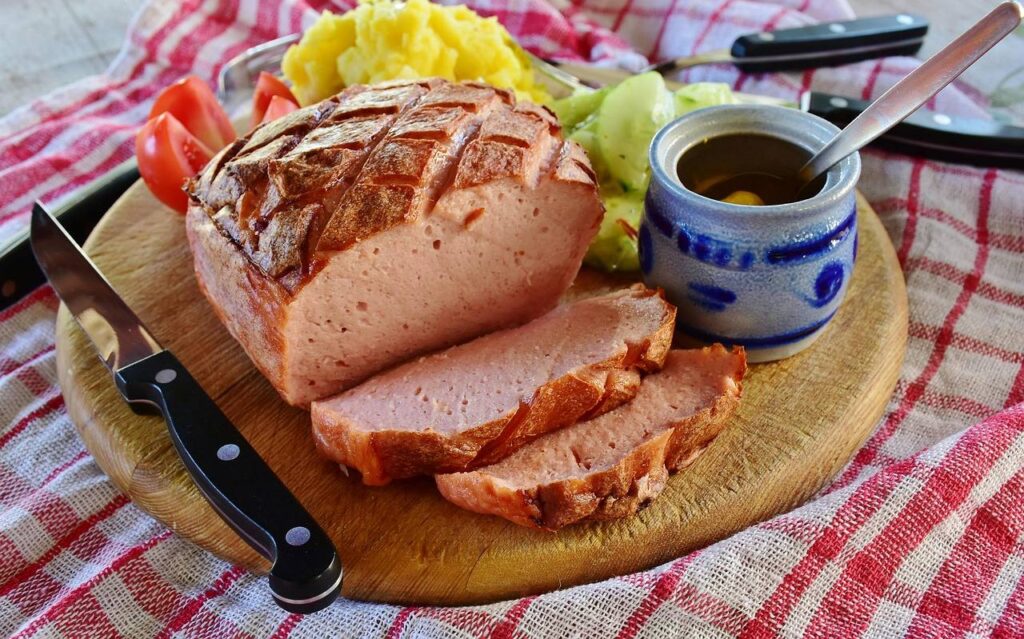
Leberkäse is a baked Bavarian loaf of ground beef, fatty pork and fat, and it contains neither of the things its name promises: Bavaria’s own culinary register states plainly that there is no liver in Bavarian Leberkäse, and the “Käse” doesn’t mean cheese either. Munich eats it two ways: warm in thick slices with potato salad, a fried egg and sweet mustard, or cold and thin in a halved roll as a Leberkässemmel, the city’s most common lunch on foot. It traces to the 18th century, after the Bavarian Elector Karl Theodor brought his own butcher up from Mannheim in 1778, and the crisp end piece of the loaf even has its own name, the Scherzel. Buy it in North America and it arrives fully cooked and frozen, sold by the loaf rather than the slice, with a half loaf running $34.98 as of September 2026.
Disclosure: some links on this page are affiliate links, marked by the products, tours and hotels they name. As an Amazon Associate, bavarianbistro.com earns from qualifying purchases. A purchase through these links may earn the site a commission at no cost to you, and it never affects what is recommended. How this works. Product prices and availability shown are as of the date stated and can change; the Amazon price at checkout applies.
Hand someone a pink, baked loaf called Leberkäse and ask what’s in it, and most guesses involve liver, or cheese, or both. There is neither, and the name is one of the small jokes this country plays on visitors without quite meaning to. Back in Munich, a Leberkäs Semmel with sweet mustard was my fast food of choice whenever an errand ran long — the original Bavarian fast food, and I mean that as a direct insult to every drive-through on this continent. This is the loaf behind the glass at nearly every butcher’s counter and beer-hall kitchen in Munich, and it earns its place in my guide to Bavarian food right next to the sausages, because that is more or less what it is: a sausage that never saw a casing.
What Leberkäse actually is
Bavaria’s own register of regional specialties settles the name question directly: there is no liver in Bavarian Leberkäse, unlike some versions made elsewhere, and the “Käse” is just as misleading — one explanation traces it to “Laib,” a loaf, and an old word for a compact, pressed mass, not the dairy product on your cheese board, which is the tidier fit for what actually lands on your plate1.
What’s actually in it: coarsely trimmed beef, fatty pork, fat tissue, water, salt and spices, ground fine and worked with ice water until smooth. Bacon goes in loosely rather than blended through, which is why a good slice shows small flecks of it, and the loaf is baked, not smoked or boiled, at 160 to 200°C (320 to 392°F), which is what gives it a browned, faintly crisp crust over a pale, dense interior1.
The end piece, where the crust wraps all the way around, has its own name: the Scherzel1.
Resi says Ask for the Scherzel by name at the counter and watch the butcher recalibrate what they think of you. It is the crust-wrapped end piece, the one regulars order like it’s a secret handshake, and there is no reason you cannot be that person too.
Where it comes from
Bavaria’s register places the dish in the 18th century, after the Elector Karl Theodor inherited the state in 1778 and brought his personal butcher up from Mannheim, who is credited with developing something close to today’s recipe within a few years of arriving. The register even quotes a line of Bavarian verse, “Leberkäs, ein feiner Duft schwängert schnell die Wirtshausluft,” roughly “Leberkäs, a fine aroma quickly fills the tavern air,” which is not a subtle poem, and is not trying to be1.
There is a second, more prosaic reading of the name too: some sources trace it instead to “Lab” and “Kasi,” terms tied to how proteins set and coagulate as the loaf bakes, rather than to any word for a pressed mass. Either way, the “Käse” on the label is a linguistic leftover, not an ingredient, and nobody at the counter will correct you for calling it a loaf instead1.
How Munich eats it, hot or cold
There are two ways to eat it, and which one you get mostly depends on the time of day1.
- Hot, at a sit-down meal. A thick slice, warmed through or fresh from the oven, plated with potato salad, a fried egg (Bavarians call the yolk-up version “Ochsenaugen,” ox eyes) and a spoon of sweet mustard on the side. This is lunch or an early dinner, not a snack.
- Cold, on the street. A thin slice in a halved roll with pickles, sold at butcher counters and market stalls as a Leberkässemmel, the version you eat standing up, on the way somewhere else, and one of the most common quick lunches in Munich.
Both versions want the same condiment: Bavarian sweet mustard, coarse and faintly sweet rather than sharp. Händlmaier‘s, the Regensburg mustard maker, says its sweet Hausmachersenf has been made the same way for over 100 years, and it is the brand most likely to be on the table next to a plate of Leberkäse in Bavaria, sold in the US in a 13.4-ounce jar on Amazon34.
Resi says Buy the Händlmaier’s. It is the sweet mustard I would put on the table without asking anyone’s permission, and the 13.4-ounce jar is easy enough to find in the US that the sharp yellow stuff next to it has no excuse.
Getting it in North America
Leberkäse does not travel the way a jarred condiment does, so buying it in the US means ordering the loaf itself, fully cooked, from a German grocer rather than a regular supermarket. Germandeli.com sells it as a Bavarian meat loaf of finely ground corned beef, pork and bacon seasoned with garlic and nutmeg, in a half loaf of about 2.7 pounds for $34.98 or a full loaf of about 5.9 pounds for $64.98, as of September 2026, fully cooked and ready to eat straight from the package, though it is best baked until the crust browns again2.
The half loaf is the sensible order for a household that has never tried it; the full loaf is for one that already knows it likes it, or is about to feed a crowd of people who are about to become fans. Either size arrives frozen and stays that way, so there is no rush to eat through it in a weekend the way you would a fresh bakery loaf. Slice what you need, reheat it in the oven or a hot pan until the cut face browns a little, and put the rest back in the freezer for the next Leberkässemmel.
Frequently Asked Questions
Does Leberkäse actually contain liver?
No. Bavaria’s own specialties register states directly that there is no liver in the Bavarian version, which distinguishes it from Leberkäse made in some other regions.
Is there cheese in Leberkäse?
No dairy cheese. One explanation for the name traces “Käs” to an old word for a compact, pressed mass rather than to cheese, which matches the dense, loaf-like texture better than the modern meaning of the word does.
What is a Leberkässemmel?
A cold, thin slice of Leberkäse in a halved bread roll with pickles, sold at butcher counters and market stalls as a quick, walking lunch in Munich.
What is the Scherzel?
The end piece of the baked Leberkäse loaf, where the crust runs all the way around the slice. It is the piece regulars ask for specifically.
What do you eat with Leberkäse?
Warm, it comes with potato salad, a fried egg and sweet mustard. Cold, it is served in a bread roll with pickles. Bavarian sweet mustard, most often the Händlmaier brand, is the condiment either way.
Can you buy Leberkäse in the United States?
Yes, fully cooked and shipped frozen by German grocers. Germandeli.com sells a half loaf, about 2.7 pounds, for $34.98 as of September 2026.
Related Articles
 Bavarian Food: The Dishes, How Munich Eats Them, and What to Cook at HomeFood
 Weißwurst: How to Eat Bavaria’s White Sausage (Skin, Mustard and the Noon Rule)Food
 Bratwurst in Bavaria: The Regional Varieties and How Each Is CookedFood
 German Sausages, Sorted: Weißwurst, Bratwurst, Knackwurst, Leberkäse, Regensburger and MoreFood
 Brotzeit: Bavaria’s Bread-Time Meal, and What Goes on the BoardFood
 Bavarian Sweet Mustard: What It Is, How to Buy It, How to Make ItFood
 How to Read a Bavarian Menu: 60 Words from Brezn to ZwetschgendatschiFood
 German Grocers That Ship in the US and CanadaPantry and tools
Sources
- Bayerischer Leberkäse — Genussorte Bayern, Bavarian State Ministry of Food, Agriculture and Forestry. Accessed 2026-09-24.
- Leberkäse – Authentic Bavarian Meat Loaf — Germandeli.com. Accessed 2026-09-24.
- Händlmaier’s Hausmachersenf — Luise Händlmaier GmbH. Accessed 2026-09-24.
- Händlmaier’s Sweet Bavarian Mustard, 13.4 oz — Amazon.com. Accessed 2026-09-24.