In brief
Radler, half beer and half lemon soda, was invented in 1922 at the Kugler-Alm Gasthof near Munich by the innkeeper Franz Xaver Kugler, who ran short of beer for a group of cyclists and mixed in lemon soda to stretch it. Spezi, cola mixed with orange soda, dates to a 1950s cola shortage in Bavarian bars, and Paulaner’s own version of it, sold in the US as Paulaner Sunset, was formalized in 1974. Apfelschorle, apple juice cut with carbonated water at roughly 40 to 60 percent juice, is the one to pour without ice, since serving ice in soft drinks is uncommon in Germany. It is also the honest, unsourced backbone of a kids’ table, which the research behind this page could not find a German tradition for at all.
Not everyone at your Oktoberfest party wants a Maß in their hand, and pretending otherwise is how the toilet line gets long and someone’s stomach revolts on the drive home. This page is the drinks list for everyone else: the designated drivers, the guests who do not drink, the kids, and the people who just want something with fizz in it that is not a full liter of lager. It is part of the full Oktoberfest party plan, and it opens with the one I actually drank myself.
None of these need a bartender or a special trip to a specialty store. Most show up at any grocery store that carries an international aisle, or can be made from apple juice and seltzer already in your fridge, which is more than you can say for a proper Maß of Oktoberfestbier.
Radler: my own drink, not a compromise
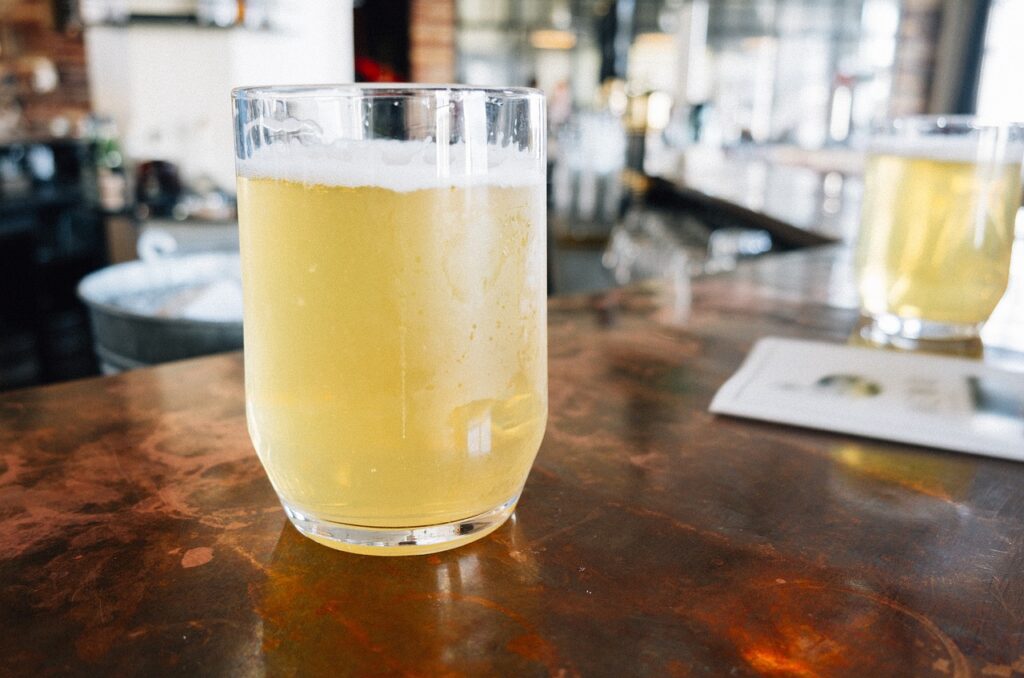
I was never much of a beer drinker, so my drink of choice at Oktoberfest and in the beer gardens was always the Radler. It is a refreshing mix of half beer and half lemon soda, so it looks like regular beer but is far less potent, and it let me sit at the same table as everyone else without matching them Maß for Maß.
Germanfoods.org, the German food trade association’s consumer site, dates the drink to 1922, when a group of cyclists arrived at the Kugler-Alm Gasthof in Bavaria on a hot day to find the innkeeper did not have enough beer to go around. Franz Xaver Kugler mixed half dark beer with half lemon soda and named the result after the cyclists, Radler being German for “cyclist”; it is now sold ready-made in cans as well as mixed to order1.
Resi says The one thing most Oktoberfest beer drinkers realize too late is that what goes in must come out. I have watched plenty of visitors skip planning for the toilet lines, or find out the hard way on the way home. A Radler will not save you from that math entirely, but it slows it down, and it is still the drink I would put in a first-timer’s hand before a full Maß.
Spezi and Paulaner Sunset
Spezi, cola mixed with orange soda, has a similar origin story to Radler: a shortage, and a bartender’s improvisation. Paulaner Sunset, the US import of Paulaner’s own version, tells it this way on its “About Us” page: “In the 1950s, bartenders in Bavaria had an idea to solve the cola shortage. By mixing cola with orange soda, they created a new drink popularly called Spezi.” Paulaner formalized its own recipe in 1974 and says “it is still produced the same way it was in 1974, from the recipe to the label, a true time capsule from the 1970s”2.
The US relaunch, simply branded Sunset, describes itself as a project of friends and family in Venice, California, built to bring Germany’s best-known soft drink to American shelves; it was reborn there in 2024 and is sold as Sunset Orange Cola and Sunset Zero Sugar, described by the brand as “smooth and mellow” with high fruit content and low carbonation2. It is the easiest single bottle to put next to the beer at a party, since it needs no explanation beyond “it’s like an orange cola, but German.”
Apfelschorle
Apfelschorle is German for apple spritzer, made from apple juice cut with carbonated water, typically 40 to 60 percent juice, described as sweet without being cloying, with its brightness coming from the carbonation rather than added sugar, and traditionally served without ice, since serving ice in soft drinks is uncommon across Europe, Germany included3. It doubles as the base of the kids’ table below, and it is the drink I would hand any adult who wants something with a little fizz but no alcohol at all.
Schnapps: Obstler, and what is not actually Bavarian
Obstler, a clear, unsweetened fruit brandy made by double-distilling fermented fruit mash, is traditional across Bavaria, Austria, Switzerland and the wider Alpine German-speaking region, and Enzian, gentian schnapps, is distilled from Alpine gentian roots; both are general regional knowledge rather than facts this research could confirm on a producer’s own page, so treat the specifics as background rather than sourced claims. One schnapps that does not belong on an Oktoberfest table at all, despite showing up on plenty of “German drinks” lists, is Jägermeister. The company’s own history page places its founding with Wilhelm Mast in Wolfenbüttel, Lower Saxony, in 1878, as a wine-vinegar business; his son Curt Mast later spent years perfecting the herbal-liqueur recipe with its 56 ingredients, and the company still describes itself as “firmly rooted” in Wolfenbüttel4. Wolfenbüttel is roughly 400 miles from Munich, which makes Jägermeister about as Bavarian as a bagel.
Non-alcoholic beer
If a guest wants something that tastes like beer without the alcohol, Erdinger Alkoholfrei and Weihenstephaner’s non-alcoholic wheat beer are both confirmed, well-documented options with real brewing behind them rather than a beer-flavored soda; the full numbers for both are on my beer list for the party page, since they are as much a beer decision as a drinks one.
Setting up the drinks table
A folding table with the beer at one end and everything on this page at the other end solves most of the awkwardness of a mixed crowd. Put the Radler fixings, a bottle of pale lager and a bottle of lemon soda, next to the beer rather than the soft drinks, since it is meant to be built to order and looks strange sitting with the juice boxes. Keep Apfelschorle, Spezi and the non-alcoholic beers together on ice, since those are the grab-and-go options, and label them if you are worried a guest will mistake a non-alcoholic wheat beer for the real thing after their third Maß.
The kids' table
Here is where I have to be honest about the research rather than dress it up as tradition: nothing in the sources behind this page describes an official or even commonly documented “kids’ table” at a Bavarian party. There is no German source for what children are handed instead of beer, so what follows is my own practical suggestion, built from what is already sourced above, not a custom I am claiming Bavaria actually has.
Apfelschorle is the obvious base, since it already reads as festive without being a straight juice box, and it needs nothing more than apple juice, sparkling water and no ice. A non-alcoholic Malzbier or a plain soda covers anyone who does not want apple juice, and pretzels and Kaiserschmarrn, the torn pancake dish that shows up on Munich’s own list of everyday specialties, work as food at a kids’ table as well as they do at the adults’ end of the yard.
Resi says Do not present the kids’ table as “the German way to do it,” because I cannot point you to a source that says Bavarians actually run one. Present it as what it is: a practical fix so the youngest guests have something that looks like they are part of the party too.
Frequently Asked Questions
What is a Radler?
A mix of half beer and half lemon soda, invented in 1922 at the Kugler-Alm Gasthof near Munich when the innkeeper ran short of beer for a group of cyclists.
What is Spezi?
A mix of cola and orange soda that originated in Bavarian bars during a 1950s cola shortage; Paulaner formalized its own version in 1974, sold in the US as Paulaner Sunset.
Is Apfelschorle served with ice?
No. Serving ice in soft drinks is uncommon in Germany, and Apfelschorle is typically served well-chilled without it.
Is Jägermeister a Bavarian drink?
No. It was founded in Wolfenbüttel, Lower Saxony, roughly 400 miles from Munich, and has no Bavarian origin.
What should non-drinkers have at an Oktoberfest party?
Radler for something beer-adjacent, Apfelschorle or Spezi for something with no alcohol at all, and Erdinger Alkoholfrei or Weihenstephaner’s non-alcoholic wheat beer for a genuine beer substitute.
Is there a traditional Bavarian kids' table at Oktoberfest parties?
No documented one. This page’s kids’ table suggestion, built around Apfelschorle, pretzels and Kaiserschmarrn, is a practical idea rather than a sourced Bavarian tradition.
What is Obstler?
A clear, unsweetened fruit brandy made by double-distilling fermented fruit mash, traditional across the Alpine German-speaking region including Bavaria.
Related Articles
 Throw an Oktoberfest Party: The Plan, the Menu, the Beer, the Outfits and the GamesParty
 The Oktoberfest Party Beer List: What US Stores Stock, and What to Pour It InParty
 An Oktoberfest Party Menu for Twelve That One Person Can Actually CookParty
 Oktoberfest Party Decorations: What Looks Bavarian, What Looks Like a Bar PromotionParty
 Bavarian Beer, Explained: Styles, Breweries, Beer Halls and Beer GardensBeer
 How Big Is a Maß? Bavarian Beer Sizes in Ounces, ExplainedBeer
Sources
- Radler — Germanfoods.org. Accessed 2026-09-26.
- About Us — Paulaner Sunset. Accessed 2026-09-26.
- Apfelschorle: German Apple Spritzer — The Daring Gourmet. Accessed 2026-09-26.
- History — Jägermeister. Accessed 2026-09-26.