In brief
On 12 July 2025, UNESCO’s World Heritage Committee inscribed “The Palaces of King Ludwig II of Bavaria” as a single World Heritage property, Germany’s 55th: Neuschwanstein, Linderhof, Herrenchiemsee and the small mountain retreat at Schachen, listed together rather than as separate sites. Of the four, Linderhof is the only one Ludwig lived to see completed, for €11 regular admission. Herrenchiemsee, his unfinished attempt at a Bavarian Versailles on an island in the Chiemsee, costs €14 for the combination ticket that covers the palace and its two museums. All three castles you can actually plan a visit to are run by the same office and keep to the same closure dates: New Year’s Day, Shrove Tuesday, and December 24, 25 and 31.
Bavarians will tell you, not entirely joking, that they still miss their king. Ludwig II bankrupted his own treasury building fantasy castles nobody asked him to build, was declared mentally unfit and deposed by his own government, then drowned under circumstances nobody has ever fully explained, and his palaces are now the reason people fly to Munich at all. That is not a small kind of vindication. As of July 2025, those palaces have UNESCO’s blessing too, and this page covers what actually got listed and what each site charges you to see it. It fits with my guide to Bavaria by train, since every one of them is a day trip from Munich, not a drive-up.
The inscription itself
The 47th session of the UNESCO World Heritage Committee, meeting in Paris, inscribed “The Palaces of King Ludwig II of Bavaria” on 12 July 2025 as a single serial property covering Neuschwanstein, Linderhof, Herrenchiemsee and Schachen, Germany’s 55th entry on the World Heritage List. UNESCO’s own reasoning, as relayed by the German Federal Foreign Office: “The palaces are considered to be outstanding testimonies of historicism and the romantic ideas of King Ludwig II of Bavaria. They combine innovative architecture with magnificently designed interiors and embody the ideal image of a past, idealised world”1.
Four sites, one listing, is the detail worth sitting with. UNESCO did not crown Neuschwanstein alone and leave the others in its shadow, the way most tourism marketing does; it recognized the whole strange, expensive, one-man project of a king building castles nobody in his government wanted him to build. Schachen, the smallest and least visited of the four, is a modest wooden hunting lodge high in the Wetterstein mountains above Garmisch, included in the inscription but not part of the standard tourist circuit the way the other three are.
Resi says “It’s nice to be a Preiß, but it’s higher to be a Bayer,” the saying goes, and it is the kind of line a Bavarian says with a straight face and a small smile. Ludwig is a large part of why: a Wittelsbach king who spent the state into debt on beauty instead of war, got locked away for it, and is more beloved dead than any sitting minister has managed alive. Preißn (Prussians, and by extension anyone not from here) built an empire; Bavaria stayed a Free State and kept its king’s castles instead, and the tourists keep coming for the second thing.
Neuschwanstein
The one on every postcard, and the reason the other three get less attention than they deserve. It is timed-entry, guided-tour only, and I have written the ticket system and the route from Munich up separately: see the full ticket breakdown and the step-by-step trip from Munich for prices, hours and how to get there without missing your slot.
Linderhof: the one Ludwig actually finished
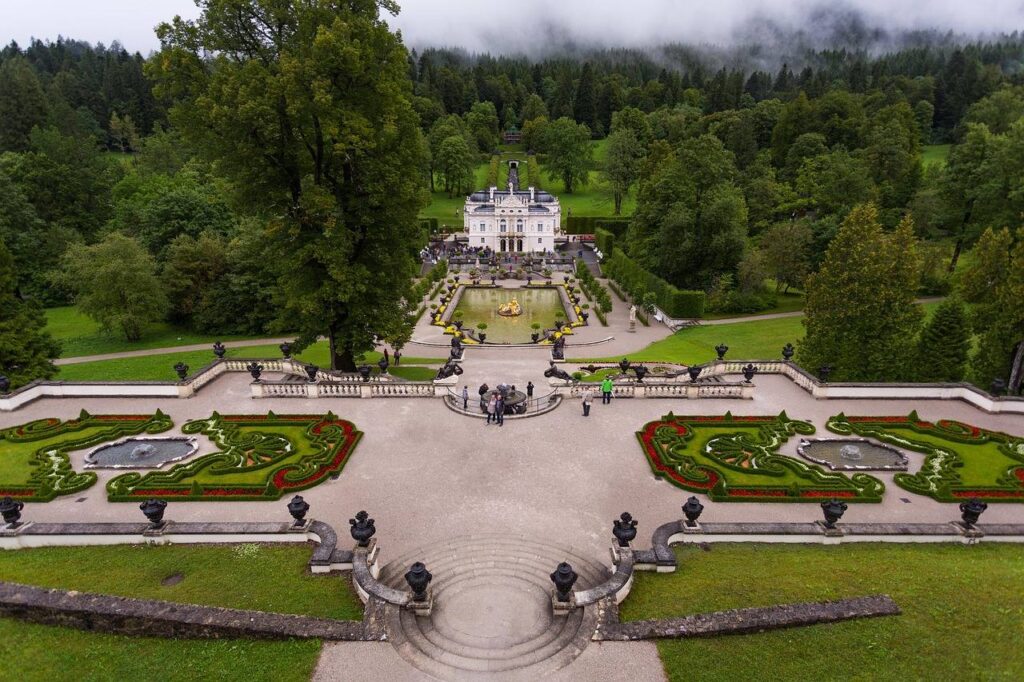
Linderhof is Ludwig’s smallest palace and the only one completed in his lifetime, set in a formal French-style park near Ettal, about 20 minutes from Oberammergau, and modeled in part on Versailles4. Like Neuschwanstein, it is a guided-tour-only visit, with tours running every 5 to 10 minutes and lasting about 25 minutes, in German and English5.
Palace admission is €11 regular, €10 reduced, and the palace is open daily except New Year’s Day, Shrove Tuesday and December 24, 25 and 31; summer hours (15 April–15 October) run 9 a.m. to 6 p.m., winter hours 10 a.m. to 4:30 p.m.2. The Venus Grotto, the artificial cave with the shell-shaped boat where Ludwig staged private performances of Wagner, is a summer-only add-on at €9 regular, or €18 for a combined palace-and-grotto ticket, reached by a steep path with up to a 20 percent gradient6. The Moorish Kiosk in the park is currently closed for restoration, with no reopening expected before 20286. Children under 18 and students with ID get in free everywhere on the grounds2.
Herrenchiemsee: the unfinished Versailles
On the island of Herreninsel in the Chiemsee, reached only by boat from the lakeside town of Prien, Herrenchiemsee was Ludwig’s attempt at his own Versailles, and he never finished it; large sections of the palace stop mid-construction, plaster walls where the marble was meant to go3. My Chiemsee and Herrenchiemsee guide covers the boat crossing.
The combination ticket covering the palace, the King Ludwig II Museum and the Augustinian Monastery Museum is €14 regular, €13 reduced; the palace’s special exhibition alone is €7, and each museum separately is €6, with students and under-18s free throughout3. Guided English tours of the New Palace run continuously through the day and last about 40 minutes, April through late October 9 a.m. to 6 p.m. and the rest of the year 10 a.m. to 4:45 p.m.3. Low water levels in the Chiemsee can close some of the boat landing stages in dry periods, so the palace administration itself recommends checking the ferry operator’s site before you travel7.
Schachen: the one almost nobody visits
Schachen is a wooden royal hunting lodge high above Garmisch-Partenkirchen in the Wetterstein range, and it is genuinely remote: there is no road to it, and reaching it means a serious mountain hike, which is most of why it stayed out of the standard three-castle tourist itinerary even after joining Neuschwanstein, Linderhof and Herrenchiemsee on the same UNESCO listing1. It is part of the inscription in name, not in daily visitor numbers.
Frequently Asked Questions
When did Neuschwanstein become a UNESCO World Heritage site?
On 12 July 2025, as part of a single listing covering four of Ludwig II’s properties: Neuschwanstein, Linderhof, Herrenchiemsee and Schachen.
Are Neuschwanstein and Linderhof both on the same UNESCO listing?
Yes. They were inscribed together with Herrenchiemsee and Schachen as one serial World Heritage property, “The Palaces of King Ludwig II of Bavaria,” not as separate sites.
Which of Ludwig's castles did he actually finish?
Only Linderhof, his smallest palace, was completed in his lifetime. Neuschwanstein and Herrenchiemsee were both left unfinished at his death.
How do you get to Herrenchiemsee?
By boat from the lakeside town of Prien to the island of Herreninsel; there is no road access.
What is Schachen and can you visit it?
A remote wooden hunting lodge in the mountains above Garmisch-Partenkirchen, part of the UNESCO listing but reachable only by a mountain hike, not by any standard tour route.
Is Germany's 55th UNESCO site the same as saying these are new discoveries?
No. The palaces have been open to visitors for decades; the 2025 inscription is UNESCO’s recognition of their heritage value, not a change to what you can see or how you book a ticket.
Do Neuschwanstein, Linderhof and Herrenchiemsee share the same ticket?
No single ticket covers all three, though each individually offers its own combination tickets with a nearby museum.
Related Articles
 Bavaria by Train: Day Trips from Munich and a Week Without a CarBavaria
 Neuschwanstein from Munich by Train, Step by StepBavaria
 Neuschwanstein Tickets: How the Timed Entry Works and the Booking Mistake to AvoidBavaria
 Chiemsee and Herrenchiemsee: The Lake, the Island and Ludwig’s VersaillesBavaria
 Romantic Road Itinerary: 2, 4 or 7 Days, With the Neuschwanstein Booking TrapBavaria
 Bavaria the Free State: The Lion, the Flag, the Seven Regions and What Freistaat MeansTrachten and customs
 Garmisch-Partenkirchen: The Partnach Gorge, the Ski Jump and the Zugspitze BaseBavaria
Sources
- Inscription of the Castles of King Ludwig II of Bavaria to the List of UNESCO World Heritage Sites — German Federal Foreign Office. Accessed 2026-09-27.
- Linderhof Palace: opening hours and prices — Schlosslinderhof.de, Bavarian Palace Department. Accessed 2026-09-27.
- Herrenchiemsee: admission — Herrenchiemsee.de, Bavarian Palace Department. Accessed 2026-09-27.
- Inscription of the Castles of King Ludwig II of Bavaria to the List of UNESCO World Heritage Sites — German Federal Foreign Office. Accessed 2026-09-27.
- Linderhof Palace: opening times — Schlosslinderhof.de, Bavarian Palace Department. Accessed 2026-09-27.
- Linderhof Palace — Schlosslinderhof.de, Bavarian Palace Department. Accessed 2026-09-27.
- Herrenchiemsee — Herrenchiemsee.de, Bavarian Palace Department. Accessed 2026-09-27.