In brief
Oktoberfest is safe in the ordinary sense that millions of people go every year and the festival runs its own medical, security and lost-and-found infrastructure to prove it: emergency medical stations run by Aicher Ambulanz, around 600 police officers, over 2,000 security staff and more than 50 cameras across the Theresienwiese. A dedicated Safe Space, staffed by three Munich associations since 2003, helps women who are harassed, separated from friends or in a crisis, and in 2025 it helped an average of about 22 people a night. Lost and found runs out of the Deutsches Museum Verkehrszentrum during the festival, and the single most common thing you will lose is not your phone, it is your spot in a toilet line you did not budget for.
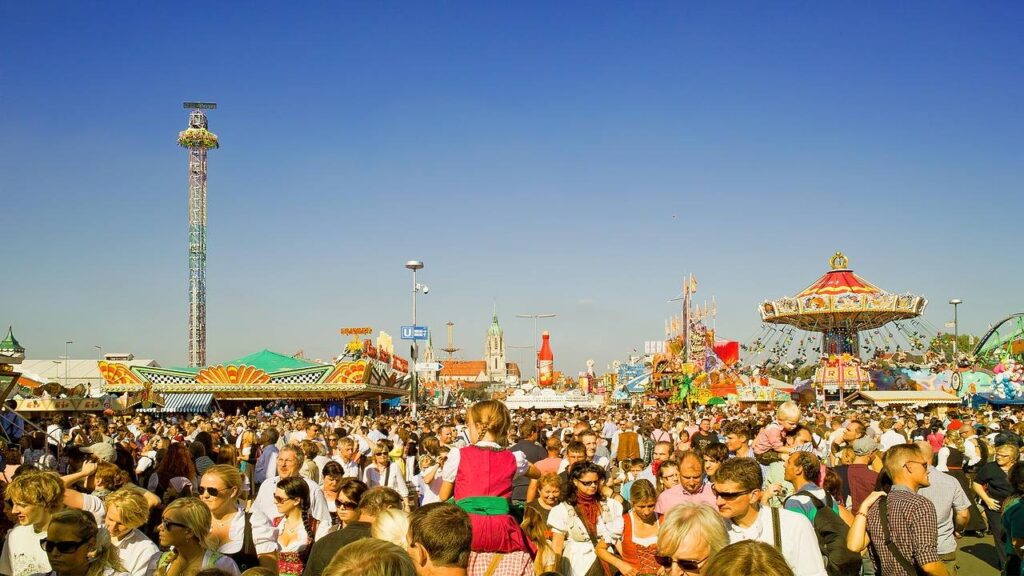
Oktoberfest is a beer festival that six million people attend over roughly two and a half weeks, and the question worth asking is not whether anything ever goes wrong, but what the festival actually has in place when it does. This page is part of my complete guide to Oktoberfest in Munich, and it covers the parts of the Wiesn nobody photographs: first aid, the women’s Safe Space, the bag rules, and the lost-and-found office that will eventually have your jacket.
First aid on the grounds
Medical care at Oktoberfest is provided by Aicher Ambulanz, which the festival’s own visitor FAQ describes as running emergency stations “at the Theresienwiese Service Center (entrance ‘First Aid’), at Esperantoplatz and at the northern end of Schaustellerstraße as well as at Street 6 of the Oidn Wiesn”1. Beyond first response, the Wiesn Outpatient Clinic functions as a small hospital with treatment rooms, operating theatres and CT scanning, and treated over 7,000 patients in the most recent full year reported, with a response target of under four minutes4. If you or someone near you needs help, one of those four stations is the destination, not a walk to a pharmacy outside the gates.
There is also a phone-based option: the “Safe Now” app lets any visitor summon help with a single button, located to within about a meter, and as of the 2026 festival it is in its fourth year and covers eight of the larger tents, addressing harassment, altercations and medical emergencies alike4.
The Safe Space, for women specifically
The Safe Space sits in the Service Center on the Theresienwiese, behind the Schottenhamel tent at the “First Aid” entrance, next to the police station, and it exists for any girl or woman who is disoriented, has lost her friends or keys, feels threatened, or is dealing with something worse, including physical or sexual violence3. It has run since 2003 as a joint effort of three Munich associations focused on prevention, victim support and education, and it keeps a phone line for the duration of the festival3. In 2025 it helped roughly 22 people a night on average, and the year before that, 354 people used it over the course of the festival, numbers the festival itself reads as the program becoming better known rather than the problem getting worse3.
Resi says If you get separated from your group at night in a tent of six thousand people, the Safe Space is not just for emergencies; the staff there will also help you find your way home, which is a more common problem than anything more serious.
Security, in numbers
The Theresienwiese is fenced, entrances are staffed by a security service working with the police, and the grounds are watched by “over 50 cameras”2. On the personnel side, the police maintain “around 600 officers on the Theresienwiese and in the surrounding area,” and beyond them, “over 2,000 security staff provide security on the festival grounds and in the tents”2. None of that will be visible from your bench, which is rather the point of most of it.
What you cannot bring in
Bags and rucksacks are capped at three liters and may not exceed 20 by 15 by 10 centimeters; backpacks and larger bags are generally not allowed at all5. Glass bottles are banned outright, along with anything that could be used as a weapon or any spray with harmful contents5. Strollers are banned all day on Saturdays and on October 3, and from 6 p.m. on every other festival day, though baby carriers are always allowed5. Bicycles, scooters and skateboards have to stay outside the entrance, and animals are not permitted at all, with the sole exception of assistance dogs5. Smoking is allowed in the open air and in beer gardens, but has been banned inside the tents themselves since 2010, with fines of up to €1,000 for lighting up anyway6.
The following table is the version you can screenshot before you leave the hotel.
| Item | Allowed? |
|---|---|
| Small bag, under 3 liters, under 20x15x10 cm | Yes |
| Backpack or large bag | No |
| Glass bottles | No |
| Stroller, Saturdays and Oct 3 | No, all day |
| Stroller, other days | No, from 6 p.m. |
| Baby carrier (“Kraxe”) | Yes, always |
| Bicycle, scooter, skateboard | No, left outside |
| Assistance dog | Yes; other animals no |
| Smoking, outdoors and beer gardens | Yes |
| Smoking, inside a tent | No, since 2010 |
Source: oktoberfest.de and euronews.com56.
The warning nobody puts on a sign
None of the festival’s own safety pages will tell you this one, because it is not a hazard, it is just arithmetic: a tent holds several thousand people drinking liter mugs of beer, and it does not hold several thousand toilets. What goes in must come out, and the line for the toilets only gets longer as the tent fills and the evening wears on. I have watched a great many visitors budget carefully for the beer and the tent and the train home, and not at all for the twenty minutes they will spend standing in that particular queue, or for a stomach that starts complaining on the walk back. Plan for it the way you plan for the beer itself, because it is exactly as predictable.
Lost and found
During the festival, the lost-and-found office runs out of the Deutsches Museum Verkehrszentrum at Am Bavariapark 5, open daily; items handed in on the grounds are not delivered to the office until the day after they were found, so the festival’s own advice is to wait a day or two before asking7. On October 5, the day after the festival closes, hours change and the office is reachable only through the pedestrian underpass from Theresienhöhe7. After that, unclaimed items move to the city’s own Fundbüro at Implerstraße 11 from November 27. If you lose something inside a tent or on a ride, the moral is patience, not panic: it is probably sitting in a box waiting for the next day’s delivery run, not gone.
For everything else about the day itself, my first-timers guide and the rules on bags and security cover the rest of what to expect before you go.
Frequently Asked Questions
Is Oktoberfest safe for tourists?
It runs its own medical stations, a dedicated women’s Safe Space, around 600 police officers and over 2,000 security staff, which is a level of infrastructure most festivals of its size do not have; the ordinary risks are the ones that come with crowds and beer, not the festival itself.
What should I do if I feel unsafe or get separated from my group?
Head to the Safe Space at the Service Center behind the Schottenhamel tent, or use the Safe Now app in the tents that support it; staff there help with harassment, disorientation and medical situations alike.
Where is the first aid station at Oktoberfest?
Aicher Ambulanz runs stations at the Theresienwiese Service Center, Esperantoplatz, the northern end of Schaustellerstraße, and Street 6 of the Oide Wiesn.
Can I bring a backpack to Oktoberfest?
No. Bags are capped at three liters and 20 by 15 by 10 centimeters, and backpacks and larger bags are generally not allowed.
Are glass bottles allowed at Oktoberfest?
No, glass bottles are banned on the grounds entirely.
Where is the Oktoberfest lost and found?
At the Deutsches Museum Verkehrszentrum, Am Bavariapark 5, during the festival; unclaimed items move to the city’s Fundbüro at Implerstraße 11 starting November 2.
Can I bring a stroller to Oktoberfest?
Not on Saturdays or October 3, and not after 6 p.m. on other days; baby carriers are always allowed.
Can you smoke inside an Oktoberfest tent?
No, smoking inside the tents has been banned since 2010, with fines up to €1,000.
Related Articles
 Oktoberfest in Munich: Dates, Tents, Reservations, What to Wear and What It CostsOktoberfest
 Oktoberfest Rules: Bag Sizes, What Is Banned and How Security WorksOktoberfest
 Oktoberfest for First-Timers: What Nobody Tells YouOktoberfest
 Oktoberfest Without a Reservation: How the Unreserved Seats Work and When to Show UpOktoberfest
 Getting to Oktoberfest: U-Bahn, S-Bahn, Walking and Why Not to DriveOktoberfest
 Oktoberfest with Kids: Family Days, Tent Curfews and the RidesOktoberfest
 Where to Stay for Oktoberfest: Hotels Within Walking Distance of the WiesnOktoberfest
 Prost, Ein Prosit and How to Hold a MaßOktoberfest
Sources
- FAQs for Wiesn visitors — oktoberfest.de, City of Munich. Accessed 2026-09-26.
- Security at Oktoberfest: What can I bring with me? — oktoberfest.de, City of Munich. Accessed 2026-09-26.
- Safe Space at the Oktoberfest: Help for girls and women — oktoberfest.de, City of Munich. Accessed 2026-09-26.
- Bag checks and safe spaces: how Munich aims to make Oktoberfest safer — The Local Germany. Accessed 2026-09-24.
- 10 Golden Rules for Oktoberfest — oktoberfest.de, City of Munich. Accessed 2026-09-24.
- Oktoberfest 2026: all the rules visitors need to know — Euronews. Accessed 2026-09-24.
- All information about the Oktoberfest Fundbüro — oktoberfest.de, City of Munich. Accessed 2026-09-24.