In brief
Berchtesgaden holds three separate reasons for a day, and you can fit all three without a car. An electric boat crosses the Königssee to St. Bartholomä in about 35 minutes, and the boatman stops mid-lake to play a trumpet into the cliffs for the echo. Round-trip tickets run €23.40 for St. Bartholomä and €29.80 for the longer run to Salet, at the end of the lake. The Salzbergwerk, Europe’s oldest still-working salt mine, has been in production since 1517 and sends visitors down a mine train and two wooden slides for a look at the underground workings. Above it all sits the Obersalzberg Documentation Center, the museum built around the mountainside the Nazi leadership made its second seat of power, open daily from 9 a.m. to 5 p.m.
Disclosure: some links on this page are affiliate links, marked by the products and tours they name. A purchase through these links may earn the site a commission at no cost to you, and it never affects what is recommended. How this works.
Berchtesgaden gets folded into a single “Eagle’s Nest day trip” more often than it deserves to be, and the town has enough on its own to fill a day without going anywhere near the Kehlstein road. This is the boat-and-mine version: the Königssee, the salt mine, and the Obersalzberg, which is a heavier stop than the other two and worth going into with the right expectations. If you also want the Eagle’s Nest itself, that route gets its own page; this one is part of the same longer plan in Bavaria by train.
The Königssee, and the trumpet
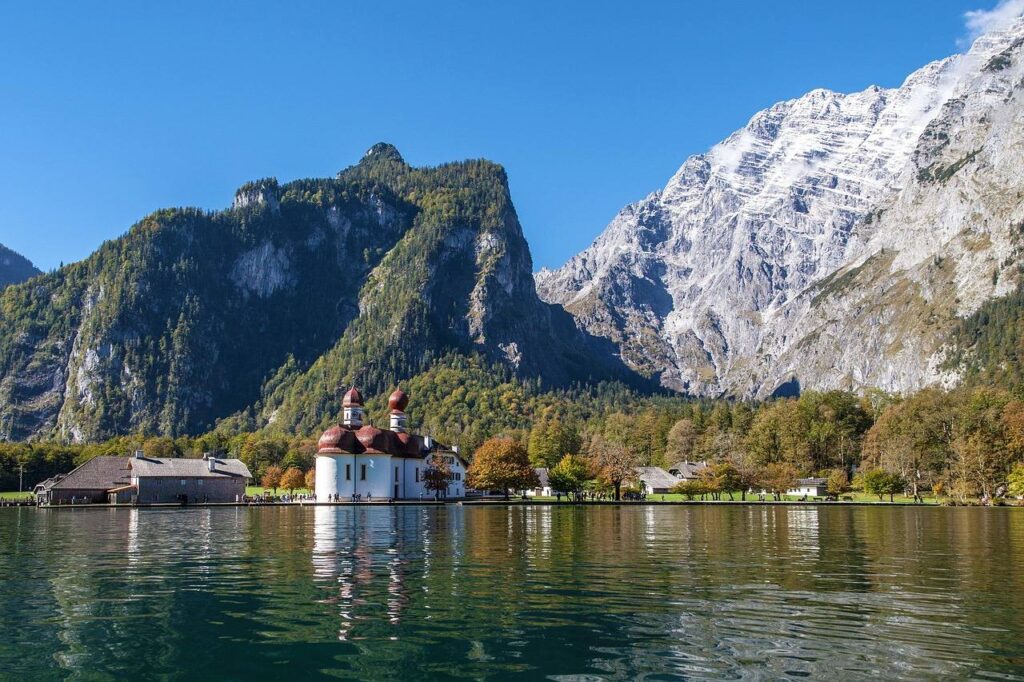
The Königssee is a fjord-narrow alpine lake south of the town, and the way most people see it is aboard one of the electric boats run by Bayerische Seenschifffahrt, which keeps the water free of engine noise on purpose1. Partway across, the boatman stops the boat, takes out a trumpet, and plays a note into the cliff face to draw out the echo, which the operator’s own site calls luring it “out of the steep rock face”1. It is a small ceremony that has been repeated on every crossing long enough to be a fixture rather than a gimmick.
The standard run goes to St. Bartholomä, the red-domed pilgrimage church on the lakeshore, in about 35 minutes each way; a former royal hunting lodge nearby serves food outdoors1. A longer route continues to Salet at the far end of the lake, about an hour each way, and only runs from the end of April to mid-October1. St. Bartholomä’s boat service runs year-round1.
| Route (round trip, adult) | Price |
|---|---|
| Seelände to St. Bartholomä | €23.40 (one-way €11.70) |
| Seelände to Salet | €29.80 (one-way €14.90) |
| Seelände to Kessel | €9.00 (one-way only) |
Source: seenschifffahrt.de, prices include 7% VAT2.
The operator’s price list is the place to check the child fares before you budget for a family; they change with the season and I would rather you read today’s number than my copy of it.
Resi says The trumpet is a five-minute stop in a much longer boat ride, and people who go expecting a concert are always a little disappointed. Go for the ride itself: a narrow alpine lake this color, with cliffs this close on both sides, does not need the horn section to be worth the fare.
The Salzbergwerk: a mine, not a museum about a mine
Berchtesgaden’s Salzbergwerk is Europe’s oldest salt mine still in production, with mining here going back to 15173. Visitors do not walk a roped-off path; they ride a mine train roughly 650 meters into the mountain, then slide down two wooden slides, one up to 40 meters long, to reach the lower galleries, finishing at a lit underground lake the operator calls the “Magic Salt Room”3. Free audio guides come in 17 languages, the mine keeps a steady 12°C year-round regardless of the weather outside, and it is open daily from 9 a.m. to 5 p.m.3. I did not find a specific 2026 ticket price on the page I fetched, so I am not putting a euro figure here; confirm current pricing before you go.
The Obersalzberg: the sober stop
Above the town, the Obersalzberg was the Nazi leadership’s second seat of power, and the Documentation Center built into the hillside is the museum that explains what stood there, under the exhibition title “Idyll and Atrocity,” with access to the surviving bunker complex beneath the site; it is open daily from 9 a.m. to 5 p.m., with last entrance at 4 p.m.4. It is not a detour from the day, or scenery with a plaque attached. Treat it as the reason Berchtesgaden is a heavier day than the lake and the mine alone would make it, and give it the time it needs rather than squeezing it between a boat crossing and a train home.
Getting there, and the season to watch
Berchtesgaden sits on Bavaria’s regional rail network, and the Bayern-Ticket covers regional trains and nearly all local bus lines across the state on one ticket, starting at €34 for a single traveler in second class5. I have not personally timed the ride from Munich, so I am not putting a specific duration on it here; check a live timetable before you fix your schedule around it.
Treat any high-Alpine or lakeside stop in this region as shoulder-season-fragile. The Salet boat run only operates end of April to mid-October, and low water can close some landing stages at nearby lakes in a dry summer, so confirm the day’s operating status directly with the operator if you are traveling outside the main season1.
If you would rather have it organized for you
The tour I would look at is From Munich Königssee Boat Ride and Berchtesgaden Salt Mine, a ten-hour trip rated 4.4 stars from 46 reviews and priced from $144 as of the date checked, which covers both stops in this article in a single day with Munich pickup included6. It is the more expensive of the two structures — a train day costs less out of pocket — but it removes the timetable math entirely, which matters if the mine and the boat are the only two things you actually came to Berchtesgaden for.
Frequently Asked Questions
How long is the Königssee boat trip?
About 35 minutes each way to St. Bartholomä, or about an hour each way to Salet at the far end of the lake, which only runs end of April to mid-October.
Why does the boatman play a trumpet on the Königssee?
To demonstrate the lake’s echo off the surrounding cliffs, a tradition on the electric boat crossings that the operator itself promotes as part of the trip.
Is the Berchtesgaden salt mine worth it?
It puts you on a mine train and two slides underground rather than behind glass, and it has been in continuous production since 1517, which is a different experience than a standard museum stop.
What is the Obersalzberg Documentation Center?
The museum covering the Nazi leadership’s use of the Obersalzberg mountainside as a second seat of power, including access to the surviving bunker complex, separate from and below the Eagle’s Nest itself.
Can I do the Königssee, the salt mine and the Obersalzberg in one day?
Yes, but it is a full day, and the Obersalzberg deserves real time rather than a rushed half hour between the other two.
Is the Königssee boat electric?
Yes. Bayerische Seenschifffahrt runs electric boats on the lake specifically to keep it free of engine noise.
Do I need a car for Berchtesgaden?
No. The town is on the regional rail network, covered by the Bayern-Ticket, and the lake, mine and Obersalzberg are all reachable from the town center without one.
Related Articles
 Bavaria by Train: Day Trips from Munich and a Week Without a CarBavaria
 Eagle’s Nest Without a Tour: Train, Bus 838 and the Brass ElevatorBavaria
 The Bayern-Ticket: One Day of Regional Trains for a Group, ExplainedBavaria
 One Week in Bavaria by TrainBavaria
 Is Salzburg Worth a Day Trip from Munich? Train Times and What FitsBavaria
 Bavaria in Winter: What Is Open, What Is Closed, What Is Worth the ColdBavaria
 The Best Time to Visit Bavaria, Month by Month, from the Climate RecordsBavaria
Sources
- Königssee — Bayerische Seenschifffahrt. Accessed 2026-09-27.
- Königssee: tickets and prices — Bayerische Seenschifffahrt. Accessed 2026-09-27.
- Salzbergwerk Berchtesgaden — Salzbergwerk. Accessed 2026-09-27.
- Obersalzberg Documentation Center — obersalzberg.de. Accessed 2026-09-27.
- Bayern-Ticket — Deutsche Bahn. Accessed 2026-09-27.
- From Munich Königssee Boat Ride and Berchtesgaden Salt Mine — Viator, product d487-2850P1. Accessed 2026-09-27.