In brief
Munich and Berlin are not a quick hop apart: the fastest train between them takes 4 hours and 2 minutes, with around 36 direct connections a day, so seeing both on a short trip means picking a base and committing to it. Berlin is the federal capital, built around the Brandenburg Gate, the Fernsehturm, Museum Island and the roughly 170 museums scattered across the city, plus the East Side Gallery. Munich is Bavaria’s capital and your door to the Alps, with the Pinakotheken art museums charging just €1 on Sundays and the Dachau memorial site a short S-Bahn ride away. Berlin’s own airport, BER, sits about 20 minutes from downtown by S-Bahn, or by the new direct Airport Express from December 2025. If you have one trip and one week, the city that matches what you want to do there beats the one with the more famous skyline.
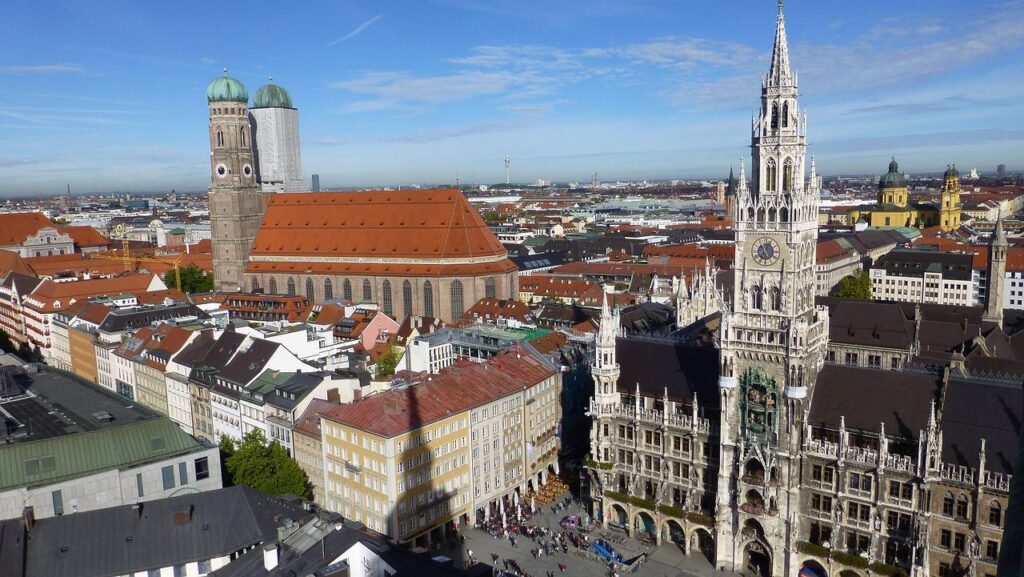
If you have narrowed a first trip to Germany down to these two and cannot decide, you are not choosing between a “real” German city and a touristy one; you are choosing between two different countries wearing the same passport. This page is part of my complete first-trip guide to Munich, and it exists because the question keeps arriving in my inbox in exactly this shape: one week, one flight, Munich or Berlin, which one.
Start with the number that settles most of the argument by itself. These two cities are not a day-trip apart, and treating them as a single base with a side excursion to the other is a mistake most first-timers make once.
The train between them
The fastest connection from Munich to Berlin runs 4 hours and 2 minutes, and there are roughly 36 such direct trains a day, so this is a full travel day either way, not an afternoon detour1. That number comes from Deutsche Bahn’s own booking page for the route, not an estimate. Budget it as a travel day with a book and a window seat, not as something you squeeze between breakfast and a museum.
Because of that, most first-timers should pick one city as a base for most of the trip and treat the other, if there is time, as its own separate two or three days at the end or the start, connected by that one long train ride rather than a string of day trips.
What each city actually hands you
Berlin’s own tourism board frames its case around six things: the Brandenburg Gate and its Quadriga, the Fernsehturm television tower, Museum Island as part of a city with around 170 museums total, Charlottenburg Palace, the East Side Gallery, and the Berliner Dom2. That is a capital built for people who want twentieth-century history walked through in person, plus a museum density most cities cannot match.
Munich’s case is different, and it is not really about the city at all. Munich is what you dial in when the Alps, not the Reichstag, are the point: Neuschwanstein, the Zugspitze and Salzburg are all a single train ride from Munich Hauptbahnhof, none of them within reach of Berlin at all. Inside the city itself, the Pinakotheken art museums drop to €1 admission every Sunday, and the Dachau memorial site, a serious half-day on anyone’s itinerary, is free entry and a short S-Bahn and bus ride from the center34. My Munich or Salzburg page and my Bavaria vs Austria page both start from that same fact: Munich is a hub, and Berlin, for better history and worse geography, is not.
Resi says I am a Nordlicht, a Northern Light in Bavarian eyes, and I lived in Munich for many years, so weigh my bias accordingly. If you have one photograph to bring home and one story to tell, Munich and the Alps behind it wins. If you want to understand the country you are actually visiting, Berlin will teach you more in three days than Munich will in three years.
Getting in from the airport
This is the one category where Berlin has a real, measurable edge. BER, Berlin’s airport, is about 20 minutes from the city center on the S9 or S45 S-Bahn lines, which run every 20 minutes; from mid-December 2025, a direct Airport Express train runs every 15 minutes and covers the same trip in “just over 20 minutes.” A single ticket covering the airport zone costs €3.60, and the Berlin Welcome Card, which bundles transit with attraction discounts, starts at €295. That is a genuinely convenient airport, closer to downtown than most European capitals manage, and if a short, cheap connection from your gate to your first coffee matters to your trip, it is a point in Berlin’s favor. My arriving in Munich page covers the Munich equivalent, and it is a longer ride.
Sundays and the ordinary stuff
Munich shuts down hard on Sundays: every shop closes except petrol stations, and bakeries alone are allowed to open, and only from 7 a.m. to noon6. That single rule catches more first-time visitors off guard than any museum closure, and it applies whether you planned around it or not. I could not confirm Berlin’s exact Sunday carve-outs on an official page this session, so I am leaving that comparison out rather than guessing; the national principle behind it, the Ladenschlussgesetz, applies in both cities, and neither is a place to plan a Sunday grocery run.
If Munich is your base: where to stay
Assuming Munich wins your week, stay near the Altstadt if this is your only visit: it is the historic center itself, rebuilt street by street after roughly 90 percent of it was destroyed in the war, and everything from the Frauenkirche to the Viktualienmarkt is a walk away7. If you would rather be near the trains for day trips to Salzburg or the Alps, the Hauptbahnhof district, officially Ludwigsvorstadt, is where every S-Bahn trunk line and four U-Bahn lines converge, immediately west of the old town8. My neighborhoods guide goes through the rest of the map area by area, and if your dates land on Oktoberfest, my hotels near Theresienwiese page is the one to open instead of this one. No hotel names here; the areas are the recommendation, and the Oktoberfest guide has the rest of what that particular week does to Munich’s hotel prices.
Frequently Asked Questions
Is Munich or Berlin better for a first trip to Germany?
It depends what you came for. Berlin gives you more history and museums packed into one city; Munich gives you the Alps, Salzburg and Bavaria’s castles within a single train ride, plus a smaller, easier-to-walk center.
How long does the train from Munich to Berlin take?
4 hours and 2 minutes on the fastest direct connection, with about 36 trains running the route each day.
Can I do both Munich and Berlin in one week?
You can, but budget a full travel day for the train between them and plan on roughly three days in each rather than trying to day-trip from one to the other.
Which city has the better airport connection?
Berlin’s. BER sits about 20 minutes from the center by S-Bahn or the direct Airport Express, noticeably closer than Munich’s airport.
Is Munich more expensive than Berlin?
No figure on either city’s overall cost was confirmed on an official page for this comparison, so that claim is left out rather than guessed at.
What is closed in Munich on Sundays?
Everything except petrol stations; bakeries alone may open, and only from 7 a.m. to noon.
Do I need a car for either city?
No. Both are built around transit and walking; a car is a liability in either downtown.
Which city is better for a family with kids?
That depends on ages and interests more than the city itself; my Munich with kids page covers the Munich side of that question in detail.
Related Articles
 Munich for a First Trip: What Is Worth It, What Is Not, and How the City WorksMunich
 Munich or Salzburg? Which City to Base In, and How to Do BothMunich
 Arriving in Munich: Airport to City by S-Bahn, Bus and Taxi, and the Train StationMunich
 Where to Stay in Munich, by What You Are There ForMunich
 Where to Stay for Oktoberfest: Hotels Within Walking Distance of the WiesnOktoberfest
 Bavaria or Austria for a First Alpine Trip?Bavaria
 Oktoberfest in Munich: Dates, Tents, Reservations, What to Wear and What It CostsOktoberfest
 Munich with Kids: The Zoo, the Deutsches Museum, the Beer Gardens with PlaygroundsMunich
Sources
- Munich to Berlin train connections — Deutsche Bahn. Accessed 2026-09-27.
- visitBerlin homepage — visitBerlin. Accessed 2026-09-27.
- Pinakothek visitor information — Pinakothek, Bavarian State Painting Collections. Accessed 2026-09-27.
- Dachau Memorial Site opening hours — KZ-Gedenkstätte Dachau. Accessed 2026-09-24.
- BER Berlin Brandenburg Airport — visitBerlin. Accessed 2026-09-27.
- Shopping information: Munich, VAT, opening hours and more — muenchen.de, City of Munich. Accessed 2026-09-27.
- Altstadt district guide — muenchen.de, City of Munich. Accessed 2026-09-24.
- Ludwigsvorstadt district guide — muenchen.de, City of Munich. Accessed 2026-09-27.