In brief
The Romantic Road is Germany’s oldest signposted holiday route, 460 km through 29 towns from Würzburg in the north to Füssen in the south, laid out in 1950. A two-day trip means picking one anchor town and one castle; four days adds the walled towns in between; seven lets you slow down and actually walk them. The route strings together Rothenburg ob der Tauber, Dinkelsbühl and Nördlingen, three medieval towns each built around their own city walls, before ending at Neuschwanstein, where a guided-tour-only ticket system catches travelers who assume they can just show up. Base yourself in the old-town center of whichever town you sleep in; every one of them is compact enough that the walls themselves are your walking radius.
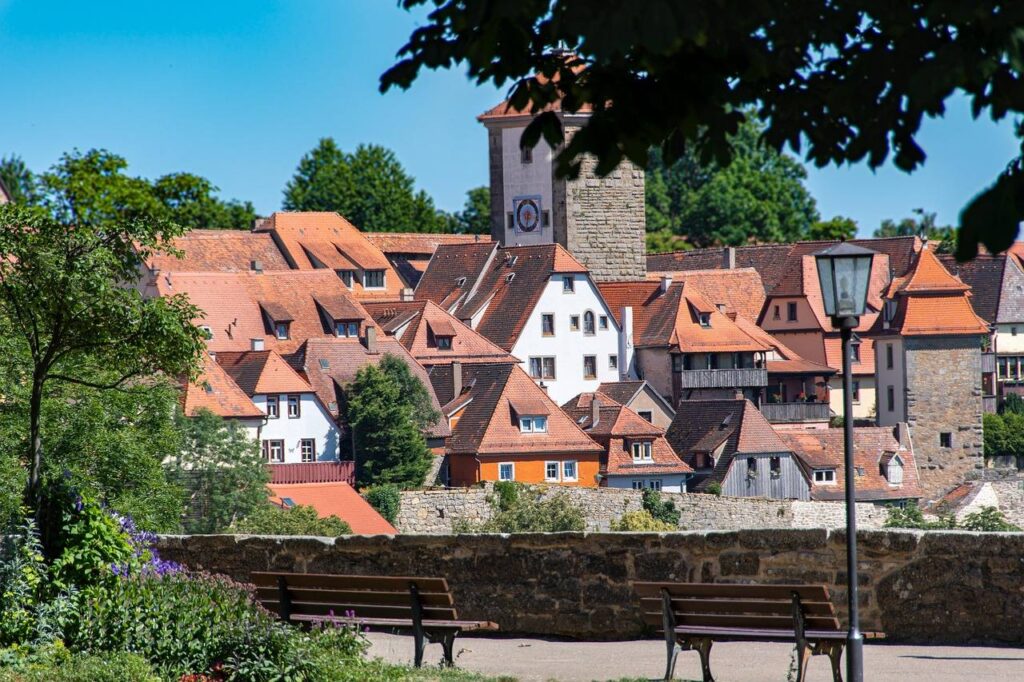
The Romantic Road is not a road in the sense of a single highway, and it is not romantic in the sense of a couples’ getaway; it is a signposted trail through the part of Germany that survived the twentieth century looking like the nineteenth, strung from Würzburg to the foot of the Alps. It is part of my guide to Bavaria by train, and whichever version of it you attempt, the same trap waits at the end: Neuschwanstein’s tickets do not work the way most castle tickets do, and this page tells you where that trap sits in each itinerary before you book anything else.
The route itself
Established in 1950, the Romantic Road runs 460 km through 29 towns between Würzburg and Füssen, and the tourism association’s own coach service, the Romantic Road Coach, still runs the route end to end, alongside standard regional trains between the towns1. You do not need a car to see most of it; you need a plan for which towns get a night and which get an afternoon.
Two days: one anchor town, one castle
If you have a weekend, pick Rothenburg ob der Tauber as your base and Neuschwanstein as your day trip, and accept you are seeing a fraction of the route rather than all of it.
Day 1: Rothenburg. The best-preserved of the Romantic Road towns, fully walled, with the Plönlein corner and a walkable town wall among its landmarks3. Walk the wall, then join the Night Watchman’s Tour on the Marktplatz in front of the town hall: about 60 minutes, €9 for the English-language tour (€8 for German), students half price, cash only, no booking required, running nightly at 8 p.m. in English from late March on4. My full Rothenburg guide has the rest of the town.
Day 2: Neuschwanstein. This is the day the itinerary can fall apart. Neuschwanstein is a fixed-time guided tour only, and the same-day allotment at the ticket center is thin; my ticket breakdown walks through the prices and the booking window, and the mistake to avoid is assuming you can buy at the door the way you would at most castles.
Resi says Book your Neuschwanstein slot before you book anything else on a two-day trip. Everything else on the Romantic Road can be improvised; the castle cannot, and if you lose that slot, your second day has nothing to replace it with.
Four days: the walled towns, one after another
Add Dinkelsbühl and Nördlingen and the trip stops being a highlight reel and starts being an actual route.
Day 1: Würzburg. Start at the Romantic Road’s northern end at the Würzburg Residenz, a Baroque palace inscribed as a UNESCO World Heritage Site in 1981, built almost entirely within one generation by the architect Balthasar Neumann and topped with a ceiling fresco by Giovanni Battista Tiepolo, his largest anywhere5. Admission is €10 regular, €9 reduced, with the Court Garden and Court Church free and open until dusk; the palace itself runs 9 a.m. to 6 p.m. April through October6. My Würzburg guide covers the town’s wine country beyond the palace.
Day 2: Dinkelsbühl. A complete medieval wall with 16 towers, bastions and four gates surrounds the town, along with the late-Gothic Minster of St George7.
Day 3: Nördlingen. The strangest stop on the route: the town sits inside the Nördlinger Ries, a crater left by a meteorite strike roughly 15 million years ago, now a UNESCO Global Geopark7. Its own town wall walkway is fully preserved, 2.6 km around with five gates and 11 towers, and St. George’s Church has a 90-meter bell tower with a viewing platform over the crater rim7.
Day 4: Rothenburg, then Neuschwanstein as a fifth day if you have it, or stop at Rothenburg and treat the castle as a future trip. Four days covers the walled towns properly; the castle is its own commitment.
Seven days: everything, at a walking pace
A full week lets you add Würzburg’s Franconian wine country on either end and gives every walled town a real morning rather than a rushed afternoon, plus a buffer day for the weather-dependent parts of the trip: the Zugspitze and the shuttle bus up to Neuschwanstein itself both run on conditions, not just a clock, and a week gives you a day to spare if either closes for weather. It also leaves room to end in Garmisch-Partenkirchen rather than doubling back to Munich the same day you see the castle.
| Itinerary | Towns | What you skip |
|---|---|---|
| 2 days | Rothenburg, Neuschwanstein | Dinkelsbühl, Nördlingen, Würzburg |
| 4 days | Würzburg, Dinkelsbühl, Nördlingen, Rothenburg | A relaxed pace, the castle itself |
| 7 days | All of the above, plus Neuschwanstein, buffer days | Nothing, but you need the week |
Source: romantischestrasse.de, this page17.
Where to stay: the old town, every time
None of these towns needs a neighborhood decision the way a city does. Rothenburg, Dinkelsbühl and Nördlingen were all built as walled towns and largely still are, which means the historic center, inside the walls, is where the sights, the restaurants and the train or bus connection all sit within the same small radius37. A room inside or immediately against the wall puts the Night Watchman’s Tour, the town gates and the morning bakery within a few minutes on foot, rather than a taxi ride from a hotel strip outside town.
Resi says I would not choose a hotel outside any of these walls to save a few euros. The entire appeal of a walled medieval town is that you can walk everywhere before your coffee gets cold, and staying outside it trades that away for a savings that rarely amounts to much once you have paid for a taxi back after dinner.
Frequently Asked Questions
How many days do you need for the Romantic Road?
As little as two if you pick one town and Neuschwanstein, four for the main walled towns at a real pace, or seven to add Würzburg’s wine country and buffer days for weather-dependent stops.
Do you need a car for the Romantic Road?
No. Regional trains and the Romantic Road Coach connect the towns; a car adds flexibility but is not required.
What is the booking trap on this itinerary?
Assuming you can buy a Neuschwanstein ticket at the door. Entry is timed-entry guided tours only, and the same-day allotment is limited; book online before the rest of the trip.
Which Romantic Road town is the most walkable?
Rothenburg ob der Tauber and Dinkelsbühl are both fully walled with compact historic centers built for walking, not driving.
Where does the Romantic Road start and end?
Würzburg in the north and Füssen, at the foot of the Alps near Neuschwanstein, in the south, a distance of 460 km.
Is Nördlingen worth adding to a short itinerary?
If you have four days or more; its meteor-crater setting and intact town wall are distinct enough from Rothenburg and Dinkelsbühl to earn their own stop.
Can you see the Romantic Road and Neuschwanstein in the same two-day trip?
Yes, if you treat one as an anchor town and the other as a single day trip, but book the castle ticket first since it is the least flexible part of the plan.
Related Articles
 Bavaria by Train: Day Trips from Munich and a Week Without a CarBavaria
 Rothenburg ob der Tauber from Munich: The Night Watchman, the Walls and the TrainBavaria
 Neuschwanstein Tickets: How the Timed Entry Works and the Booking Mistake to AvoidBavaria
 Neuschwanstein from Munich by Train, Step by StepBavaria
 Würzburg: The Residenz and Franconia’s WineBavaria
 One Week in Bavaria by TrainBavaria
 How Many Days Do You Need in Bavaria?Bavaria
 Garmisch-Partenkirchen: The Partnach Gorge, the Ski Jump and the Zugspitze BaseBavaria
Sources
- The Romantic Road — Romantische Straße Tourismusverband. Accessed 2026-09-27.
- Visitor information — Hohenschwangau.de, Bavarian Palace Department. Accessed 2026-09-27.
- Rothenburg ob der Tauber — Rothenburg Tourismus Service. Accessed 2026-09-27.
- Night Watchman’s Tour — Rothenburg.de, City of Rothenburg ob der Tauber. Accessed 2026-09-27.
- The Würzburg Residenz — Residenz-Wuerzburg.de, Bavarian Palace Department. Accessed 2026-09-27.
- Würzburg Residenz: opening times and prices — Residenz-Wuerzburg.de, Bavarian Palace Department. Accessed 2026-09-27.
- Highlights of the Romantic Road — Romantische Straße Tourismusverband. Accessed 2026-09-27.