In brief
The flag most parties reach for is the wrong one: Germany’s black-red-gold tricolor has nothing to do with Bavaria, while the actual Bavarian state flag comes in two official versions, a plain white-over-blue striped flag and a white-and-blue lozenge pattern of at least 21 diamonds, both defined by Bavaria’s own Interior Ministry. Blue and white is the color rule that matters more than any single flag design. Even inside the festival, decoration is more restrained than the party-store version suggests; Munich’s own description of the Hacker-Festzelt tent calls it a place to “celebrate under the white and blue sky of the Bavarians,” a painted ceiling rather than a wall of branded banners. Most bunting and pennant sets sold for Oktoberfest parties in the US carry the two colors correctly, even when their prices could not be confirmed on a fetched page here.
Disclosure: some links on this page are affiliate links, marked by the products and tours they name. As an Amazon Associate, bavarianbistro.com earns from qualifying purchases. A purchase through these links may earn the site a commission at no cost to you, and it never affects what is recommended. How this works.
Walk into most Oktoberfest party sections in September and the shelves are one country over: red-and-yellow German flags, “Prost!” banners in Bud-Light-Oktoberfest orange, and plastic lederhosen printed on a tablecloth. None of that is wrong exactly, but none of it is what Bavaria itself flies either, and getting the colors right is the cheapest way to make a backyard party look considered rather than grabbed off an end cap. This page is one piece of the full Oktoberfest party plan.
The flag question: lozenge, stripes, or neither
Bavaria’s Interior Ministry describes two official state flags, and neither one is the German national tricolor. The striped flag is two equal horizontal bands, white on top and blue on the bottom. The lozenge flag, the one most people picture when they think “Bavarian flag,” contains at least 21 white and blue diamonds, counting any cut off by the edges, with the upper right corner always beginning on a cut white lozenge1.
Either version is correct for a party. What is not correct, though it shows up constantly in US party aisles, is Germany’s black-red-gold tricolor, which represents the whole country and has no more to do with Bavaria specifically than a US flag has to do with any one state.
This mix-up is not new, and it is not really your fault. The one thing most Americans and non-Germans get wrong about Germany, in my own experience, is confusing it wholesale with Bavaria: the Trachten outfits, the castles, even the cuckoo clock all get filed under “German” when they are specifically Bavarian, or in the cuckoo clock’s case, not even that. Cuckoo clocks are from the Black Forest, which is nowhere near Bavaria, so a decorator hanging one at a Bavarian-themed party has, in a sense, imported a prop from the wrong region entirely. Bavarians themselves are not shy about the distinction, or about thinking rather well of it.
Resi says If you can only buy one thing, buy it in the lozenge pattern. It reads as Bavarian at a glance in a way the plain stripes do not, and it is the version most bunting and banner sets already use. Skip the cuckoo clock centerpiece if you want to be strictly correct about it, though I will not tell anyone if you keep it for the charm.
The rule underneath all of it: blue and white
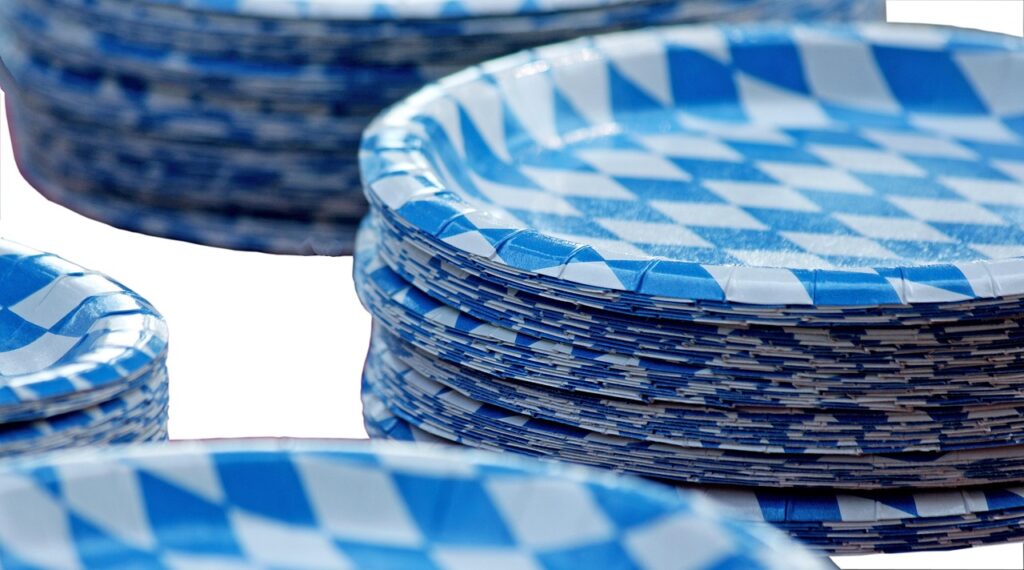
Strip away the specific flag pattern and what is left is the rule that actually does the work: blue and white, together, is the Bavarian color scheme, and it is the detail to check before you buy anything. A banner, a bunting set, a tablecloth or a balloon arrangement in blue and white will read as Bavarian even without a single lozenge printed on it; the same items in red, yellow and black, or in a beer brand’s own house colors, will not, no matter how many pretzels are printed on them.
What a real tent actually looks like
The party-store version of an Oktoberfest tent is a wall of hanging beer logos and string lights. The real thing, at least going by what Munich’s own tourism site says about its 17 large and 21 small tents, leans more on theme and craft than on branding: the Hacker-Festzelt is described as a place to “celebrate under the white and blue sky of the Bavarians,” a reference to a painted sky ceiling rather than a banner wall; the Marstall-Festzelt is called “family-friendly and cosy under the sign of horses”; and Café Theres is noted for its “idyllic murals,” each tent carrying its own specific theme rather than a generic beer-branded backdrop2.
That is the standard worth copying at home: pick one or two themes, blue-and-white bunting plus something specific like a wooden barrel, a string of pretzel cutouts, or a painted paper sky, rather than trying to reproduce a beer company’s trade-show booth in your backyard.
What to skip
Skip anything branded to a specific beer company’s US marketing campaign rather than to Bavaria itself; a banner that says a beer brand’s name in giant letters is an ad, not a decoration, and it will look exactly like what it is once your guests are looking at it for three hours instead of walking past it in a store. Skip the German tricolor bunting for the reason above.
Skip, too, the instinct to cover every surface. The actual tents this research could confirm details for lean on one theme each, a sky ceiling here, a horse motif there, a set of murals somewhere else, rather than stacking every available prop into one room. A backyard trying to do the sky ceiling, the horse motif and the murals all at once will look busier than any real tent does, not more authentic.
And skip buying a decoration item for a specific claimed price you saw online without checking it yourself; several of the pennant banners and fabric bunting sets commonly listed for Oktoberfest parties had prices that would not load on a second look in this research, so treat any price you see as a starting point to verify, not a number to repeat.
What is worth buying
A blue-and-white pennant banner or fabric bunting set covers the visual rule in one purchase and is the single highest-impact item for the least effort; string it along a fence line or over the food table rather than wall to wall. A beer-stein cutout or two, in the lozenge pattern rather than a beer logo, works well hung next to the bunting. For the table itself, a blue-and-white checked tablecloth does more than any single decoration to make a backyard look like it is hosting something specific rather than a generic cookout, and it is the one item worth spending slightly more on since it is also the one guests actually sit at for hours.
None of this needs to be expensive or elaborate. A single well-chosen color scheme, applied consistently across the banner, the tablecloth and one small themed touch, reads as considered in a way that a pile of unrelated party-store items never quite manages, no matter how much more of it there is.
Frequently Asked Questions
What is the Bavarian flag?
Bavaria has two official state flags: a plain striped flag, white over blue, and a lozenge (diamond) flag with at least 21 white and blue diamonds. Neither is the German national tricolor.
Is the German flag the same as the Bavarian flag?
No. Germany’s flag is a black-red-gold tricolor representing the whole country; Bavaria’s own flags are white and blue, either striped or in a lozenge pattern.
What colors should Oktoberfest party decorations be?
Blue and white. It is the one rule that reads as Bavarian even without a specific flag pattern.
What do real Oktoberfest tents look like inside?
Themed rather than generically beer-branded: Munich’s own tent descriptions mention a painted blue-and-white sky ceiling in one tent, a horse theme in another, and murals in a third, rather than a wall of beer-company signage.
Should I decorate with beer brand banners?
Skip them if they are a specific beer company’s marketing material rather than blue-and-white Bavarian decor. They read as an ad rather than a party theme.
How many Oktoberfest tents are there?
Munich’s festival runs 17 large tents and 21 small ones, each with its own theme.
Are cuckoo clocks Bavarian?
No. Cuckoo clocks come from the Black Forest, a different region of Germany, though they are commonly and mistakenly grouped with Bavarian traditions.
Related Articles
 Throw an Oktoberfest Party: The Plan, the Menu, the Beer, the Outfits and the GamesParty
 An Oktoberfest Party Menu for Twelve That One Person Can Actually CookParty
 The Oktoberfest Party Beer List: What US Stores Stock, and What to Pour It InParty
 Oktoberfest Party Drinks Beyond Beer: Radler, Spezi, Schnapps and the Kids’ TableParty
 What to Wear to Oktoberfest, and Whether You Have ToOktoberfest
 Oktoberfest Tents: All 14 Big Tents, the Small Ones and the Oide Wiesn, ComparedOktoberfest
Sources
- Bayerische Staatssymbole — Bavarian State Ministry of the Interior (Staatsministerium des Innern). Accessed 2026-09-26.
- Oktoberfest beer tents — muenchen.de. Accessed 2026-09-26.