In brief
The popular story says a Dirndl apron bow tied on the left means single, right means taken, front-center means a virgin (or, in a newer gloss, no information at all), and back means widowed or a waitress working. Munich’s own tourism office calls the whole thing “a rule of thumb, not a strict rule,” and says plainly that “there are no official regulations”. A Munich lifestyle outlet adds that the bow was traditionally tied front- or back-center, and that tying it to the side only became common in the 20th century. Bavaria’s own Trachtenverband, which documents the real details of traditional dress down to the Loferl and the headdress, has no page at all on the apron bow. Treat it as the story tourists are told, not a code you need to worry about getting wrong.
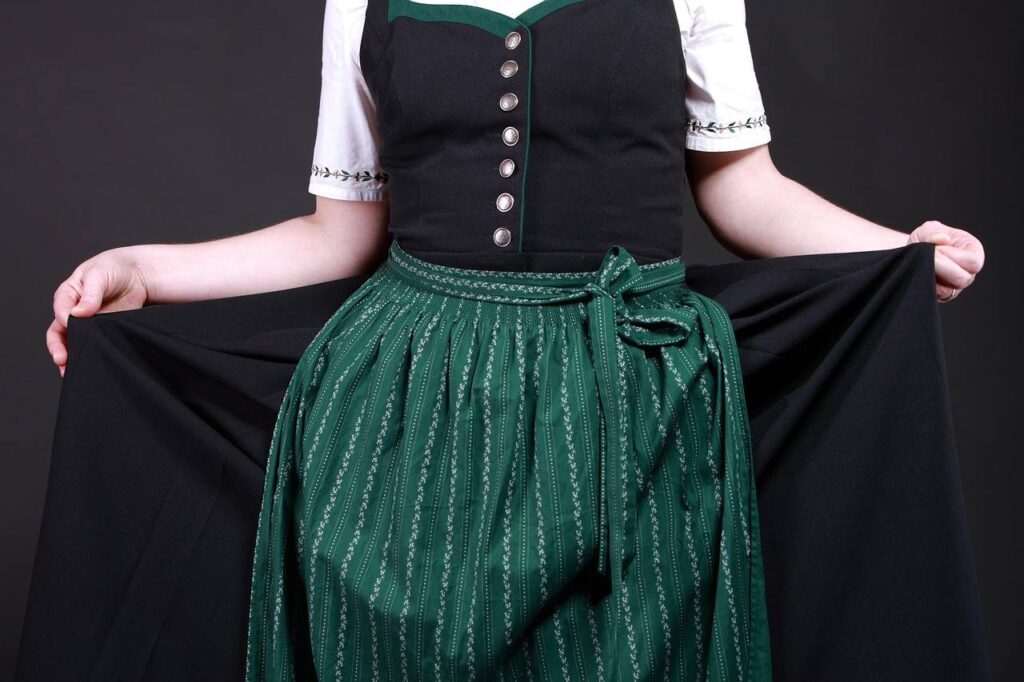
If you have been told that where you tie your apron bow announces your relationship status to an entire Biergarten table of strangers, and you would like to know whether that is real before you accidentally announce something untrue about yourself: it is mostly folklore, and Bavaria’s own institutions say so. This is the deep-dive version of the two paragraphs I give it on the Trachten and customs pillar, because the claim deserves more care than a quick dismissal or a confident retelling.
The claim, exactly as it is told
Here is the popular version, word for word as it circulates: tie the bow on your left if you are single, on your right if you are taken or married, at the front center if you are a virgin, or, in a softer modern gloss, if you would simply rather not say, and at the back if you are widowed or working as a waitress1. It is tidy, it is memorable, and it is exactly the kind of “fact” that spreads because it sounds like it must be true.
What Munich's own tourism office says about it
Munich’s own tourism copy, the closest thing to an official municipal voice on the subject, addresses the claim directly and does not endorse it: “This is a rule of thumb, not a strict rule. There are no official regulations”2. That is about as clear a disclaimer as a city website gets, and it is worth taking seriously precisely because muenchen.de has no reason to undersell a piece of local color if it could stand behind it.
What the history looks like when you go looking for it
A Munich lifestyle outlet that has looked into the custom more closely adds an important wrinkle: traditionally the bow was tied at the front or back center, and tying it to the side, the version the whole left-right story depends on, only became common in the 20th century. The outlet’s own conclusion is blunt: “not every explanation popular today can be documented as a centuries-old, uniform tradition”1.
That absence shows up again somewhere you would expect to find it if the custom were real and old. Bavaria’s Trachtenverband keeps a dedicated section on the care and research of traditional dress, and it is thorough: it covers the Loferl, the Rieglhaube headdress, suspenders, neckwear, lace and hat care in detail. It has no page on the apron bow at all3. An organization built to document exactly this kind of folk custom, in exhaustive detail, on everything else, staying silent on the one claim everyone repeats is itself a kind of evidence.
Resi says I have never once seen this checked in a beer tent, and I have spent a fair amount of time in them. Tie your bow wherever it looks best with the rest of the outfit. If someone tells you your knot has announced your marital status to the room, you now know more about the actual history of that claim than they do.
One bow rule that is actually useful
While Munich’s tourism office is busy disclaiming the meaning of the bow, it offers a piece of advice about the bow itself that has nothing to do with symbolism and everything to do with getting home at the end of the night: do not double-knot it2. A double knot looks the same as a single one from across the tent, but it is much harder to undo after several hours and several Maß, and you will be the one standing at the coat check fighting with your own apron while everyone else has already left.
Why the story is so sticky
None of this is a knock on anyone who has repeated the four-position version, myself included before I looked into it properly. A rule that is specific, easy to remember, and lets a stranger read your love life off your outfit is more fun to pass along than “nobody is quite sure, and the side-tying itself is fairly recent.” Tour guides, costume shops and well-meaning blog posts all have an incentive to keep the tidy version alive, and none of that makes it malicious. It just means the tidy version and the documented version are not the same thing, and it is worth knowing which one you are repeating.
So is it real, or is it not
Both, depending on which part you mean. The bow itself, and the general idea that its position carries some meaning, is a widely repeated modern custom. What does not hold up is the specific, tidy four-position code as an old, documented Bavarian tradition: no ethnographer, folklorist or dated historical source backs it, Munich’s own tourism office disclaims it outright, and the one regional authority that would document a real folk custom like this has nothing on file about it23. The honest way to describe it to a visitor is as the story tourists are told, sometimes with real Bavarians’ tongues at least a little in cheek, rather than a rule with any weight behind it.
If you are buying the apron anyway
Since the bow is not the detail worth losing sleep over, put that energy into the apron and the dress underneath it instead. Rare Dirndl, the Chicago studio that hand-makes and imports real ones, sells current styles for roughly $389 to $498 with free shipping over $2504. My full page on the Dirndl itself covers the fit, the fabric and the rest of what actually separates a real one from a costume.
Frequently Asked Questions
What does it mean if a dirndl bow is tied on the left?
In the popular story, left means single. There is no official or historically documented basis for this; Munich’s own tourism office calls it a rule of thumb rather than a real rule.
What does it mean if the bow is tied on the right?
The popular story says right means taken or married, again without documented historical backing.
What does a bow tied in the front center mean?
The traditional telling says virgin; a newer, softer version says it simply gives no information. Neither is an official or historically confirmed rule.
What does a bow tied at the back mean?
Popularly, widowed, or a waitress at work. Like the other three positions, it is folklore rather than a documented custom.
Is the dirndl bow rule actually true?
Munich’s own tourism office says no: it calls the left-right-center-back convention a rule of thumb with no official regulations behind it.
Where did the bow rule come from?
Nobody can trace it to a historian, folklorist or old written source. A Munich outlet notes that side-tying itself only became common in the 20th century, and Bavaria’s own Trachtenverband has no page documenting the claim at all.
Do I need to worry about how I tie my dirndl bow?
No. Tie it wherever it sits best with your outfit. It is a fun piece of trivia to know, not a rule anyone is checking.
Related Articles
 Dirndl, Lederhosen and the Bavarian Year: Trachten and Customs ExplainedTrachten and customs
 The Dirndl Explained: Blouse, Bodice, Skirt, Apron and How It Should FitTrachten and customs
 Where to Buy a Real Dirndl in the US and Canada, and What Real MeansTrachten and customs
 Renting a Dirndl or Lederhosen in Munich: Shops, Prices, FitTrachten and customs
 What to Wear to Oktoberfest, and Whether You Have ToOktoberfest
 Oktoberfest in Munich: Dates, Tents, Reservations, What to Wear and What It CostsOktoberfest
Sources
- Dirndl-Schleife: Was die Schleife bedeutet — In München. Accessed 2026-09-24.
- Oktoberfest Outfits: Dirndl and Lederhosen — muenchen.de. Accessed 2026-09-24.
- Trachtenpflege und Trachtenforschung — Trachtenverband Bayern. Accessed 2026-09-24.
- Rare Dirndl — Rare Dirndl. Accessed 2026-09-24.