In brief
Almabtrieb, called Viehscheid in the Allgäu, is the day each village’s cattle come down from the high alpine pastures and get sorted back to their owners at the Scheidplatz, the sorting ground, after which farmers and herders celebrate the end of the mountain summer with the visitors who came to watch. Around 30,000 cattle make the descent across roughly 30 villages strung along the Alpine chain between Lake Constance and the royal palaces, and the crowds that turn out to watch are at least double that number. The season runs from early September to early October, with the Allgäu’s 2026 tourism-board calendar listing dates from Bad Hindelang on September 11 to Heimhofen on October 10. Most villages set up a festival tent for the day, with food stalls and carnival booths alongside the cattle procession.
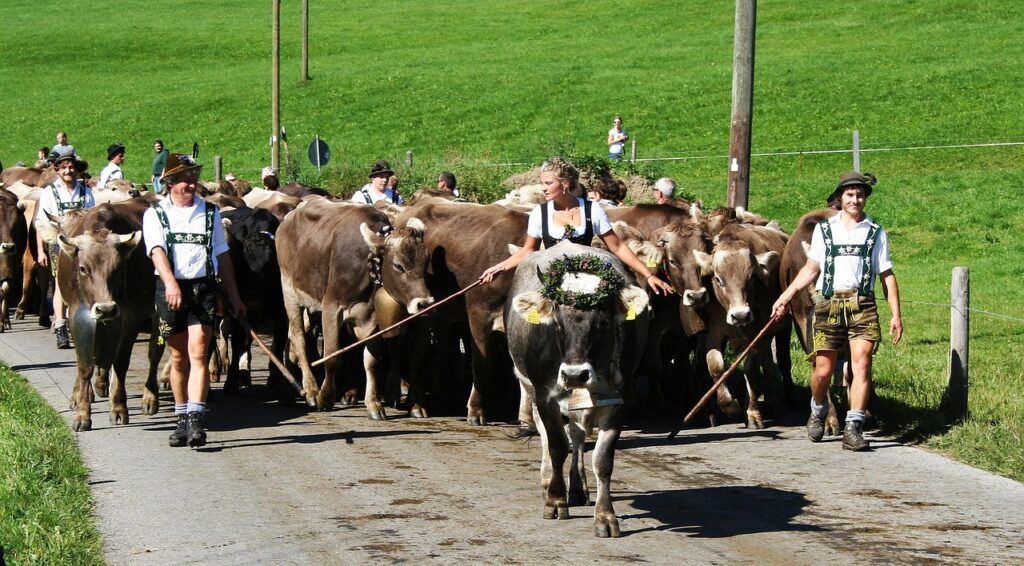
If you find yourself stuck behind a slow-moving herd of cattle coming down a narrow mountain road into an Allgäu village that has otherwise turned itself into a fairground for the day, you have not stumbled onto anything private. You have found a Viehscheid, and the entire village planned for it, right down to the food stands. It is one of the fixed points of the Bavarian year of Trachten and customs, and unlike most of the entries on that calendar, this one runs on a farmer’s schedule, not a saint’s day.
Why the herd went up the mountain in the first place
The whole custom exists because of what happens before it. Cattle from an Allgäu village spend the summer grazing together on a shared alpine pasture, high above the valley, tended by herders who live up there with them for the season. That grazing is not incidental to the region’s food, either: the milk the herd produces up on the alpine pastures is what becomes Allgäuer Bergkäse, the cheese the tourism board credits with its distinctive flavor precisely because the herd has spent the summer on alpine grass and herbs rather than valley pasture1. The Viehscheid is the last day of that arrangement each year, the point where the mountain summer ends and the herd goes home.
What actually happens on the day
On the day of the Viehscheid, the herd is driven back down and sorted, “scheid,” at the Scheidplatz, the designated sorting ground, so that each owner gets their own animals back out of a herd that has spent months mixed together1. Once the sorting is done, the herders and farmers mark the end of the season together with the visitors who came to watch1. It is a working day dressed up as a festival, which is a fair description of a lot of Bavarian customs, but this one starts with actual livestock management, done by people whose living depends on getting it right, and the party comes after, not instead of it.
How big this actually is
This is not a village doing something quaint for a handful of tourists. Roughly 30,000 cattle come down across around 30 locations spread along the Alpine chain between Lake Constance and the royal palaces of the Allgäu and neighboring Tyrol, and the tourism board’s own estimate puts visitor numbers at double the cattle count or more1. Do the arithmetic and you get crowds in the tens of thousands moving through small villages built for a fraction of that, on a single September or October Saturday. Most villages respond the way you would expect: a festival tent goes up for the day, usually with food stands and carnival-style booths alongside the main event1. Parking, seating and a place to stand and actually watch the herd come in are all in shorter supply than the crowd wants, so arriving well before the announced start does more for your day than anything else you could plan.
The 2026 dates
The season stretches across most of September and into October, and each village picks its own day, so there is no single date to plan around. Here is a spread across the 2026 calendar, from the earliest villages to the latest.
| Village | 2026 Viehscheid date |
|---|---|
| Bad Hindelang | September 11 |
| Oberstdorf | September 12 |
| Pfronten | September 12 |
| Nesselwang | September 16 |
| Immenstadt | September 19 |
| Bolsterlang | September 22 |
| Haldenwang | September 26 |
| Memhölz (Waltenhofen) | October 3 |
| Heimhofen (Grünenbach) | October 10 |
Source: allgaeu.de, Viehscheid Allgäu 2026 calendar.
That table leaves out roughly twenty other villages on the same 2026 calendar, all falling in between these dates, so if your visit lands anywhere from mid-September through early October, some Allgäu village is likely holding its Viehscheid within a day or two of it. The full 2026 list also includes several villages in the Tannheimer Tal and at Jungholz, just across the border in Austria, alongside the German ones2. The custom, in other words, does not stop at a national border; the alpine pastures involved do not either.
Resi says I would build a trip around one specific village’s date rather than showing up in the Allgäu and hoping. The dates move every year with the weather and the grass, and a village that drew a big crowd one September is not guaranteed to repeat it on the same date the next. Check the current year’s list before you book anything, and pick a smaller village over a famous one if you actually want to see the herd rather than the back of other people’s heads.
Where to stay
The villages holding a Viehscheid are working alpine towns first, not resort towns built around a single event, and lodging in the smaller ones fills up fast on their festival date. Oberstdorf and Bad Hindelang are the larger, more visitor-equipped bases on the list, with more rooms and more of them still open close to the date, and either makes a sensible base for reaching a smaller neighboring village’s Viehscheid without needing a room in the village itself. Pfronten and Immenstadt are worth the same treatment if their dates line up with your trip; both sit within easy reach of several of the smaller villages on the 2026 calendar. The honest limit here: these are small places with a finite number of beds, and a festival weekend is exactly when that matters most, so the earlier you book, the better your options, and a village with a very small, single-day event may simply not have a room left by the time you look.
Frequently Asked Questions
What is the difference between Almabtrieb and Viehscheid?
Almabtrieb is the general German term for driving cattle down from alpine summer pastures. Viehscheid is the Allgäu’s own name for the same event, referring specifically to the sorting of the herd back to individual owners.
When is Viehscheid in 2026?
Allgäu villages hold their Viehscheid across a season running from early September to early October 2026, with dates set individually by each village.
How many cattle take part?
Around 30,000 cattle come down from alpine pastures across roughly 30 Allgäu villages over the course of the season.
Is Viehscheid free to attend?
The event itself is a public village occasion; individual food stands, carnival booths and tent seating inside the festival tents may charge as they would at any village fair.
Can I see more than one Viehscheid on a trip?
Yes, since villages spread their dates across several weeks, a trip timed well can catch two or three in nearby villages, provided you check the current year’s calendar rather than relying on a past year’s dates.
Do all Allgäu villages hold a Viehscheid?
No. The 2026 calendar lists around 30 participating villages; not every Allgäu village takes part, and the practice is tied to villages with shared alpine summer pastures.
What happens at the festival tent afterward?
Villages typically set up a tent with food stands and carnival-style booths where farmers, herders and visitors mark the end of the mountain season together.
Related Articles
 Dirndl, Lederhosen and the Bavarian Year: Trachten and Customs ExplainedTrachten and customs
 The Maibaum: Why Bavarian Villages Raise a Tree on May 1 and Steal Each Other’sTrachten and customs
 The Bavarian Year: Fasching to Christkindlmarkt, Month by MonthTrachten and customs
 Bavaria the Free State: The Lion, the Flag, the Seven Regions and What Freistaat MeansTrachten and customs
 Schuhplattler and Blasmusik: Bavaria’s Slap Dance and Brass BandsTrachten and customs
 Garmisch-Partenkirchen: The Partnach Gorge, the Ski Jump and the Zugspitze BaseBavaria
 Bavaria by Train: Day Trips from Munich and a Week Without a CarBavaria
Sources
- Viehscheid — allgaeu.de, Allgäu GmbH tourism board. Accessed 2026-09-26.
- Viehscheid Allgäu 2026 (PDF calendar) — allgaeu.de, Allgäu GmbH tourism board. Accessed 2026-09-24.