In brief
Schuhplattler is the Bavarian dance where men slap the soles, heels and thighs of their own shoes and legs in time with the music, a movement whose name comes straight from “platteln,” to slap. It grew out of the rural population, farmers, hunters and loggers, and got formally organized when Miesbach founded a Schuhplattler-Gesellschaft in 1861. Roughly 150 distinct regional variations of the dance survive across the Alpine region between the Bodensee and the Königssee, danced in either the strict, upright Oberbayern style or the looser, heel-based Oberland style. The music underneath it, Blasmusik, runs on brass and the accordion-playing Ziachspieler, with a 20-part brass arrangement written specifically to sound Alpine that can still be played with as few as four musicians.
If you have watched a group of men in lederhosen slap their own shins, thighs and shoe soles in a fast, precise rhythm and wondered whether you were witnessing choreography or a fight, you were watching Schuhplattler, and yes, it is choreography, extremely deliberate choreography with its own regional dialects. It belongs, along with the brass music that usually goes with it, on my Bavarian Trachten and customs page, and it deserves its own explanation.
Where the slapping comes from
Schuhplattler grew up among Bavaria’s rural population: farmers, hunters and loggers, not the court or the city1. The name itself describes the move, “platteln” meaning to slap, applied to the soles, heels and thighs in rhythm. One of the earliest descriptions close to the modern dance comes from an 1838 visit by the Russian Empress to Wildbad Kreuth, where an observer recorded something “already very close to Schuhplattler,” and the Bavarian Trachtenverband’s own history page notes a possible reference as far back as 1050, though it flags that earlier date itself as unverified, essentially legendary rather than documented1. So the dance is old by any reasonable measure, and precisely how old depends on how strict you want to be about the evidence, which is a very Bavarian problem to have.
Standardizing a folk dance
What turned a rural custom into an organized tradition happened in the mid-19th century. Miesbach founded a Schuhplattler-Gesellschaft, a dedicated Schuhplattler society, in 1861, and Joseph Vogl founded a folk-costume preservation society in 18831. Between them, those two organizations moved Schuhplattler from something villages did their own way into something with rules, regional chapters and eventually formal competition, which is the structure still running the dance today.
One dance, about 150 versions of it
Ask a dancer from the southeastern Oberbayern region to demonstrate Schuhplattler and you get something the Trachtenverband describes as “exact, strict… with loud slaps and upright posture.” Ask someone from the Oberland instead, and you get a “comfortable” version danced more on the heel, with rounder, looser slaps1. Between those two poles sit roughly 150 distinct regional variations across the Alpine region running from the Bodensee, Lake Constance, to the Königssee at the opposite end of Bavaria1. This is worth knowing before you assume the version you saw once at a beer hall is “the” Schuhplattler; it is one of about 150, and the dancers performing it would likely tell you exactly which one.
Where a visitor is likely to see it
Schuhplattler groups perform at Oktoberfest, at regional Trachtenfeste and at the folk-music gatherings the Bavarian Trachtenverband’s own music committee organizes and tracks, including the Landesjugendtrachtenfest, a youth Trachten festival scheduled for 2026 in Pfaffenhofen an der Ilm, and an annual Tag der Tracht on July 142. Smaller, informal versions of the same folk-culture world happen at gatherings the committee calls Hoagart’n, Wirtshaussingen (pub singing nights) and Ziachspielertreffen, accordion-player meetups, which are closer to a community jam session than a staged performance2. It has also shown up at genuinely large stages: the 1972 Munich and 1976 Montreal Olympics, the 1974 and 2006 FIFA World Cups (2006 hosted in Munich itself), the 1983 IGA garden show, the 1984 Katholikentag, the 1998 Deutsches Turnfest and the “200 Years Oktoberfest” celebration in 20101.
The Preisplattln: when it becomes a competition
Schuhplattler is also a competitive sport within its own world, formally judged as Preisplattln. The first regional Gauverband competition was held on August 19, 1906, in Endorf, and the modern flagship event, “Preisplattln um den Bayerischen Löwen” (“for the Bavarian Lion”), has run since 20021. If you see dancers in a tent or hall performing with unusual precision and a panel watching closely from the side, you are likely watching one of these.
The Trachtenverein behind all of it
The organization coordinating most of this is the Bayerischer Trachtenverband, structured into Sachausschüsse, subject committees, one for Volkstanz und Schuhplattler and a separate one for Volkslied und Volksmusik, folk song and folk music, established in 19742. That music committee meets twice a year to coordinate folk-music education and joint events, produces a Liedheft für Feldmessen, a hymnal of songs for outdoor festival masses that includes the Bavarian anthem, and records regional material together with Bayerischer Rundfunk, Bavaria’s public broadcaster2. A local Trachtenverein, in other words, is not just a dance troupe; it is a chapter plugged into a statewide structure that also keeps the songs and the music alive on paper and on tape.
The instruments: Ziachspieler and the brass
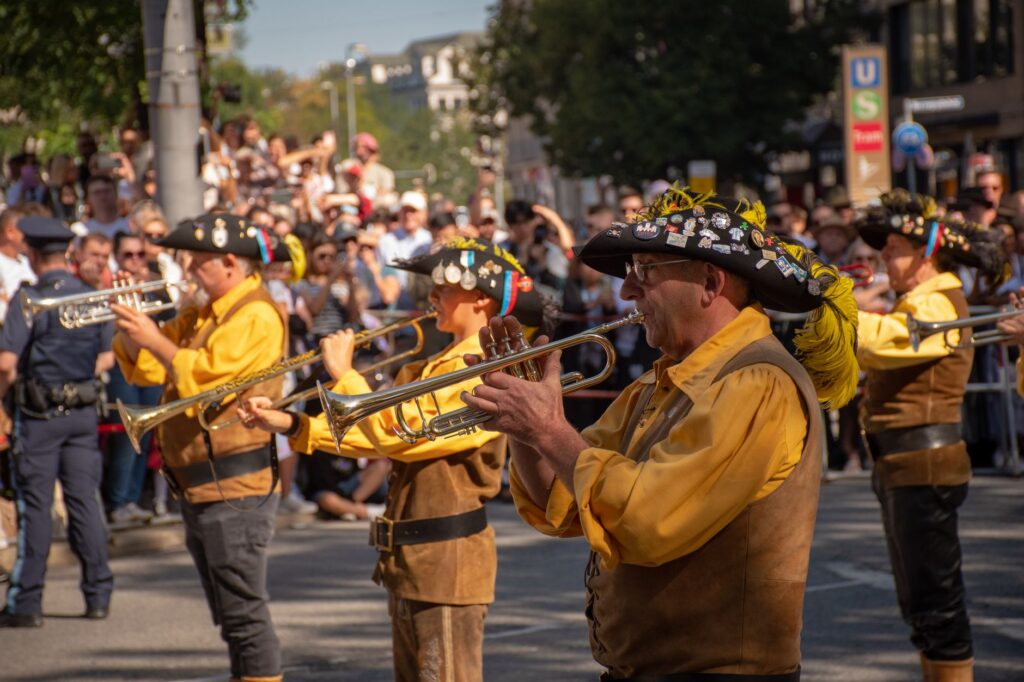
The accordion players, Ziachspieler, are a fixture of Bavarian folk music, and the brass side has its own specifically Bavarian engineering: a 20-part brass arrangement, a Bläsersatz, was composed deliberately “to sound Alpine and fit our region,” and it was built so it can still be played correctly with as few as four brass musicians when a full band is not available2. Performance dress ranges from full Festtracht, formal Tracht, down to Halbtracht, half-Tracht, or simply a “Dirndlg’wand” for the more casual end of the scale2.
The tent bands and "Ein Prosit"
The brass band you will actually hear the most, though, is not at a folk festival at all: it is the one in the beer tent, playing “Ein Prosit” two to three times an hour throughout the day. Where the song actually came from is a genuinely unsettled question. The specialty guides that write about Oktoberfest’s own music history do not even agree on who composed it, so I am not going to pretend there is a tidy answer here. What both accounts agree on is the mechanism that made it an Oktoberfest fixture in the first place: a Nuremberg innkeeper named Georg Lang distributed songbooks in his beer tent starting in 1898, and the song, paired with his brass band, spread from there into what is now standard repertoire in every large tent3. Whoever wrote it, Georg Lang’s marketing is the reason you will hear it whether you asked to or not.
Resi says By your third hour in a tent, “Ein Prosit” stops being a song and starts being a Pavlovian bell: it plays, you stand, you clink, you sit back down. I find it more charming than annoying, mostly because nobody in the tent seems to be pretending otherwise. Nobody claims it is a deep cut.
Frequently Asked Questions
What does Schuhplattler mean?
It comes from “platteln,” to slap, describing how dancers slap the soles, heels and thighs of their shoes and legs in rhythm.
Who traditionally danced Schuhplattler?
Bavaria’s rural population: farmers, hunters and loggers, before the dance was later organized into formal clubs and competitions.
Is there only one version of Schuhplattler?
No. Roughly 150 distinct regional variations exist across the Alpine region between the Bodensee and the Königssee, including a stricter Oberbayern style and a looser Oberland style.
When was Schuhplattler first organized into a club?
Miesbach founded a dedicated Schuhplattler-Gesellschaft in 1861, and a related folk-costume preservation society followed in 1883.
What is Preisplattln?
A formal, judged Schuhplattler competition. The first regional one was held in Endorf in 1906, and the current flagship competition has run since 2002.
Who composed "Ein Prosit"?
Sources disagree, and the two English-language guides to Oktoberfest’s music history each name a different composer, so no single answer is confirmed. What is agreed is that a Nuremberg innkeeper’s 1898 songbook-and-brass-band campaign is what made the song an Oktoberfest fixture.
What instruments make up Bavarian Blasmusik?
Brass instruments in a specifically composed Alpine-sounding arrangement, playable with as few as four musicians, alongside the accordion-playing Ziachspieler.
Where can I see Schuhplattler as a visitor?
At Oktoberfest, at regional Trachtenfeste, and at organized folk-music events such as the Landesjugendtrachtenfest and the annual Tag der Tracht on July 14.
Related Articles
 Dirndl, Lederhosen and the Bavarian Year: Trachten and Customs ExplainedTrachten and customs
 The Maibaum: Why Bavarian Villages Raise a Tree on May 1 and Steal Each Other’sTrachten and customs
 Almabtrieb and Viehscheid: When the Cows Come Down the MountainTrachten and customs
 Bavaria the Free State: The Lion, the Flag, the Seven Regions and What Freistaat MeansTrachten and customs
 The Bavarian Year: Fasching to Christkindlmarkt, Month by MonthTrachten and customs
 Oktoberfest in Munich: Dates, Tents, Reservations, What to Wear and What It CostsOktoberfest
 Bavarian Beer, Explained: Styles, Breweries, Beer Halls and Beer GardensBeer
Sources
- Volkstanz und Schuhplattler — trachtenverband-bayern.de, Bayerischer Trachtenverband. Accessed 2026-09-26.
- Volkslied und Volksmusik — trachtenverband-bayern.de, Bayerischer Trachtenverband. Accessed 2026-09-24.
- The biggest Wiesn hits to dance to in the beer tents — oktoberfest.de, City of Munich. Accessed 2026-09-24.