In brief
A German Christmas table runs on two protected names and one hot drink: Nürnberger Lebkuchen, which by EU rule may only be made in Nuremberg, Dresdner Stollen, which carries its own EU seal and a list of fifteen required ingredients, and Glühwein, hot spiced red wine that needs no passport to make at home. Weißwurst belongs on the table too, but as a menu choice, not a proven Christmas custom; no source ties it to the holiday specifically. Krampus is real in one very specific place, Berchtesgaden, where the local custom is not actually called Krampus at all, and the confirmed date is Saint Nicholas Day, not Christmas.
Disclosure: some links on this page are affiliate links, marked by the products, tours and hotels they name. As an Amazon Associate, bavarianbistro.com earns from qualifying purchases. A purchase through these links may earn the site a commission at no cost to you, and it never affects what is recommended. How this works. Product prices and availability shown are as of the date stated and can change; the Amazon price at checkout applies.
The party version of a German Christmas is usually built from whatever the box store had in the seasonal aisle, and most of it is a guess. This page is the parts that are actually German, actually Bavarian where that matters, and actually dated, so you can build the table without repeating a claim nobody can back up. It is one course in the larger Oktoberfest and Bavarian party series, and the drinks and sweets below work for any winter gathering, not only one held in December.
Glühwein, the drink everyone actually wants
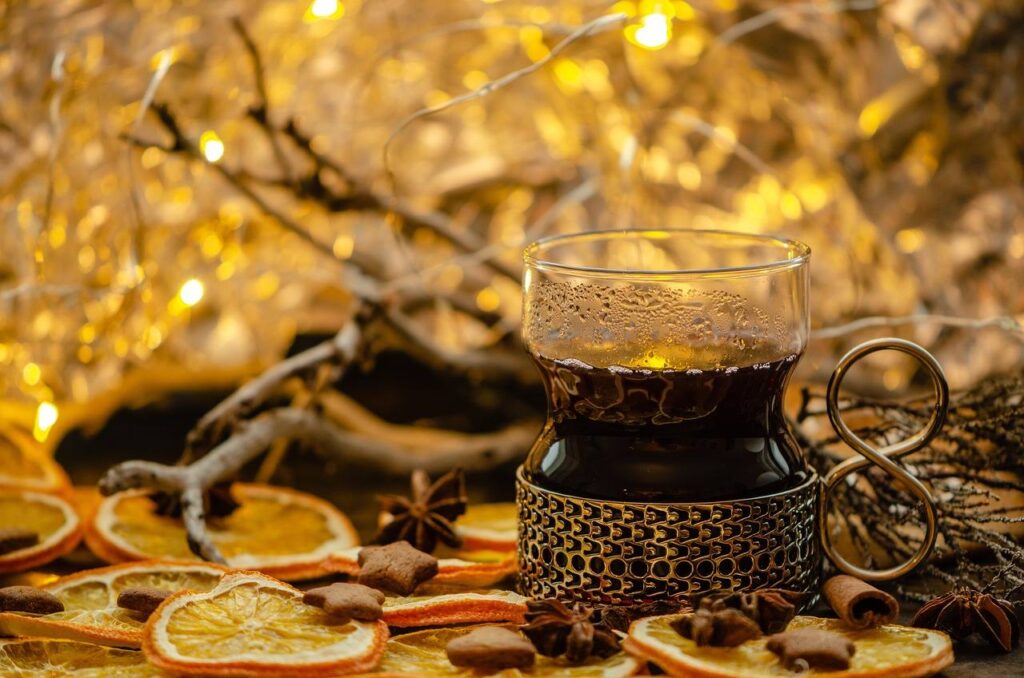
Glühwein is red wine heated slowly with cloves, cinnamon and sugar, usually with lemon added, and it is meant to steam, not boil; boiling burns off the alcohol you paid for. Germanfoods.org, the German food trade association’s own consumer site, gives the basic ratio as one bottle of red wine to about sixteen cloves, a cinnamon stick and a few tablespoons of sugar, served in a heatproof glass with a metal spoon inside it so the glass does not crack3. I want to be precise about what I am not claiming: German wine law almost certainly regulates Glühwein in some formal way, but I could not find a producer or regulator page that states the definition in plain terms, so I am not going to invent one. Treat it as a drink, not a legal category, and it will still taste right.
If you want the version that turns a party into an event, Feuerzangenbowle is the one to know: the same idea with a rum-soaked sugar cone set on fire over the pot, dripping in as it melts. Germanfoods.org’s own recipe calls for two bottles of dry red wine, two organic oranges and lemons, a cinnamon stick, cloves, ginger and dark rum at least 54 percent alcohol, and it does not undersell the theatrics, calling it “Germany’s most impressive party drink” while also warning it involves open flame around alcohol4. Do this one outside, or over a sink, and have a lid within reach.
Making it work in a North American kitchen
None of this needs a special trip. Any dry, inexpensive red wine does the job; nobody at a Christmas party is checking the label, and an expensive bottle is wasted once it is full of cloves anyway. Whole cloves and cinnamon sticks live in the regular spice aisle, not a specialty store, and a slow cooker set to low does a better job holding Glühwein at drinking temperature through a three-hour party than a pot on the stove, which someone always forgets and lets boil. Ladle it into anything heatproof; a real market stall would use a Glühwein mug, but a plain coffee mug holds heat just as well, and nobody’s tongue can tell the difference. If you want the actual market mugs for the look of the thing, my Christmas market party page covers that question.
Lebkuchen, and why "Nürnberger" means something
Not all gingerbread gets to use the name. Nürnberger Lebkuchen carries an EU-wide protected geographical indication, and the trade site lebkuchen-nuernberg.com is direct about what that means: the specialty “may, because of this protection, only be produced in Nuremberg,” even though the ingredients themselves can still be sourced elsewhere1. The city has been baking it since the medieval period, and the EU’s protected-name system itself only dates to 1992, so the cookie is a great deal older than the label protecting it1.
For your table, the honest shortcut is to buy the real thing rather than approximate it. My pick is the Wicklein Original Nürnberger Lebkuchen, a 200-gram box of the glazed, wafer-backed kind, running $9.99 as of September 2026. The limit is size: a single box disappears at a party of more than four or five people, so buy two and put the extras out early rather than rationing them6.
Resi says I do not pretend the Lebkuchen at your local grocery store is the same thing, but I have a shortcut that gets close without a special order: once or twice a year, Aldi’s in-house “Deutsche Küche” line shows up with German staples, and it is absolutely the real deal, not a costume version of one. Their frozen strudels, bratwursts, sweet mustard and dark sunflower-seed bread are the items I actually buy, and when that shelf appears, I stock up, because it does not stay long.
Dresdner Stollen, if you want the other classic
Stollen is not Bavarian, and I will say so plainly rather than let the party pretend otherwise: Dresden is in Saxony, several hundred miles north. But it is the other fixture of a German Christmas table, and it carries its own protection, an EU-recognized designation of origin, per the Schutzverband Dresdner Stollen’s own English page2. The association names fifteen required ingredients, including raisins or sultanas, butter and clarified butter, and both candied lemon and orange peel, and it explicitly bans margarine, artificial flavors and other additives, though it does not publish the exact minimum quantities on that page2. Serve it alongside the Lebkuchen and call it what it is: German, not Bavarian, and welcome at the table anyway. It also keeps well: a genuine Stollen is dense and heavily buttered on purpose, and I would buy it a week or two ahead of the party rather than the morning of, since a butter-heavy loaf like this only gets better wrapped and left alone for a few days.
Weißwurst, as a menu option, not a myth
Weißwurst has one real rule, and it is about the clock, not the calendar: it should never hear the noon church bells. I could not find any source that ties it specifically to Christmas as opposed to any other Munich morning, so I am not going to dress it up as a holiday tradition here. What I will say is that it is a legitimate, easy addition to a party that starts before noon, boiled gently and served with sweet mustard and a pretzel; my full how-to covers the skin, the mustard and the timing in full.
The Krampus question, honestly answered
Krampus shows up on a lot of American party-supply sites in December, usually as a generic horned mask with no source behind it. Berchtesgaden’s own tourism site is the one place I found that actually confirms a version of this custom, and it is worth reading closely, because it does not use the word “Krampus” at all: it describes wild figures called the Buttnmandl and Kramperl, dressed in fur and straw, who are “rooted in Celtic times and later shaped by Saint Nicholas traditions” and who “roam through Berchtesgaden and the surrounding villages on Saint Nicholas Day, accompanied by the sound of ringing bells”5. Saint Nicholas Day is December 6, not Christmas Eve or Christmas Day, and the custom belongs to one corner of Bavaria, not the whole country. If you want a Krampus-adjacent moment at your party, borrow the name Berchtesgaden actually uses, know it is a pre-Christmas custom rather than a Christmas one, and do not claim it is universal, because it is not.
Frequently Asked Questions
What is a Bavarian Christmas party supposed to have?
There is no fixed list, but Glühwein, Nürnberger Lebkuchen and Dresdner Stollen are the three items with the strongest claim to being both genuinely German and genuinely traditional, with Weißwurst as an optional daytime addition.
Is Glühwein just mulled wine?
Functionally yes: red wine heated with cloves, cinnamon, sugar and usually lemon, kept below a boil so the alcohol stays in the glass.
What is Feuerzangenbowle?
Glühwein’s showier cousin: the same mulled wine with a rum-soaked sugar cone set alight above the pot so it drips in as it melts. It involves open flame around alcohol, so do it carefully.
Why does Nürnberger Lebkuchen matter as a name?
Because it is legally protected. Under EU rules, only gingerbread actually produced in Nuremberg can carry that name, regardless of where the ingredients came from.
Is Dresdner Stollen Bavarian?
No. It is from Dresden, in Saxony, several hundred miles from Bavaria. It is still a German Christmas staple and a fine addition to any table.
Is Weißwurst a Christmas food?
Not by any source I could confirm. It is a Munich everyday food with a noon-only rule; it works as a party brunch item but is not a documented Christmas tradition.
Is Krampus a real Bavarian Christmas tradition?
A version of it is, but only in Berchtesgaden, where the local names are Buttnmandl and Kramperl and the date is Saint Nicholas Day, December 6, not Christmas itself. Treat wider “Krampus” marketing with some skepticism.
What wine should I use for Glühwein?
Any dry, inexpensive red wine. The spices and sugar do the flavor work, so there is no reason to open something you would otherwise save for drinking on its own.
Related Articles
 Throw an Oktoberfest Party: The Plan, the Menu, the Beer, the Outfits and the GamesParty
 A Christmas Market Party at Home: Stalls, Glühwein and the Smell of Roasted AlmondsParty
 German Christmas Markets in the US and Canada, by RegionParty
 Weißwurst: How to Eat Bavaria’s White Sausage (Skin, Mustard and the Noon Rule)Food
 Bavarian Food: The Dishes, How Munich Eats Them, and What to Cook at HomeFood
 How to Read a Bavarian Menu: 60 Words from Brezn to ZwetschgendatschiFood
 Bavarian Christmas Traditions: Advent, Krampus, Christkind and the FoodsTrachten and customs
Sources
- Geschützte geografische Angabe — Lebkuchen-Nürnberg.com. Accessed 2026-09-26.
- Dresden Christmas Stollen — Schutzverband Dresdner Stollen. Accessed 2026-09-26.
- Spiced Mulled Wine — Germanfoods.org. Accessed 2026-09-26.
- Fire Tongs Punch (Feuerzangenbowle) — Germanfoods.org. Accessed 2026-09-26.
- The quiet season in Berchtesgaden — Berchtesgaden.de. Accessed 2026-09-26.
- Wicklein Original Nürnberger Gingerbread, 200g — Amazon.com. Accessed 2026-09-26.