In brief
Bavarian Christmas starts weeks before December 25, with Nikolaus filling children’s shoes overnight on December 6 and costumed Buttnmandl and Kramperl figures parading through towns like Berchtesgaden that same week. Gifts arrive on Christmas Eve, brought by the Christkind rather than Santa Claus, in the North American sense the holiday is often translated into. Nürnberger Lebkuchen, the spiced gingerbread that carries its own EU protected status, is one of the few Bavarian Christmas foods with a source solid enough to print. Bleigießen, pouring molten metal to read a New Year’s fortune, still happens, but the lead figures once used for it fall well outside an EU limit that has applied since 2015, which is why the sets sold today are tin or wax instead. Around January 6, Sternsinger, child carol singers, go door to door chalking a blessing over the frame, a custom formally revived in 1959.
Disclosure: some links on this page are affiliate links, marked by the products, tours and hotels they name. As an Amazon Associate, bavarianbistro.com earns from qualifying purchases. A purchase through these links may earn the site a commission at no cost to you, and it never affects what is recommended. How this works. Product prices and availability shown are as of the date stated and can change; the Amazon price at checkout applies.
If you have only ever had “German Christmas” explained to you as Glühwein and a market stall, Bavaria’s actual season is stranger and more specific than that, built around a handful of very particular days rather than one long generic vibe. This page walks through it in order, from the frights of early December to the fortune-telling on New Year’s Eve. My Trachten and Customs pillar covers the rest of the Bavarian year, and if you are planning the December frights or a party of your own, both get their own pages below.
Nikolaus, on his actual day
December 6, not December 25, is when Bavarian children traditionally find their reward: a shoe or boot left out the night before, filled by St. Nicholas with small gifts if the year has gone well. In Berchtesgaden, the day comes with an actual procession: the Buttnmandl-Laufen, run by the Bundeswehr’s Gebirgsjäger mountain troops, starts at 2 p.m. from the Strub barracks and brings St. Nicholas and his costumed companions to the castle square by around 3:15, handing out small gifts to children along the way1.
The costumed figures themselves are not one thing. “Buttnmandl” and “Ganggerl” wear long straw coverings hung with large bells; “Kramperl” wear fur masks and carry smaller bells and switches, and the bell-ringing itself, per the town’s own account, was originally meant to wake winter nature early in the cold season, a pre-Christian practice folded into the Christian Nikolaus feast rather than replaced by it1. My Krampus, Nikolaus and the Perchten page goes through the frights, and the local names, in full.
Advent, and the Christkind instead of Santa
Advent in Bavaria runs the four Sundays before Christmas the same way it does anywhere else in German-speaking Europe, with a wreath, a calendar and a slow build, and it is also when the region’s Christkindlmarkt season fills its town squares, a subject substantial enough that it gets its own page rather than a paragraph here. Where Bavaria differs from the North American picture most is on the night itself: Bavarian children are told their presents come from the Christkind, not Santa Claus, and they arrive on the evening of December 24, not the morning of the 25th.
Christmas Eve is also the day some of Berchtesgaden’s outlying villages hold their own smaller Buttnmandl-Laufen, at Maria Gern in the afternoon, layering the Nikolaus custom onto the holiday itself rather than keeping the two entirely separate1.
Resi says If you grew up on the American version of this holiday, the date is the single hardest habit to break: Christmas Eve is the big night in Bavaria, and December 25 is the quiet, sleepy day after, not the other way around.
The foods, and the one I can actually stand behind
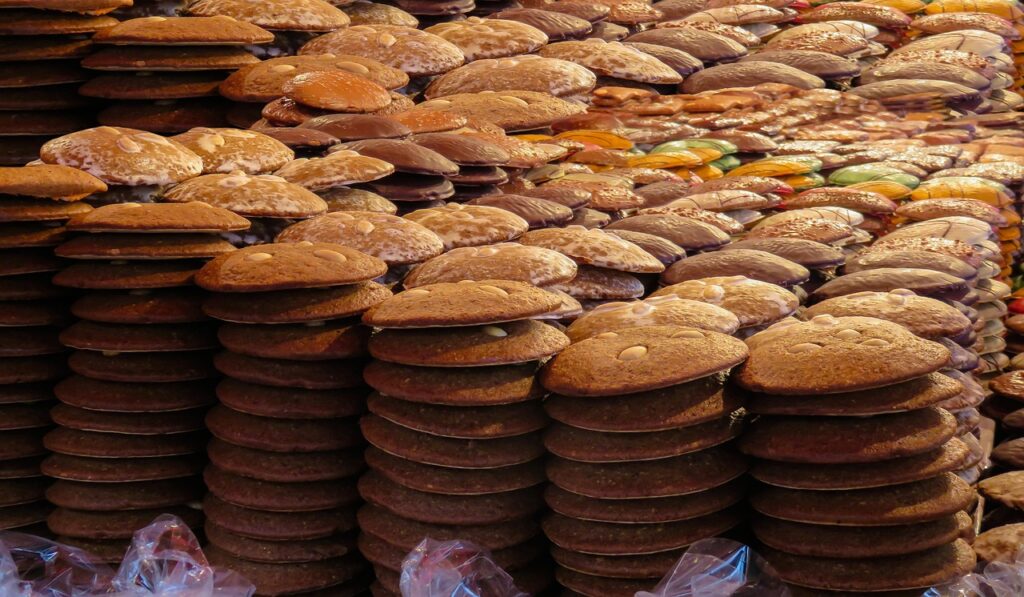
I would love to hand you a full menu for Bavarian Christmas Eve dinner, but I only have one dish I can source properly, so that is the one you get. Nürnberger Lebkuchen, the city’s spiced gingerbread, carries EU geographical-protection status, and Bavaria’s own agriculture ministry lists it by name among the state’s protected foods2.
The reasoning is worth a sentence, because it is the kind of detail that actually explains something: the ministry’s own text notes that “individual early-stage ingredients cannot be produced within the geographic area (e.g. the oriental spices used for Nürnberger Lebkuchen),” which is exactly why the protection covers where it is baked, not where every ingredient in it grew2. Cinnamon, cardamom and clove were never going to come from Franconia; the protection was written with that in mind rather than around it.
Everything else you will read elsewhere about Bavarian Christmas Eve dinner, a fish course, a goose on the day after, a table of cookies, is real in a general German sense, but I could not run down a Bavaria-specific source for any of it this session, so I am leaving the specifics out rather than repeating what every other site repeats without checking. One thing worth saying plainly, because it gets muddled constantly: Christstollen, the fruited Christmas loaf sold everywhere in December, carries its own protection as a product of Dresden, in Saxony, not Bavaria, even though it turns up on every Bavarian bakery counter this time of year.
My own pick, checked directly on Amazon, is the Wicklein Original Nürnberger Lebkuchen Manufacturers Assortment, glazed, 14.1 ounces, which ran $19.99 as of September 2026, rated 4.2 from 124 reviews5.
Resi says If you want to bring one thing to the table that is honestly Bavarian and not just German-in-general, that assortment is the one, not the supermarket kind shaped like a heart on a ribbon. It is soft where a good Lebkuchen should be soft, and it is gone from my counter within a week, which is either an endorsement or a warning. If you would rather set the whole scene, a Bavarian Christmas party is where the rest of the table comes together.
Bleigießen, and the ban that is real but narrower than the story
Bleigießen, pouring molten metal into cold water on New Year’s Eve and reading a fortune in the shape it hardens into, is still a live tradition, but the lead figurine sets that gave it its name are no longer legally sold in the EU in their original form. The actual rule, an amendment to the EU’s REACH chemicals regulation, entered into force May 13, 2015, and set a compliance deadline of June 1, 2016; the operative text caps lead content in small metal articles, and their accessible parts, at 0.05 percent of weight, with an alternative migration-rate ceiling for any lead-releasing coating3.
Traditional lead Bleigießen figures fall well above that limit, which is why the sets on shelves today are tin or wax instead, sold for the same fortune-telling custom under a different metal. The commonly repeated claim that old sets ran up to 70 percent lead comes from consumer-press reporting rather than the regulation itself, which does not name Bleigießen at all, so I am flagging that specific figure rather than printing it as settled.
The Sternsinger, after the new year
The season’s last custom runs into January rather than stopping at Christmas. Around January 6, Epiphany, groups of child carol singers known as Sternsinger go door to door, blessing homes and collecting donations for children in need worldwide, under a campaign, Aktion Dreikönigssingen, that was revived in 1959 and gained the Bund der Deutschen Katholischen Jugend as a co-organizer in 1961; its own organizers bill it as the world’s largest solidarity campaign run by children for children4.
Local parishes set their own visit dates, any time “between December 27 and the third Friday in January,” so the singers at your door will not necessarily show up on the sixth itself4. The chalk mark they leave over a doorway, in the format 20*C+M+B+27 for the coming year, reads as the Latin blessing “Christus Mansionem Benedicat,” may Christ bless this house, and is also traditionally read as the initials of the Three Kings, Caspar, Melchior and Balthasar.
Frequently Asked Questions
When do Bavarian children get their Christmas presents?
On the evening of December 24, from the Christkind, not from Santa Claus and not on Christmas morning.
What happens on December 6 in Bavaria?
St. Nicholas Day. Children traditionally find small gifts in a shoe left out the night before, and towns like Berchtesgaden hold a costumed Buttnmandl-Laufen procession.
Is Krampus a Bavarian tradition?
Berchtesgaden’s own tourism page describes its costumed December figures as Buttnmandl and Kramperl, not “Krampus”; see my dedicated page for where the terms do and do not overlap.
What is Nürnberger Lebkuchen?
Nuremberg’s protected spiced gingerbread, one of the few Bavarian Christmas foods with clear EU-recognized status.
Is Bleigießen still legal?
The custom is legal; the original lead figurine sets are not, under an EU limit on lead content that has applied since 2016. Tin and wax sets are sold instead.
What is Christstollen, and is it Bavarian?
A fruited Christmas loaf with its own protected status as a product of Dresden, in Saxony. It is widely sold and eaten in Bavaria, but it is not a Bavarian product.
Who are the Sternsinger?
Child carol singers who go door to door around Epiphany, January 6, blessing homes and collecting donations, under a campaign formally revived in 1959, with visits scheduled by local parishes anytime between December 27 and the third Friday in January.
Why is Nürnberger Lebkuchen protected if some of its ingredients are not grown in Bavaria?
Because the EU protection covers where the product is baked, not where every spice in it originated; Bavaria’s own ministry cites the imported spices in Lebkuchen as the exact reason that category of protection fits it.
Related Articles
 Dirndl, Lederhosen and the Bavarian Year: Trachten and Customs ExplainedTrachten and customs
 The Bavarian Year: Fasching to Christkindlmarkt, Month by MonthTrachten and customs
 Krampus, Nikolaus and the Perchten: Bavaria’s December FrightsTrachten and customs
 Christmas Markets in Bavaria: Munich, Nuremberg, Rothenburg and the DatesTrachten and customs
 A Bavarian Christmas Party: Glühwein, Lebkuchen, Weißwurst and the Krampus QuestionParty
 A Christmas Market Party at Home: Stalls, Glühwein and the Smell of Roasted AlmondsParty
 Bavarian Food: The Dishes, How Munich Eats Them, and What to Cook at HomeFood
Sources
- Buttnmandl — berchtesgaden.de. Accessed 2026-09-24.
- EU-Herkunftsschutz — stmelf.bayern.de, Bavarian State Ministry for Food, Agriculture and Forestry. Accessed 2026-09-24.
- Regulation (EU) 2015/628 (CELEX:32015R0628) — EUR-Lex. Accessed 2026-09-24.
- Sternsingen FAQ — sternsinger.de, Kindermissionswerk “Die Sternsinger.” Accessed 2026-09-24.
- Wicklein Original Nurnberger Lebkuchen Gingerbread Manufacturers Assortment Glazed, 14.10oz — Amazon.com. Accessed 2026-09-26.