In brief
Servus means both hello and goodbye in Bavaria, one word doing the job of two. Griaß di, or Griaß eich for a group, is the warmer, more local greeting, and Prost beianand toasts the whole table at once, not just the person across from you. Munich’s own tourism office defines more than two dozen Bavarian words and phrases for visitors, from Wiesn for Oktoberfest to Zefix for a mild curse, and this page collects the ones worth actually knowing.
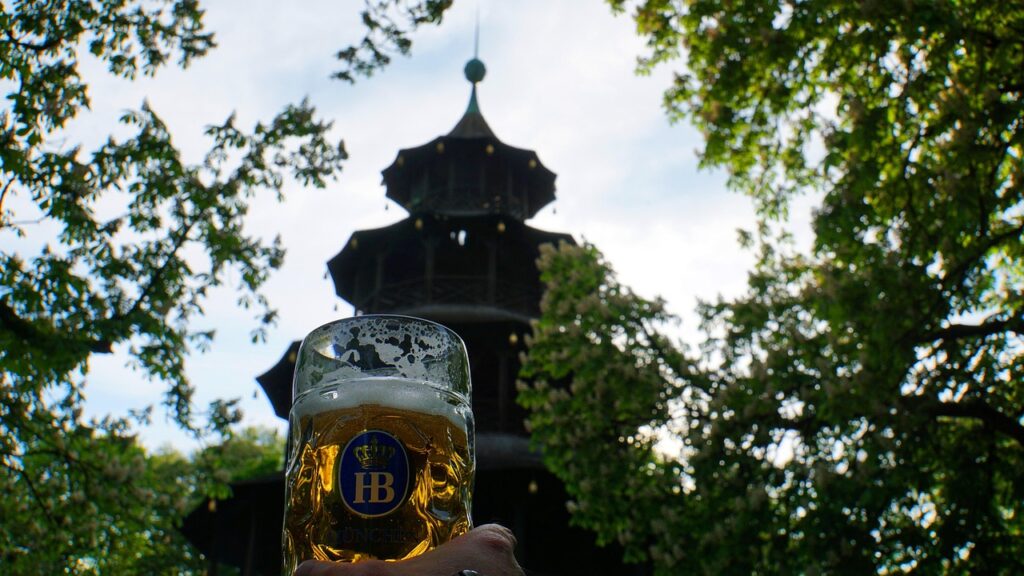
Bavarian is not an accent on German, and the first sentence someone says to you in a beer tent will make that obvious. It has its own words, its own grammar in places, and its own sense of when a single syllable will do. You do not need to learn any of it to enjoy Munich, but knowing a dozen words changes a transaction into a conversation, and that is worth more than the two minutes this page takes to read. It belongs with the rest of my guide to Trachten and Bavarian customs.
The words, what they mean, when to use them
Munich’s own tourism office publishes a page teaching visitors Bavarian dialect for Oktoberfest, and the table below is built from it. Nothing here is guesswork; every definition is the city’s own1.
| Word or phrase | Meaning | When to use it |
|---|---|---|
| Servus | Hello or goodbye | Anytime, with anyone, arriving or leaving |
| Griaß di / Griaß eich | Hello (to one person / to a group) | A slightly warmer greeting than Servus |
| Maß | One liter of beer | Ordering at a beer tent or garden |
| Brezn | The pretzel | Ordering food; never “Brezel” here |
| Radi | Radish, spiral-cut and salted | A beer-garden snack order |
| Obazda | A cheese spread of camembert, butter, onion and paprika | Reading a Brotzeit menu |
| Gaudi | Fun | Describing a good time, loosely |
| Oans, zwoa, gsuffa | “One, two, three, drink” | The chant before everyone drinks together |
| Wiesn | Oktoberfest | What locals actually call the festival |
| Brotzeit | A cold meal of bread, cold cuts and cheese | Ordering a snack plate, not a hot meal |
| Prost / Prost beianand | Cheers / cheers, everyone | Toasting one person, or the whole table |
| An Guadn | Bon appétit | Just before a meal starts |
| Zoin bittschee | The check, please | Flagging a server at the end of a meal |
| Noagerl | The last swallow left in a Maßkrug | Describing dregs nobody wants to finish |
| Suri | Tipsy | A polite way to describe your own state |
| Gmiatlich | Cozy, relaxed, sociable | Describing a good beer garden or evening |
| Zuagroaster | A newcomer to the area | Describing anyone who moved in, kindly or not |
| Bassd scho | “That works,” “it’s fine” | General approval, low effort |
| Ja mei | An exclamation for almost anything | Reacting to good news, bad news, or a shrug |
| O’zapft is | “It’s tapped” | The mayor’s line opening Oktoberfest itself |
| Hendl / Hoibs Hendl | Chicken / half a roast chicken | Ordering the classic tent food |
| Steckerlfisch | Fish grilled on a wooden skewer | Ordering at an outdoor stall |
| Schweinsbrodn | Roast pork | Ordering a hearty tent meal |
| Gebrannte Mandln | Candied almonds | Buying a sweet snack from a stall |
| Dirndl | The traditional dress; also “girl” | Talking about the outfit or, informally, a young woman |
| Janker | The traditional wool or loden jacket | Naming the jacket half of a Tracht outfit |
| Zefix | Roughly “damn it” | A mild curse, said with feeling, used sparingly by visitors |
Source: muenchen.de1.
Resi says Learn four: Servus, Prost, Brezn and Ja mei. Servus and Prost get you through every social moment that matters, Brezn keeps you from calling it a pretzel to someone selling it, and Ja mei will make a Bavarian smile the first time you use it correctly, because it means you were listening.
How to actually say them
Nobody sourced a pronunciation guide for you, so here is mine, and it needs no citation because it is just how the words sound to an ear that has heard them for years. Servus is “SEHR-voos,” soft on the second syllable. Maß rhymes with the English word “mass,” not “mace,” despite what the umlaut-free spelling suggests to an English reader. Brezn collapses the “e” almost entirely, closer to “BRETS-n” than “BRET-zen.” Gaudi is “GOW-dee,” not “GAW-dee.” Prost is exactly what it looks like, one syllable, said with the glass already moving toward someone else’s.
Bairisch and Bayerisch: two words that look like typos of each other
Munich’s own dialect page distinguishes two words that trip up English speakers precisely because they look like the same word misspelled: Bairisch is the dialect itself, the language of everything in the table above, while Bayerisch describes anything relating to the Free State of Bavaria more broadly, official documents, institutions, the government. A Bavarian saying “des is bayerisch” about a law and “des is bairisch” about a word are making two different claims, and mixing them up is a small, forgivable, entirely visitor-shaped mistake1.
Bavarians will let you know they are not "just German"
Ask a Bavarian where they are from and you may get “Bavaria” before you get “Germany,” and it is not an accident. Bavarians commonly refer to everyone else in the country, in good humor, as Preißn, Prussians, regardless of whether that person has ever been near Prussia, and there is a saying for the whole attitude: “It’s nice to be a Preiß, but it’s higher to be a Bayer.” Bavaria calls itself a Free State in its own official name, and more than a few Bavarians still miss their king, Ludwig. Non-Germans tend to lump the whole country together and credit Bavaria’s specifics, the Tracht, the castles, even the cuckoo clock, to “Germany” generically, and a Bavarian will notice. The cuckoo clock, for what it’s worth, is actually from the Black Forest, nowhere near Bavaria, which makes the mix-up a little bit Bavaria’s problem too.
Why some words you might expect are missing
Grüß Gott, the formal southern-German greeting, is the phrase most guidebooks reach for first, but I could not confirm it on any of the sourced pages for this article; what Munich’s own dialect page actually teaches is Griaß di and Griaß eich, the Bavarian-dialect versions of the same greeting, which is why those are the ones on the table above and in the title instead. A handful of other classic dialect words, Grüß Gott among them, along with Pfiat di, Habe die Ehre and a few more, turned up in earlier research but could not be confirmed against a source I could actually read this pass, so they are left out rather than guessed at.
Frequently Asked Questions
What is the most useful Bavarian word for a visitor to know?
Servus. It works as both hello and goodbye, with anyone, at any point in a conversation.
What do you say when toasting in Bavaria?
Prost, or Prost beianand when you are toasting an entire table rather than one person.
Is Bavarian a language or a dialect?
It functions as a dialect of German with its own vocabulary and pronunciation; Bavarians themselves often just call it Bairisch.
What does "Wiesn" mean?
It is the local name for Oktoberfest, short for Theresienwiese, the field where the festival is held.
What is a mild Bavarian swear word?
Zefix, used the way an English speaker might use “damn it.” It is common enough to hear, but a visitor using it lands as trying a bit hard.
What does "Griaß di" mean, and how is it different from "Servus"?
Both mean hello, but Griaß di is the dialect greeting used for one person, with Griaß eich for a group, while Servus doubles as hello and goodbye in either case.
Do Bavarians consider themselves German first or Bavarian first?
Many will say Bavarian first, and jokingly refer to other Germans as Preißn (Prussians), regardless of where in the country they are actually from.
Related Articles
 Dirndl, Lederhosen and the Bavarian Year: Trachten and Customs ExplainedTrachten and customs
 Bavarian Manners: Tipping, Quiet Hours, Sundays and PfandTrachten and customs
 The Oktoberfest Dictionary: Wiesn, Maß, O’zapft is and 40 More WordsOktoberfest
 How Big Is a Maß? Bavarian Beer Sizes in Ounces, ExplainedBeer
 Brotzeit: Bavaria’s Bread-Time Meal, and What Goes on the BoardFood
 Obatzda: The Bavarian Beer-Cheese Spread, What Goes in It and How to Make ItFood
 Bavaria the Free State: The Lion, the Flag, the Seven Regions and What Freistaat MeansTrachten and customs
Sources
- Learn Bavarian for the Oktoberfest — muenchen.de. Accessed 2026-09-26.