In brief
Brotzeit, literally “bread-time,” is Bavaria’s name for a cold snack platter built around bread and whatever goes well with it: radishes, cured sausage, cheese, pickles and Obatzda, the beer-cheese spread, are the fixtures. It is also the reason you can bring your own food into a genuine Bavarian beer garden: 19th-century authorities barred brewers from selling food to protect established innkeepers, so guests brought their own, and that workaround is still the rule at every real beer garden. A genuine Biergarten needs two things by that same rule: guests may bring food, and it has to be an actual garden under mature trees. The 1999 Bavarian ordinance regulates noise and hours, 7 a.m. to 11 p.m. with stricter cutoffs after 10, but it is the older food compromise, not that ordinance, that created the bring-your-own custom. One radish, eaten raw and salted, is said to cover an adult’s entire daily vitamin C requirement.
Disclosure: some links on this page are affiliate links, marked by the products, tours and hotels they name. As an Amazon Associate, bavarianbistro.com earns from qualifying purchases. A purchase through these links may earn the site a commission at no cost to you, and it never affects what is recommended. How this works. Product prices and availability shown are as of the date stated and can change; the Amazon price at checkout applies.
Somewhere between a snack and a meal sits Brotzeit, and the word gives away exactly what it is: Brot, bread, and Zeit, time. It is less a recipe than an approach, a board built around bread and a handful of things that go well next to it, and two of those things, a warm potato salad and a fresh Brezn, are among the Schmankerl I still miss most from Munich. It is also the custom behind one of the more surprising rules of Bavarian hospitality: you can bring your own food to a beer garden. This page is part of my guide to Bavarian food, and it covers what actually goes on a Brotzeit board and why the bring-your-own rule exists in the first place.
What goes on the board
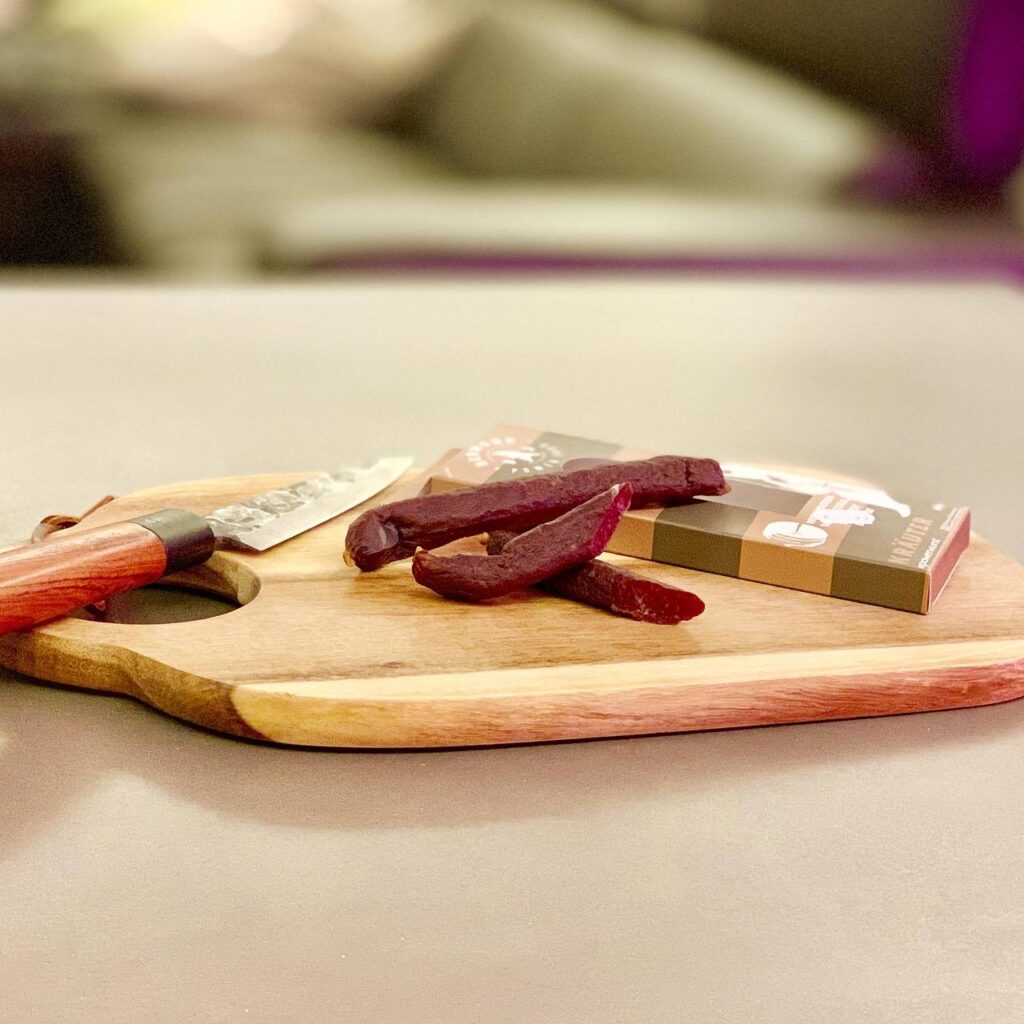
Bavaria’s own culinary register centers Brotzeit on the Radi, the radish, eaten raw, thinly sliced, salted, and gladly paired with a pretzel, framing Brotzeit more broadly as a platter built around items like Radi, Wurstsalat (sausage salad) and Obatzda, often with hearty rolls on the side. Munich’s own tourism content puts the same idea in plainer terms: a snack platter of assorted sausages, ham, cheese, radishes and pickles, which it calls “Bavarian tapas-style” fare, a comparison that gets at the spirit of it even if the ingredients are entirely different12.
A Bavarian tourism page adds pretzels, Obatzda, white radishes, black bread, pickled gherkins and a pork-fat spread to the traditional lineup4. There is no fixed recipe, which is the point: a Brotzeit board can be as simple as bread, butter and radishes, or as full as a spread of Obatzda, cold cuts, cheese and pickles. What holds it together is that everything on it is meant to be eaten cold, assembled rather than cooked, and shared at the table rather than plated individually.
Resi says The register gives the radish more credit than you would expect from a garnish. One is said to cover an adult’s entire daily vitamin C requirement, and it is called “ein scharfes Stärkungsmittel,” a pungent fortifying agent, with a history as laborer’s food going back to ancient Egypt. I believe every word of it; nothing else on the board wakes your mouth up quite the same way, or quite that fast.
Why you can bring your own food to a beer garden
This is where Brotzeit stops being just a menu item and becomes a legal-sounding house rule. Bavaria’s beer gardens grew out of 19th-century brewers digging cellars into river terraces to store winter-brewed beer through the summer, then planting shade trees, chiefly limes and chestnuts, over those cellars to slow the ice from melting; those shaded plots became popular weekend spots, and brewers started serving beer there directly3.
Once brewers began selling food alongside the beer, professional innkeepers pushed back, worried about the competition. The authorities’ compromise, rather than shutting the brewers down, was to let them keep selling beer at their cellars while barring them from selling food. Guests, left without a food option on site, started bringing their own, and that 19th-century workaround, not any modern regulation, is the documented origin of the bring-your-own-food tradition that marks every genuine Bavarian beer garden and Franconian beer cellar to this day3.
A separate Bavarian tourism page confirms the custom still holds and adds a second requirement: a genuine Biergarten needs two things, guests may bring their own food, and it has to be an actual garden under mature trees rather than a patio with a few planters. King Maximilian I Joseph granted the first such beer-garden license in 18124.
What the 1999 ordinance actually regulates
It is tempting to credit a single law with the bring-your-own-food custom, but that is not what the 1999 Bavarian Beer Garden Ordinance does. The ordinance, issued 20 April 1999 and in effect from 1 May 1999, sets noise-protection rules for beer gardens near housing: daytime hours run 7 a.m. to 11 p.m., with noise limits varying by zoning from 55 to 65 decibels, music has to end by 10 p.m., and food and drink service by 10:30 p.m., so operations wind down before the 11 p.m. cutoff. It was signed in Munich by Barbara Stamm, then Deputy Bavarian Minister-President5.
What it does not do is define what a “Biergarten” is or say anything about outside food. That custom predates the ordinance by well over a century and comes from the brewer-innkeeper compromise above35.
Side by side, the custom and the ordinance cover different ground entirely:
| Rule | What it covers |
|---|---|
| Bring-your-own food | 19th-century custom: brewers barred from selling food, so guests brought their own |
| Must be under mature trees | Defines a genuine Biergarten vs. a plain patio |
| 1999 ordinance, daytime hours | 7 a.m.–11 p.m., zoned noise limits of 55–65 dB(A) |
| 1999 ordinance, service cutoffs | Music by 10 p.m., food/drink service by 10:30 p.m. |
Source: Bayerischer Brauerbund3; Bavaria Tourism4; Bayerische Biergartenverordnung5.
Where to bring a Brotzeit in Munich
The Viktualienmarkt, Munich’s historic food market a few minutes from Marienplatz, is both a place to assemble a Brotzeit and a place to eat one. Its beer garden rotates among the city’s six major breweries roughly every five to six weeks, and the market’s own description is direct about the rule: you may bring your own Brotzeit, but you must buy your drinks in the beer garden6. My full Viktualienmarkt guide covers the market itself in more detail.
Building a Brotzeit board at home
A spread of Bavarian sweet mustard belongs on almost any Brotzeit board that includes sausage or Leberkäse; Händlmaier‘s, the Regensburg-based maker, sells its sweet mustard in a 13.4-ounce jar on Amazon7.
Resi says Add a jar of that, a loaf of dark bread, sliced radishes and, if you want the centerpiece the register itself calls out, a bowl of Obatzda, and you have a reasonable board without needing a single recipe, or a single apology for how simple it is.
Frequently Asked Questions
What does Brotzeit mean?
Literally “bread-time.” It refers to a cold snack platter built around bread, typically with radishes, sausage, cheese, pickles or a cheese spread like Obatzda.
Can you really bring your own food into a Bavarian beer garden?
Yes, at a genuine Biergarten. The custom dates to a 19th-century compromise that barred brewers from selling food, so guests brought their own; it still applies at places like Munich’s Viktualienmarkt, where you buy drinks on site but may bring your own Brotzeit.
Does the 1999 Bavarian ordinance say you can bring your own food?
No. That ordinance regulates noise and operating hours for beer gardens near housing. The bring-your-own-food custom predates it by more than a century and comes from the 19th-century brewer-innkeeper compromise.
What makes a beer garden "genuine" rather than just a patio with beer?
Two things, per a Bavarian tourism source: guests may bring their own food, and it has to be an actual garden shaded by mature trees, not just planters on a patio.
What is typically on a Brotzeit board?
Radishes, cured sausage or sausage salad, cheese, pickles, bread and often Obatzda, the beer-cheese spread.
Is Brotzeit the same as Obatzda?
No. Obatzda is one item that commonly appears on a Brotzeit board; Brotzeit is the broader category of cold snack platter that Obatzda, along with radishes, sausage and cheese, belongs to.
Related Articles
 Bavarian Food: The Dishes, How Munich Eats Them, and What to Cook at HomeFood
 Obatzda: The Bavarian Beer-Cheese Spread, What Goes in It and How to Make ItFood
 Munich Beer Garden Rules: Bring Your Own Food, Never Your Own BeerBeer
 The Viktualienmarkt: Munich’s Food Market and Its Beer GardenMunich
 The Bavarian Breakfast: Weißwurst, Pretzel, Sweet Mustard and a Morning Wheat BeerFood
 Bavarian Sweet Mustard: What It Is, How to Buy It, How to Make ItFood
 What Is Leberkäse? No Liver, No Cheese, and How Munich Eats ItFood
 Beer Hall or Beer Garden? How Munich’s Two Beer Cultures Differ and Which to PickBeer
Sources
- Radi (radish) and Brotzeit culture — Genussorte Bayern, Bavarian State Ministry of Food, Agriculture and Forestry. Accessed 2026-09-24.
- Bavarian cuisine: these dishes have tradition — Muenchen.de, City of Munich. Accessed 2026-09-24.
- Biergärten — Bayerischer Brauerbund (Bavarian Brewers’ Association). Accessed 2026-09-24.
- Beer garden tradition — Bavaria Tourism (bavaria.travel). Accessed 2026-09-24.
- Bayerische Biergartenverordnung (BayBiergV) — Bavarian State Chancellery, official legal text. Accessed 2026-09-24.
- Viktualienmarkt — Muenchen.de, City of Munich. Accessed 2026-09-24.
- Händlmaier’s Sweet Bavarian Mustard, 13.4 oz — Amazon.com. Accessed 2026-09-24.