In brief
“Oktoberfest beer” today means a specific, legally defined golden lager. Since 2022, “Oktoberfestbier” has held EU Protected Geographical Indication status, meaning it must be brewed in Munich to a fixed specification, complying with both the Munich Purity Law of 1487 and the German Purity Law of 1906. Munich’s own tourism office describes it as having an original wort extract of at least 13.6 percent and an alcohol content between 5.3 and 6.6 percent ABV, golden-yellow and full-bodied, while noting the six tent breweries’ beers still differ noticeably in aroma and finish. That golden beer is newer than the festival itself: “Märzen” is the older amber style, brewed strong in March under a centuries-old seasonal law and stored through summer, and as of 2026, only Hacker-Pschorr’s tent still pours the original amber Wiesnmärzen from the wooden barrel alongside the standard pale beer every other tent serves. A Maß runs €14.80 to €15.90 across the festival’s tents this year.
Disclosure: some links on this page are affiliate links, marked by the products, tours and hotels they name. As an Amazon Associate, bavarianbistro.com earns from qualifying purchases. A purchase through these links may earn the site a commission at no cost to you, and it never affects what is recommended. How this works. Product prices and availability shown are as of the date stated and can change; the Amazon price at checkout applies.
Order “the Oktoberfest beer” today and what lands in front of you is a golden, strong, easy-drinking liter that is heavier than it looks, not the darker beer the festival’s earliest visitors would have known. Märzen and Festbier are shorthand for that split: Märzen the old amber style born from a centuries-old brewing calendar, Festbier the plain German word for whatever the tents actually pour now. Here is what the record supports about each, and I will say upfront that I ordered a Radler through most of my own years at the Wiesn, so take my beer opinions with the grain of salt they deserve. This page sits in my Bavarian beer guide, alongside the fuller Oktoberfest guide.
Why "Märzen" is a season, not a color
Duke Albrecht V’s 1553 Landesordnung restricted the brewing of bottom-fermented “Braunbier” to the cooler months, between Michaeli (September 29) and Georgi (April 23); Duke Maximilian I’s 1616 Polizeiordnung reaffirmed the same seasonal limit, though wheat beer could be brewed year-round under the same rules3.
The practical effect was that brewers made a stronger, more heavily hopped batch in March, the last month the law allowed, specifically to survive being stored through the warm months until the next season’s beer was ready. That storage logic, not a particular shade of amber, is where the word “Märzen” comes from.
What "Oktoberfestbier" is, legally, today
Since 2022, “Oktoberfestbier” has carried its own EU Protected Geographical Indication, one step more specific than the older “Münchener Bier” designation, registered in 1998, or “Bayerisches Bier,” registered in 20015.
The PGI means the beer must be brewed exclusively in Munich according to its specification, complying with both the Munich Purity Law of 1487 and the German Purity Law of 1906. Only beer from “established and reputable traditional Munich breweries” may be served at the festival at all, a rule that in practice limits the pour to six names: Augustiner, Hacker-Pschorr, Hofbräu, Löwenbräu, Paulaner and Spaten1.
Munich’s own tourism office describes what that specification produces in the glass: an original wort extract of at least 13.6 percent, an alcohol content between 5.3 and 6.6 percent ABV, a golden-yellow color, and a relatively full-bodied, easy-drinking character. It adds an honest caveat that matters if you are tent-hopping: despite those shared requirements, the beers differ noticeably in their malt and hop aromas, bitterness and finish2.
Augustiner’s own description of its Oktoberfestbier, for instance, cites 6.3 percent ABV and “a very soft, but full-bodied and rounded character” that comes from extended cold storage6.
Resi says That is the one I would point you to first if a tent gives you the choice. My own order at the Wiesn tended to be something with more lemon soda in it than beer, but Augustiner’s Oktoberfestbier is the one that seems to leave the most satisfied faces at the next table.
So is today's Oktoberfest beer a Märzen?
Mostly, no, and one brewery’s own tent menu makes the point better than any outside source could. At Hacker-Pschorr’s tent specifically, “the original amber-colored Wiesnmärzen from the wooden barrel is served in addition to the well-known pale Oktoberfest beer”1.
Read carefully, that sentence tells you two things at once. The pale, golden PGI-specification beer is the standard pour across the festival, and the old-style amber Märzen has become enough of a throwback that only one tent still offers it, and offers it as an addition to, not instead of, the modern beer. “Festbier,” literally “festival beer,” is the plain-language way people describe that modern golden style when they want a word other than the legally protected “Oktoberfestbier.”
Märzen then, Oktoberfestbier now
| Historic Märzen | Modern Oktoberfestbier | |
|---|---|---|
| Why it exists | 1553/1616 law restricted brewing to cooler months; brewed strong in March to store through summer | Purpose-brewed for the festival under a fixed 2022 EU specification |
| Color | Amber | Golden-yellow |
| Legal status today | No longer the standard pour; kept alive as a specialty | EU Protected Geographical Indication since 2022, Munich-only |
| Where to find it in 2026 | Hacker-Pschorr’s tent, as the “Wiesnmärzen,” alongside the standard beer | Every one of the six official Oktoberfest breweries |
| Typical strength | Not given in current specification form | 13.6%+ original wort extract, 5.3–6.6% ABV |
Source: Oktoberfest.de on the tents and the PGI1; the City of Munich on the specification2; Bayerisches Bier on the seasonal law3.
What it costs in 2026
The 2026 Maß price ranges from €14.80 to €15.90 across the festival’s large and small tents, an increase of about 2.38 percent over 2025’s €14.50–€15.80 range, with an official average of €15.614.
The cheapest 2026 beer is at Familienplatzl and the Museumszelt on the Oide Wiesn, at €14.80, and several tents, including Armbrustschützen-Festzelt, Bräurosl and Löwenbräu-Festzelt, are tied at the top price of €15.90; Kufflers Weinzelt, which pours wheat beer rather than the standard Oktoberfestbier, charges a premium of €18.40. For comparison, downtown Munich prices for the same style currently range from €7.70 to €13.40 per liter, the benchmark the city itself uses to judge whether festival prices are reasonable, and somewhere between 6 and 7 million liters of beer get drunk at Oktoberfest each year4. All of that liquid has to go somewhere eventually, and the toilet lines at the Wiesn are their own kind of festival tradition, one I always budgeted for a little better than the people laughing at my Radler.
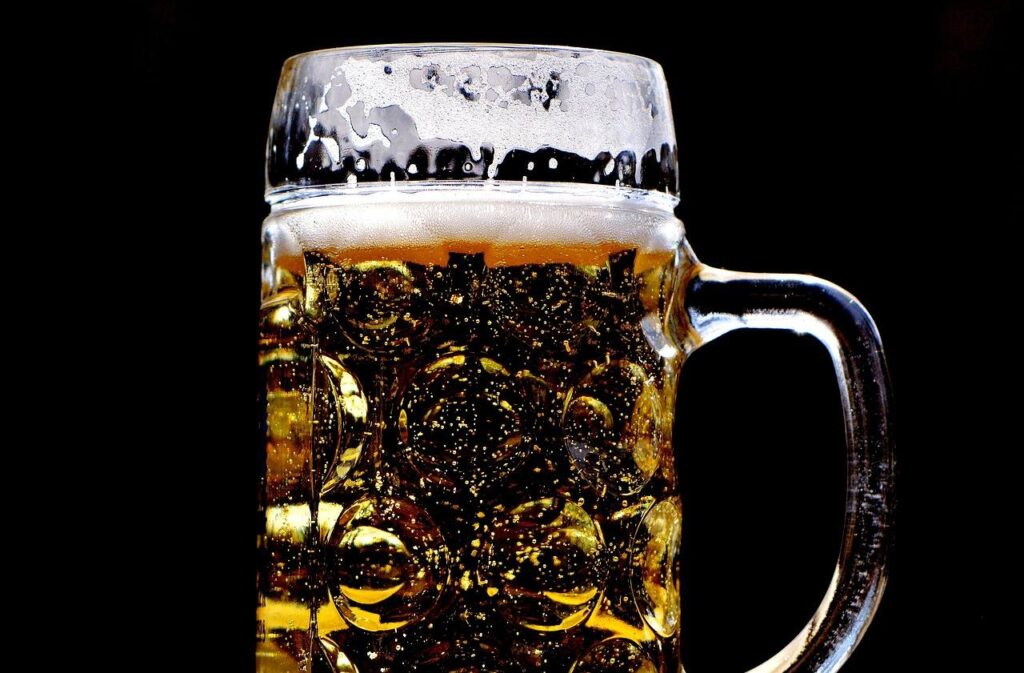
However you drink it, it comes in a Maß, the festival’s standard one-liter measure. A 1-liter dimpled glass beer stein modeled on the Hofbräuhaus Maßkrug is sold on Amazon, if you want the size at home7.
Resi says Buy the stein before your first Oktoberfest, not after; you will want to know what a full liter actually feels like before a server hands you one with both hands and a straight face.
Frequently Asked Questions
Is Oktoberfest beer the same as Märzen?
Not anymore. Modern Oktoberfestbier is a golden, EU-protected style brewed to a fixed 2022 specification; the older amber Märzen is now a specialty that, as of 2026, only Hacker-Pschorr’s tent still pours.
Why is Märzen brewed in March?
Because a 1553 ducal law, reaffirmed in 1616, restricted bottom-fermented beer brewing to the cooler months. Brewers made a stronger batch in March, the last month allowed, to store through summer.
What breweries are allowed to serve beer at Oktoberfest?
Six: Augustiner, Hacker-Pschorr, Hofbräu, Löwenbräu, Paulaner and Spaten.
How strong is Oktoberfest beer?
Munich’s tourism office gives an original wort extract of at least 13.6 percent and an alcohol content between 5.3 and 6.6 percent ABV.
Is "Oktoberfestbier" a legally protected name?
Yes. It has held EU Protected Geographical Indication status since 2022 and may only be brewed in Munich to its specification.
How much does a Maß cost at Oktoberfest in 2026?
Between €14.80 and €15.90 depending on the tent, with Kufflers Weinzelt’s wheat beer priced separately at €18.40.
Can I still get the old-style amber Märzen at Oktoberfest?
As of 2026, Hacker-Pschorr’s tent serves it as the “Wiesnmärzen,” alongside the standard pale Oktoberfest beer.
Related Articles
 Bavarian Beer, Explained: Styles, Breweries, Beer Halls and Beer GardensBeer
 Oktoberfest in Munich: Dates, Tents, Reservations, What to Wear and What It CostsOktoberfest
 Bavarian Beer Styles: Helles, Dunkel, Weißbier, Märzen, Bock and the RestBeer
 The Reinheitsgebot Explained: What the 1516 Purity Law Says and What It Means TodayBeer
 How Much Does Oktoberfest Cost? A 2026 Budget in Euros and DollarsOktoberfest
 Munich’s Big Six Breweries: What Each One Is Known For and Which to VisitBeer
 How Big Is a Maß? Bavarian Beer Sizes in Ounces, ExplainedBeer
Sources
- The Six Munich Breweries at Oktoberfest — Oktoberfest.de. Accessed 2026-09-24.
- Beer Prices 2026: Breweries — City of Munich (muenchen.de). Accessed 2026-09-24.
- Geschichte des Weißbieres — Bayerisches Bier (Bayerischer Brauerbund). Accessed 2026-09-24.
- Oktoberfest Beer Prices 2026 — Oktoberfest.de. Accessed 2026-09-24.
- Bayerisches Volksgetränk — Bayerisches Bier. Accessed 2026-09-24.
- Unser Bier: Oktoberfestbier — Augustiner Bräu. Accessed 2026-09-24.
- 1 Liter HB “Hofbrauhaus Munchen” Dimpled Glass Beer Stein — Amazon.com. Accessed 2026-09-24.