In brief
Oktoberfest did not start as a beer festival. It started as a horse race, thrown to mark the wedding of Crown Prince Ludwig of Bavaria and Princess Therese of Saxe-Hildburghausen on October 12, 1810, with the race itself run on October 17 on a meadow that was named Theresienwiese in the bride’s honor. It grew, in fits and starts, into an annual municipal event with beer tents, rides and a tapping ceremony, and it has been cancelled by wars, cholera, inflation, a bombing and a pandemic along the way. Today it calls itself the largest folk festival in the world, and it draws around six million visitors a year.
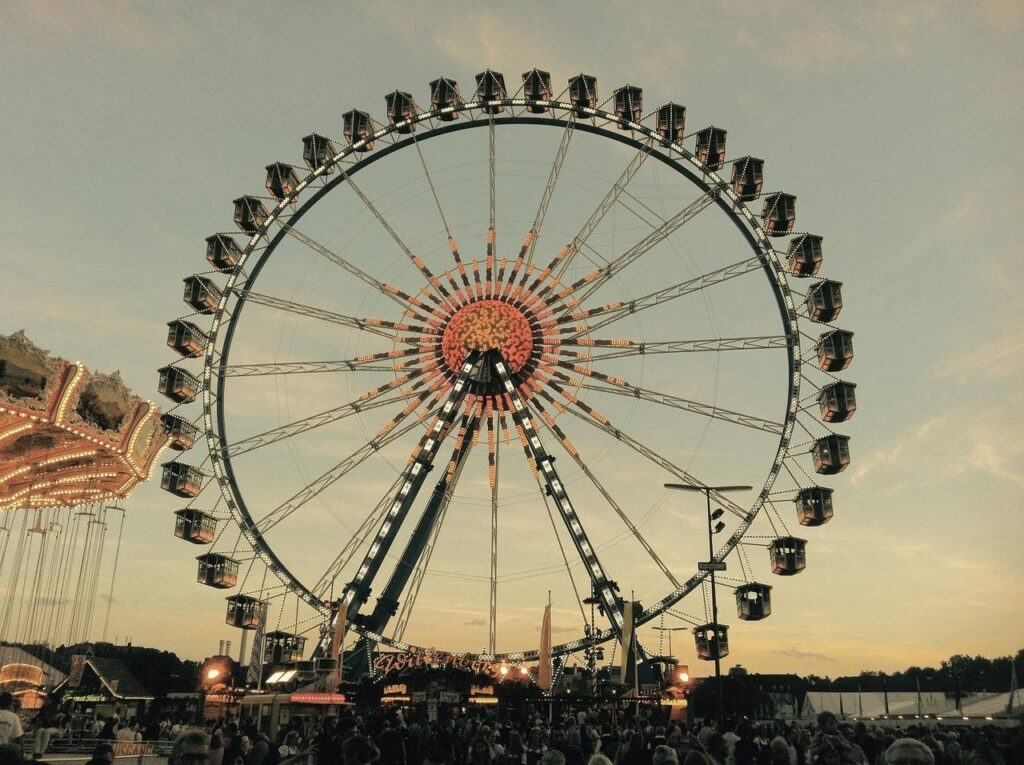
If you have ever wondered why a beer festival is named after a month it mostly does not take place in, the short answer is a wedding, a horse, and 216 years of Munich deciding what to do with both. This is the story of how a five-day royal celebration turned into the Wiesn, the eleven-day-to-eighteen-day festival that closes out the northern summer every year, and my complete guide to Oktoberfest in Munich is where to go next for the parts you actually need to plan a trip.
A wedding, not a beer festival
The whole thing began with Crown Prince Ludwig, later King Ludwig I of Bavaria, marrying Princess Therese of Saxe-Hildburghausen. A Bavarian National Guard officer named Andreas Michael Dall’Armi proposed marking the occasion with a horse race, the wedding took place on October 12, 1810, and the official festivities ran five days, ending on October 17 with that race, held on a meadow just outside Munich’s gates1. The meadow was christened “Theresens-Wiese” for the bride, and Munich still shortens it to “the Wiesn” without a second thought. Dall’Armi got a gold citizens’ medal out of it in 1824, which is a reasonable return for one good idea about a horse race.
There was no beer tent in 1810. There was a race, a wedding party, and a field. Everything else came later, a piece at a time.
From a one-time race to a fixture on the calendar
The city noticed the revenue potential fast: by 1819, Oktoberfest was an official annual municipal event, not a one-off wedding anniversary. The beer vendors were capped at eighteen booths in 1825, arranged in a circle called the Wirtsbudenring, and the Bavaria statue that still watches over the grounds went up in 18501. The chicken rotisserie that gave the festival its Wiesnhendl arrived in 1881, and it was 1898 before the showman Georg Lang put up the first proper beer tent, the “1. Bayerische Riesenhalle,” replacing the old individual booths1. By 1907, six brewery tents had replaced what was left of the Wirtsbudenring stalls, and in 1930 the grounds were laid out roughly as they still are, along the Wirtsbudenstraße and Schaustellerstraße.
Rides were part of the picture almost from the start, if modestly: a carousel and two swings went up in 1818, and the German fairground boom of the 1880s expanded that considerably1. By the centennial in 1910, the Pschorr-Bräurosl tent, then the largest on the grounds, had a 12,000-person capacity and reportedly served 12,000 hectoliters of beer that year1. The festival had stopped being a wedding memory and become an industry.
One quirk from this same stretch of history explains a question every first-time visitor asks: why does “Oktoberfest” run mostly in September? Munich moved the start date earlier beginning in 1872, in its own words “because the weather in October was usually already cooler and the days are significantly shorter”2. The festival still always ends on the first Sunday in October unless that Sunday would fall before October 3, German Unity Day, in which case it runs a day or two longer to include it, which is why some years are sixteen days and others stretch to eighteen2.
The years the tents stayed empty
Oktoberfest has been cancelled more often than the marketing suggests, and the festival’s own historical account, while it does not claim to be a complete list, names several stretches when Munich called the whole thing off: 1813, for the fighting of the Napoleonic Wars; 1854 and again in 1873, for cholera outbreaks, the 1854 epidemic alone bringing roughly 15,000 cases and 7,730 deaths to the city; 1866, when Bavaria was drawn into the Austro-Prussian War; 1914 to 1918, for the entirety of the First World War; and 1923, when hyperinflation made a festival unaffordable3. During the Second World War the Wiesn was cancelled outright, and Munich celebrated only a scaled-down “autumn festival” from 1946 to 1948 before the real thing returned3. Most recently, the coronavirus pandemic forced a two-year hiatus in 2020 and 20213. Among them, these are the cancellations the festival itself records; a run this old almost certainly has quieter gaps the official history glosses over.
The 1980 bombing
On September 26, 1980, a bomb exploded at the Oktoberfest’s main entrance, killing thirteen people and injuring more than two hundred1. The man responsible, Gundolf Köhler, died in the blast himself, and for decades the case was treated as the act of a lone, disturbed individual. A reinvestigation carried out between 2014 and 2020 reached a different conclusion: an act of right-wing extremist terrorism aimed at influencing the 1980 federal election1. It remains the deadliest attack in postwar German history connected to a public event of this kind, and the festival did not close for it; it continued, and continues.
O'zapft is: a tradition younger than you would think
The image everyone has of Oktoberfest, the mayor tapping the first keg to a cheer, is not from 1810 and is not even especially old. The official tapping ceremony was established on September 16, 1950, by then-mayor Thomas Wimmer, who needed seventeen strikes of the mallet to get his own keg open on the first attempt4. The record since is two strikes, held jointly by former mayors Christian Ude and Dieter Reiter, and matched by Munich’s new mayor Dominik Krause at his first tapping in 20264. The phrase that follows a clean tap, “O’zapft is,” roughly “it’s tapped, to a peaceful Wiesn,” has been said every opening day since, and since 1980 the sitting Bavarian Minister-President has received the first stein poured, straight from the mayor’s hand4.
The Oide Wiesn revival
Not every corner of the festival looks forward. The Oide Wiesn, the “Old Wiesn,” is a deliberately old-fashioned section behind its own fence at the south end of the grounds, and it has been a permanent part of Oktoberfest since 20115. It does not run every single year: every four years it steps aside for the Zentral-Landwirtschaftsfest, Bavaria’s central agricultural festival, with 2028 and 2032 next on that rotation2. It is the closest thing the modern Wiesn has to a memory of what the festival looked like before it became the spectacle it is now.
Six million people, one meadow
Two centuries after a horse race for a royal wedding, Oktoberfest calls itself the largest folk festival in the world and draws around six million visitors a year to that same meadow1. The math of what that many people eat, drink and leave behind is its own story, and my Oktoberfest by the numbers page has the current tally. If you are trying to work out when to go among those six million, the dates and calendar page and the best days and hours page are the two to read next.
Resi says Two hundred and sixteen years is a long time for one idea to survive, and what strikes me most is what did not change: it is still, underneath the tents and the AI crowd cameras, a party the city throws for itself that visitors happen to be welcome at. Dall’Armi wanted a horse race for a wedding. He would not recognize the chicken rotisserie, but I think he would recognize the crowd.
Frequently Asked Questions
When did Oktoberfest start?
It began in 1810, as a horse race on October 17 marking the wedding of Crown Prince Ludwig of Bavaria to Princess Therese of Saxe-Hildburghausen five days earlier.
Why is it called Oktoberfest if it happens in September?
The festival ran in October until 1872, when organizers moved the start earlier because the weather was already turning cold and the days were shorter later in the month.
Has Oktoberfest ever been cancelled?
Yes, several times: for the Napoleonic Wars in 1813, cholera outbreaks in 1854 and 1873, the Austro-Prussian War in 1866, both World Wars, hyperinflation in 1923, and the coronavirus pandemic in 2020 and 2021.
What happened at Oktoberfest in 1980?
A bomb exploded at the main entrance on September 26, 1980, killing thirteen people and injuring more than two hundred. A later investigation concluded it was an act of right-wing terrorism.
Who taps the first keg at Oktoberfest?
The mayor of Munich, in a ceremony established in 1950. The mayor announces “O’zapft is” once the tap goes in cleanly, and the festival officially begins.
What is the Oide Wiesn?
A historical section of the festival, with old rides and traditional tents, that has been a permanent feature since 2011, except every fourth year when it makes way for Bavaria’s agricultural festival.
How many people go to Oktoberfest each year?
Around six million, according to the festival’s own figures, making it the largest folk festival in the world.
Related Articles
 Oktoberfest in Munich: Dates, Tents, Reservations, What to Wear and What It CostsOktoberfest
 Oktoberfest Dates: 2026, 2027 and Why It Starts in SeptemberOktoberfest
 Oide Wiesn: The Old-Fashioned Corner of OktoberfestOktoberfest
 Oktoberfest by the Numbers: Visitors, Beer, Chickens and Lost ItemsOktoberfest
 The Oktoberfest Parades: Brewers on Saturday, Costumes and Riflemen on SundayOktoberfest
 The Oktoberfest Dictionary: Wiesn, Maß, O’zapft is and 40 More WordsOktoberfest
 Oktoberfest for First-Timers: What Nobody Tells YouOktoberfest
Sources
- The history of Oktoberfest — oktoberfest.de, City of Munich. Accessed 2026-09-26.
- FAQs for Wiesn visitors — oktoberfest.de, City of Munich. Accessed 2026-09-24.
- War, bombs, cholera and the history of Oktoberfest — oktoberfest.de, City of Munich. Accessed 2026-09-24.
- Der Anstich — muenchen.de, City of Munich. Accessed 2026-09-24.
- The Oide Wiesn — oktoberfest.de, City of Munich. Accessed 2026-09-24.