In brief
Regensburg is Germany’s best-preserved medieval city, and it does not undersell itself: its own tourism board describes it as a “double UNESCO World Heritage” city, listed in 2006 for the old town and again in 2021 when the Danube Limes was added as a second title. The centerpiece is the Steinerne Brücke, the Stone Bridge, built in the twelfth century and billed among the city’s own sixteen highlights as a “Miracle of the Middle Ages”. It reaches Munich by regional train, and the Bayern-Ticket, which starts at €34 for one traveler, is the natural way to cover the ride.
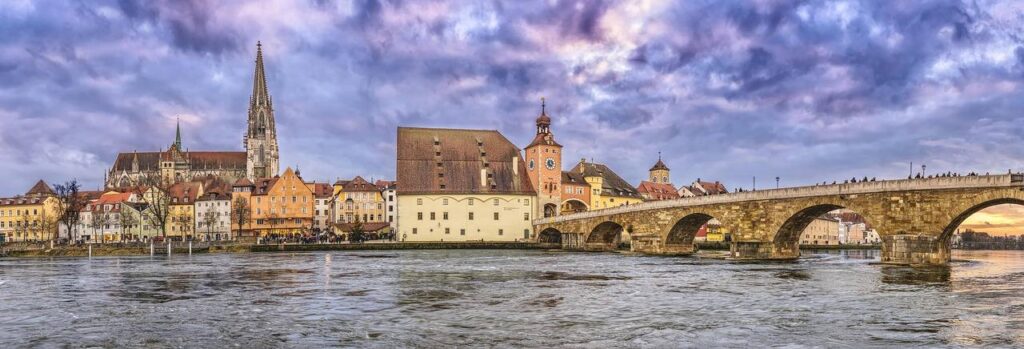
Regensburg gets left off a lot of first-time Bavaria itineraries in favor of the bigger names, Nuremberg for its castle, Bamberg for its beer, and that is a genuine shame, because Regensburg is arguably the most intact medieval city in the country and the least crowded of the three. If “worth it” is the actual question in your search bar, the answer is yes, with one honest caveat: this is a walking city with almost nothing that needs a timed ticket, which means the whole value of the day rides on the old town itself holding your attention, and it does.
Why "double UNESCO" is not marketing
Regensburg’s old town has held UNESCO World Heritage status since 2006, and in 2021 the Danube Limes, the Roman frontier that once ran along the river through the city, was added as a second, separate UNESCO title, which is what lets the tourism board call itself “double UNESCO” without exaggerating1. That combination is unusual: most heritage cities have one designation covering one thing, a cathedral or a historic quarter. Regensburg has two different eras of history, a free imperial city’s medieval core and a Roman frontier beneath and around it, both independently recognized.
The Stone Bridge is the single structure the city puts at the center of its own case for itself, built in the twelfth century and described on its own site as one of sixteen headline highlights, a “Miracle of the Middle Ages” for the engineering it took to cross the Danube at all with the tools of the period1. Walking it costs nothing and takes ten unhurried minutes, and it is the one thing in Regensburg that genuinely earns the description everyone gives it before they have seen it.
Resi says Everyone will tell you about the Wurstkuchl sausage kitchen by the bridge, which claims to be one of the oldest of its kind anywhere, and about the Walhalla monument on the bluff outside town. Both are real, both are popular, and the years and prices you hear for them vary with the teller. Eat the sausages, look at the marble, and let the superlatives wash over you.
What the old town actually gives you
Beyond the bridge, Regensburg’s appeal is the density of the old town itself: a medieval street plan that was never significantly bombed in the war and never significantly rebuilt to look old, because it did not need to be. This is the rare German old town that is not a careful reconstruction, and it shows in details that are hard to fake, uneven stonework, genuinely worn steps, doorways sized for a shorter century. Walking without a fixed itinerary is, honestly, the correct way to spend the day here.
Regensburg’s other advantage over Nuremberg and Bamberg is scale: it is small enough that you are never more than a fifteen-minute walk from the river, and the old town’s narrow streets funnel you back toward the Stone Bridge more or less on their own, so getting lost here mostly means finding another good street you had not seen yet. Ordinary life keeps happening in these same lanes, delivery vans threading past the cathedral, people running errands past buildings older than most countries, which keeps the old town from feeling like a museum piece even on a quiet weekday. That mix, daily life layered over genuinely old stone, is the thing photographs of the Stone Bridge never quite capture, and it is the reason a single unstructured afternoon here tends to outperform a day built around checking off named sights one at a time.
Getting there and back by train
Regensburg sits on Bavaria’s regional rail network, and the Bayern-Ticket is built for exactly this kind of trip: Deutsche Bahn’s day pass starts at €34 for one traveler in second class and scales to €74 for a group of five, covering “all regional trains, transport associations, and nearly all bus lines in Bavaria” while excluding the faster ICE and IC lines. On weekdays the ticket is valid from 9 a.m. to 3 a.m. the next day, and on weekends and holidays it is valid from midnight, which matters less here than at Neuschwanstein or Berchtesgaden since Regensburg has no fixed-time entry ticket forcing an early start. Up to three children aged six to under fifteen travel free with an adult, and younger children always do2. I do not have a verified minute count for the ride itself from an official schedule I have checked personally, so budget the day loosely rather than around a specific arrival time; check bahn.de the morning you travel, since Bavaria’s regional timetable shifts with engineering work often enough that a number printed here could be wrong by the time you read it.
Resi says Of the three northern Bavaria day trips I cover here, Regensburg is the one I would send a first-time visitor to if they only had energy for one no-agenda, no-ticket day. Nuremberg asks you to plan around a castle tour and a somber museum; Regensburg asks you to walk.
Regensburg or a guided version of it
There are guided day trips out of Munich that bundle Regensburg with a coach ride and a walking tour, and I am not recommending one, because Regensburg does not need a guide the way a site with fixed-entry rules like Neuschwanstein does; a paper map and a willingness to double back down an interesting street covers most of what a guide would tell you, and the money saved buys a long lunch by the Danube instead.
Frequently Asked Questions
Is Regensburg worth a day trip from Munich?
Yes. It is Germany’s best-preserved medieval old town and carries double UNESCO status, and unlike Nuremberg or Neuschwanstein it has no timed-entry ticket forcing your schedule.
How do you get from Munich to Regensburg without a car?
By regional train, covered by the Bayern-Ticket, Deutsche Bahn’s regional day pass for Bavaria.
What is the Steinerne Brücke?
Regensburg’s twelfth-century Stone Bridge across the Danube, one of the city’s own headline highlights and free to walk.
Why does Regensburg call itself "double UNESCO"?
Its old town was listed as a World Heritage Site in 2006, and the Danube Limes, the Roman river frontier through the city, was added as a second, separate title in 2021.
Is one day enough for Regensburg?
Yes, for the old town and the Stone Bridge; a second day would only make sense paired with a nearby destination like Passau.
Do you need to book anything in advance for Regensburg?
No single major sight in the old town requires the kind of timed-entry booking that Neuschwanstein or Nuremberg’s Documentation Center does.
Is Regensburg quieter than Nuremberg or Bamberg?
It gets meaningfully less tourist traffic than either, which is part of its appeal for a slower, unscheduled day.
Related Articles
 Bavaria by Train: Day Trips from Munich and a Week Without a CarBavaria
 Nuremberg Beyond the Christmas MarketBavaria
 Bamberg Day Trip: The Old Town, Little Venice and the BeerBavaria
 Passau: Three Rivers, One Cathedral OrganBavaria
 The Bayern-Ticket: One Day of Regional Trains for a Group, ExplainedBavaria
 One Week in Bavaria by TrainBavaria
Sources
- Regensburg — tourismus.regensburg.de, City of Regensburg. Accessed 2026-09-27.
- Bayern-Ticket — bahn.de, Deutsche Bahn. Accessed 2026-09-27.