In brief
Steckerlfisch is a whole fish, skewered lengthwise and grilled slowly over embers until the skin blisters and turns crisp, which Bavaria’s own register of specialties names as the entire point of the dish. The fish are freshwater species from the lakes, rivers and fish farms south of Munich, mainly trout, salmon trout and a whitefish called Renke. At Oktoberfest, where the dish is a fixture, the fish mostly come from Lake Chiemsee, and the tent built around it, Fischer-Vroni, grills them along a line of open fires about 15 meters long. It comes wrapped in paper or on a plate with a pretzel or a bread roll, and you eat it with your hands, standing up, bones and all if you are brave about it.
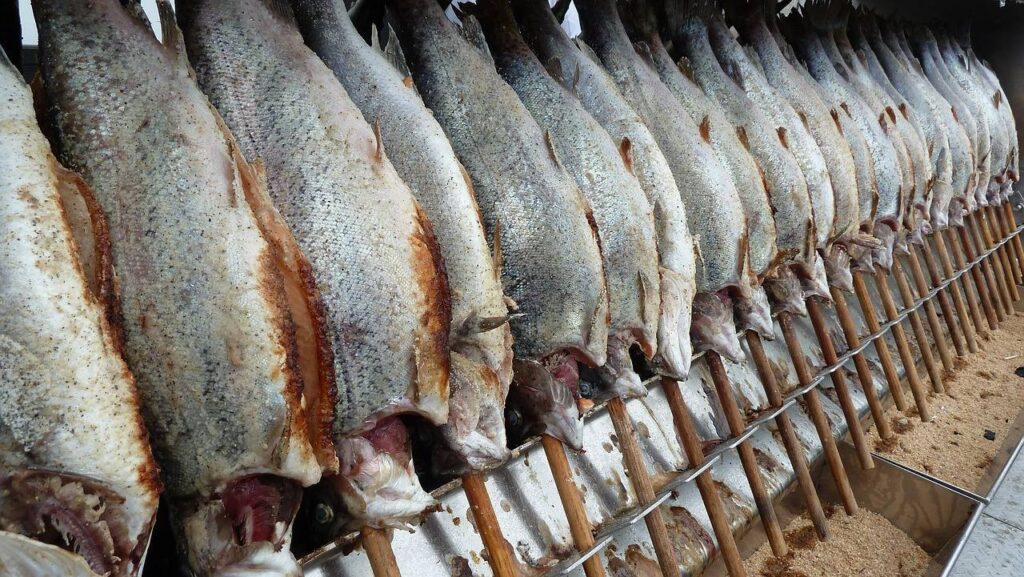
If you have ever followed your nose through an Oktoberfest tent and ended up somewhere that smells like a campfire that caught a fish, you have found Steckerlfisch, and you are exactly where you should be. It is the one Wiesn dish that gets cooked in front of you instead of behind a counter, on open grills long enough that you can walk past twice before you see the end of them. It belongs in my guide to Bavarian food for that reason alone: nothing else on the fairground is this visible about how it gets made.
What Steckerlfisch actually is
The name is literal. “Steckerl” is the stick, “Fisch” is the fish, and Bavaria’s culinary register defines the dish as exactly that: a skewered, heavily seasoned fish, with the crisp skin as its defining feature1. The fish is threaded onto a wooden or metal skewer, seasoned, and set at an angle over an open charcoal fire so the skin faces the heat directly while the flesh inside stays moist.
The fish themselves are not exotic. The register lists trout, salmon trout and a lake whitefish called Renke, along with other whitefish species, all pulled from lakes, rivers and fish farms in the country south of Munich, and calls the dish a specialty of Upper and Lower Bavaria specifically for that reason1. This is a dish built on what is nearby, not on anything shipped in.
A fixture of the folk festival
The register describes Steckerlfisch as a typical delicacy at folk festivals, and singles out Oktoberfest by name, noting that the fish served there mostly come from Lake Chiemsee1. That detail is worth sitting with: a lake roughly an hour southeast of Munich supplies a dish eaten by millions of visitors over sixteen days, and the fish still arrives fresh enough to skewer whole.
The Fischer-Vroni tent
If one tent owns this dish, it is Fischer-Vroni, and Oktoberfest’s own site calls its Steckerlfisch famous by name. The tent grills mackerel, whitefish, trout and char along an open-fire grill line that runs about 15 meters down its south side, next to a stork’s nest built into the roof, and pours Augustiner beer from wooden barrels the old way2.
It has real history behind the name: innkeeper Josef Pravida built the half-timbered building in 1904 as the “Fischerhütte zum Holländer,” Karl Winter’s fish company took over sales after the Second World War, and the tent is named for his wife Philippine Winter, known around Munich as “Fischer-Vroni” in her lifetime. Her grandson Hans Stadtmüller runs it today, and in 1998 the whole building moved to Wirtsbudenstraße for fire safety, where it still stands2.
Resi says Fischer-Vroni is not a loud tent by Wiesn standards, and that is exactly why I would go. Everyone there is there for the fish and the beer, not to be seen, and a tent that calm at ten in the morning is a rare thing at Oktoberfest. Get there before the grill line has a crowd around it and you can actually watch your own fish cook.
How it is eaten
You order at the grill, not at a table, and the fish comes wrapped in paper or set on a plate, skewer and all. Peel the skin back with your fingers, pick the flesh off the bone in pieces, and eat it the way you would eat corn on the cob: standing, a little messily, without cutlery. A pretzel or a bread roll on the side is traditional, and both do the job of soaking up whatever grease the paper did not catch1.
Nobody expects delicacy here. The whole point of grilling a fish whole, skin on and bones in, is that you do the work of taking it apart yourself, at a table or, more often, standing at a beer garden bench.
Making it at home
The home version keeps the shape of the original without the open-fire grill line. Pick a whole trout, gut and scale it, season it simply, and thread it onto a long metal skewer lengthwise so it holds its shape over the heat. A charcoal or gas grill set to medium-high does the job a Bavarian wood fire does at the Wiesn: enough heat to blister and crisp the skin before the inside overcooks. Turn it every few minutes and give it long enough that the skin can do what it is supposed to do, which is turn into something worth eating rather than something you peel off and discard.
Serve it the way it is served in Bavaria: on paper or a plate, with a pretzel or a roll, and nothing more complicated than a squeeze of lemon if you want it.
Frequently Asked Questions
What is Steckerlfisch?
A whole fish, seasoned and skewered lengthwise, then grilled slowly over an open fire until the skin turns crisp. It is a specialty of the beer gardens and folk festivals of Upper and Lower Bavaria.
What fish is used for Steckerlfisch?
Freshwater species from the lakes and rivers south of Munich, mainly trout, salmon trout and a whitefish called Renke, along with other whitefish. At Oktoberfest, the fish mostly come from Lake Chiemsee.
Where do you get Steckerlfisch at Oktoberfest?
The Fischer-Vroni tent is the one built around it, with an open grill line about 15 meters long. It is one of the fourteen big tents, so it takes reservations, but part of it is kept for walk-ins.
Do you eat the skin?
Yes. The crisp skin is the reason the dish exists in the first place; a Steckerlfisch with soft skin has been badly grilled.
What do you eat with Steckerlfisch?
A pretzel or a bread roll, eaten with your hands, standing up. It is a beer garden food, so a beer is assumed rather than stated.
Can I make Steckerlfisch without a wood fire?
Yes. A charcoal or gas grill on medium-high heat, with the whole fish threaded onto a long skewer, gets you most of the way there. The wood smoke is a bonus, not a requirement.
Is Steckerlfisch only served at Oktoberfest?
No. It is a beer garden dish year-round in Bavaria, especially in Upper and Lower Bavaria near the lakes the fish come from; Oktoberfest is simply where it gets the most attention.
Related Articles
 Bavarian Food: The Dishes, How Munich Eats Them, and What to Cook at HomeFood
 Oktoberfest Food: What to Eat in the Tents and at the StallsOktoberfest
 Wiesn Hendl: Oktoberfest Roast Chicken, and How to Make It at HomeFood
 Oktoberfest in Munich: Dates, Tents, Reservations, What to Wear and What It CostsOktoberfest
 Munich Beer Garden Rules: Bring Your Own Food, Never Your Own BeerBeer
 Bavarian Beer, Explained: Styles, Breweries, Beer Halls and Beer GardensBeer
Sources
- Steckerlfisch — GenussErbe Bayern, Bavarian State Ministry of Food, Agriculture and Forestry. Accessed 2026-09-26.
- Fischer-Vroni: Reservation, atmosphere, history — Oktoberfest.de. Accessed 2026-09-26.