In brief
Munich beer gardens run on one custom and one law. The custom, dating to a nineteenth-century dispute between brewers and professional innkeepers, lets you bring your own food into “every genuine Bavarian beer garden,” but it never extended to beer, which stayed the house’s exclusive product to sell. The law, the 1999 Bavarian Beer Garden Ordinance, sets a beer garden’s operating day as 7 a.m. to 11 p.m., requires music to stop by 10 p.m. and food and drink service to end by 10:30 p.m. so the site clears by curfew. Germany’s Youth Protection Act sets the drinking age for beer and wine at 16, with an exception when a minor is with a parent or legal guardian. None of it is enforced by a sign at the gate. It is enforced by everyone else at the table already knowing it.
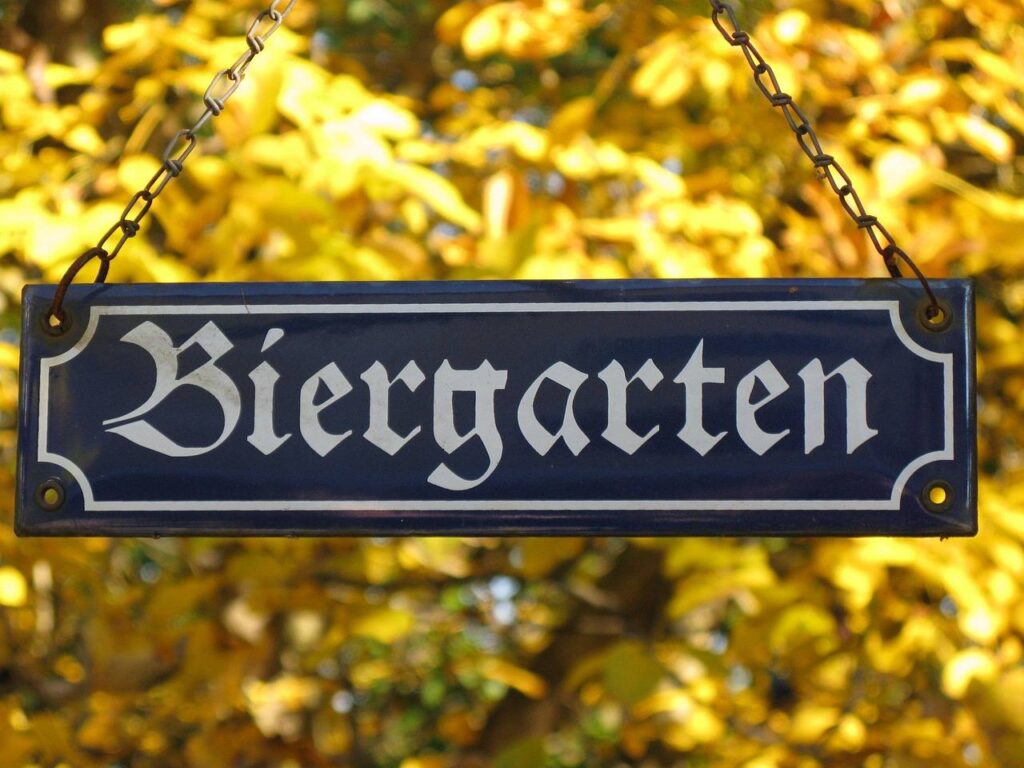
Every guidebook mentions that you can bring a picnic into a Munich beer garden, delivers that one fact like it settles the whole subject, and then wanders off, leaving you to learn the rest by making a mistake in public. It does not settle the whole subject. This page covers where the food rule actually comes from, what it very much does not cover, what the law everyone credits for it actually regulates, and the drinking-age rule that quietly ambushes visiting families. It is part of my Bavarian beer guide; for the difference between a beer garden and an indoor beer hall, see beer hall or beer garden.
Where "bring your own food" actually comes from
The custom is older than most of the buildings it happens in. Nineteenth-century Bavarian brewers ran ice-cooled cellars, shaded with trees, to keep their summer beer cold, and once those shaded plots became popular gathering spots, the brewers began serving beer there directly. Professional innkeepers, who were licensed to sell food and worried about the competition, petitioned the authorities to stop the brewers from doing the same, and the compromise settled the matter for good: brewers were barred from selling food at their beer gardens, while guests were permitted to bring their own, “a tradition that marks every genuine Bavarian beer garden and Franconian beer cellar to this day”1. It was never a general right to bring your own refreshments. It was a specific trade, and the brewers kept the exclusive right to sell what they made while losing the right to sell what they did not.
Resi says “Bring your own food, never your own beer” is not really two rules, whatever it sounds like. It is one nineteenth-century deal that has never once been renegotiated, and it did not get more flexible just because you found a really good rosé. Walking in with a cooler of your own beer does not extend the tradition, it breaks the one that is actually there, and I have zero sympathy for anyone who tries to relitigate it with a waiter who has heard that argument approximately a thousand times before.
What the 1999 ordinance actually regulates
The Bayerische Biergartenverordnung, issued 20 April 1999 and in effect from 1 May 1999, is a noise-protection regulation aimed at beer gardens near housing. It is not a definition of what a beer garden is, and it is not where the food custom comes from2. Its provisions break down by section:
| Section | What it sets |
|---|---|
| §1 | Scope: noise-protection requirements for beer gardens near residential development |
| §2(1) | “Daytime” for beer gardens is 7:00–23:00; noise limits are 65 dB(A) in mixed/core/village zones, 60 dB(A) in general residential zones and 55 dB(A) in pure residential zones, per the TA Lärm noise standard of 26 August 1998 |
| §2(2) | To protect the 23:00 night-rest cutoff, music must end by 22:00, food and drink service by 22:30, and operations must wind down so traffic clears by 23:00 |
| §2(3) | Authorities may set different rules for special circumstances |
| §3 | Took effect 1 May 1999 |
Source: Bayern.Recht, BayBiergV2.
The ordinance says nothing about food you bring yourself. That custom was already a hundred years old when the ordinance was signed in Munich by Barbara Stamm, then Deputy Bavarian Minister-President2.
Self-service or table service: it changes the etiquette
Not every part of a beer garden runs the same way. The Königlicher Hirschgarten splits into a roughly 500-seat indoor section, a 1,200-seat area with table service, and a self-service area for about 7,000 more, by its own description4. In the self-service section, you collect your own beer at the counter, find a table, and unpack whatever food you brought. In the table-service section, a waiter takes your order the way one would in a beer hall, and the outside-food custom sits more awkwardly next to a menu someone is actively bringing you. When a beer garden is large enough to have both, working out which section you are in before you spread out a Brotzeit board saves an argument with the waitstaff over a table that was never meant for it.
The drinking age, for visiting families
Germany’s Jugendschutzgesetz, §9, governs who can be sold or served alcohol. Beer, wine, wine-like drinks and sparkling wine may not be sold to or consumed by anyone under 16 in a restaurant, a shop, or in public generally, and that age limit does not apply if the minor is accompanied by a parent or legal guardian; spirits, by contrast, are off-limits to minors of any age regardless of who they are with, and alcohol vending machines are banned from public places unless they are technically secured against minors3. In practice, this means a 15-year-old at a family table can be served a beer if a parent is there, and a 15-year-old with friends and no parent cannot be served at all.
The rules of the table
- Find a seat, then ask. Long tables are shared as a matter of course. “Ist hier noch frei?” (is this seat still free?) is the phrase, and it works.
- Order your own beer. The kitchen and the taps belong to the house; your picnic basket does not extend to the tap.
- Keep your food modest and self-contained. The custom is a picnic, not a catered spread competing with the kitchen next to it.
- Watch the clock in the evening. With music off by 10 p.m. and service ending by 10:30 p.m. under the ordinance, a beer garden winds down earlier than a beer hall does2.
- Know the age rules if you have teenagers with you. Sixteen is the line for beer and wine, and it moves only if a parent or guardian is present3.
Resi says My own drink of choice in a beer garden was never beer; it was a Radler, half beer and half lemon soda, which tastes like a reward for good behavior and gets you through an entire long table of small talk at half the strength. Whatever you order, budget for the toilet line before you need it, not after. I have watched more than one visitor discover, always a little too late, that a liter of anything eventually wants to leave the same way it came in, and the queue for the facilities does not care in the slightest how well your afternoon was going.
Frequently Asked Questions
Can you bring your own food into a German beer garden?
Yes. It is a documented nineteenth-century custom, the result of a compromise between brewers and innkeepers, and it marks every genuine Bavarian beer garden and Franconian beer cellar to this day.
Can you bring your own beer into a Munich beer garden?
No. The same nineteenth-century compromise that allows outside food kept beer sales as the brewers’ exclusive right; bringing your own beer was never part of the custom.
What are the legal hours for a Bavarian beer garden?
The 1999 ordinance sets the “daytime” operating window at 7 a.m. to 11 p.m., with music ending by 10 p.m. and food and drink service by 10:30 p.m.
What is the legal drinking age for beer in Germany?
Sixteen, for beer, wine and similar drinks, under the Jugendschutzgesetz, §9. The age limit does not apply when a minor is accompanied by a parent or legal guardian.
Does a 1999 law require beer gardens to allow outside food?
No. The 1999 ordinance is a noise regulation covering hours and decibel limits; the food custom is nineteenth-century and predates it by more than a hundred years.
What is the largest beer garden in Munich?
The Königlicher Hirschgarten, open since 1791, which describes itself as the largest beer garden in the world, with roughly 500 indoor seats, 1,200 in its service area and 7,000 in self-service.
Related Articles
 Bavarian Beer, Explained: Styles, Breweries, Beer Halls and Beer GardensBeer
 Beer Hall or Beer Garden? How Munich’s Two Beer Cultures Differ and Which to PickBeer
 Munich Beer Gardens: The Big Ones, the Quiet Ones and How to ChooseBeer
 Is the Hofbräuhaus Worth It? An Honest Look at Munich’s Most Famous Beer HallBeer
 Drinking Age and Beer Laws in Germany: What Applies to VisitorsBeer
 How to Order a Beer in Bavaria: The Words, the Tip, the Stammtisch and the NoagerlBeer
 Andechs from Munich: The Monastery Beer Garden and the Hike Up to ItBeer
Sources
- Biergärten — Bayerischer Brauerbund (bayerisches-bier.de). Accessed 2026-09-24.
- Bayerische Biergartenverordnung (BayBiergV) — Bayern.Recht, Free State of Bavaria. Accessed 2026-09-24.
- Jugendschutzgesetz, §9 — Bundesministerium der Justiz. Accessed 2026-09-24.
- Königlicher Hirschgarten — Hirschgarten. Accessed 2026-09-24.