In brief
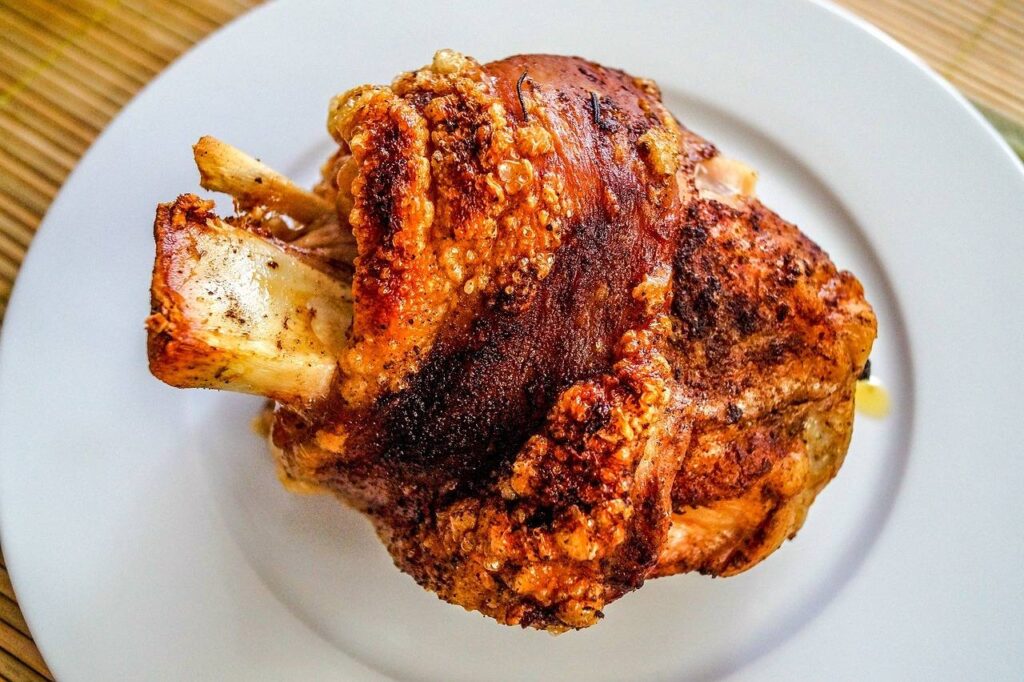
Ask an American butcher for a “pork knuckle” and you will likely get a blank look, because the cut Bavaria calls Schweinshaxe is a hock on this side of the ocean, not a knuckle in the regulatory sense. Farms selling it direct online include White Oak Pastures at $15.99 for a 5-pound pack and Wachholz Family Farm at $4.00 per pound, pickup only. In Canada, The Butcher Shoppe in Arthur, Ontario sells a Frenched pork hock for $9.99, and Berryman Farms in Victoria, BC sells one for $7.97 CAD, though it was sold out when I checked. Order it under “hock,” not “knuckle,” and you will get further faster.
Disclosure: some links on this page are affiliate links, marked by the products, tours and hotels they name. As an Amazon Associate, bavarianbistro.com earns from qualifying purchases. A purchase through these links may earn the site a commission at no cost to you, and it never affects what is recommended. How this works. Product prices and availability shown are as of the date stated and can change; the Amazon price at checkout applies.
The gap between what a recipe calls for and what a butcher counter has on hand is mostly a translation problem, not a supply problem. This page sorts out the cut names and points you at the farms and shops that will actually ship or sell you one, as part of my guide to cooking Bavarian in North America.
What the cut is actually called
Bavaria’s own register of specialties defines Schweinshaxe’s cut plainly: the part of the pig’s leg between the knee or elbow joint and the foot joints, including the fatty rind. In English, that part goes by three overlapping names, and North American butchers do not use them interchangeably with the German original.
The Canadian Food Inspection Agency’s own official meat-cuts manual is the clearest regulatory source on the terms. It defines a hock as the portion of the shoulder separated from the foot and from the shoulder picnic by a cut through the base of the arm bone, and a shank as the portion of the leg separated from the foot and from the leg’s shank portion by a cut through roughly the midpoint of the shank bones. Notably, the manual does not define “knuckle” as its own retail cut at all; the word only appears in an anatomical sense, the head of the femur at the hip6. In practice, that means the front-leg version of this cut, the one Schweinshaxe most often uses, is sold in North America as a hock, and “pork knuckle” is a colloquial translation that will not show up on a CFIA-regulated label.
A US food-culture explainer backs up the popular-usage side of the same split: a “pig knuckle,” or ham hock, sits between the fuller ham and the bonier trotter, while the trotter is the foot itself, bony and gristly enough to need overnight soaking before it is cooked7. That source does not weigh in on the shank-versus-hock question directly, but it confirms the everyday habit of calling the joint-adjacent cut a knuckle even where the regulatory language will not.
Resi says Call it a hock when you order, and mention Schweinshaxe or German-style roasting if the person behind the counter looks unsure. “Pork knuckle” is what your recipe says; “hock” is what gets you the actual cut without a second trip.
What Schweinshaxe needs from the cut
My full Schweinshaxe recipe page covers the cooking in detail, but the shopping list is short: a front-leg hock with the rind still on, since the crackling is the point, seasoned simply with salt, pepper and garlic and then roasted or grilled rather than cured. Ask for the rind intact if a butcher offers to trim it; a hock without its skin cannot become Schweinshaxe no matter how it is roasted.
Where to order it online in the US
White Oak Pastures, a pastured farm in Georgia, sells Pastured Pork Hocks in a 5-pound pack for $15.99, describing them on its own product page as “also called pork knuckles” and noting they are commonly used in German, Dutch, Italian, Swedish and Polish cooking. Shipping is free on orders over $249 and $15 on orders over $149; the site does not state a flat charge below that threshold2.
Wachholz Family Farm sells Fresh Hocks at $4.00 per pound, averaging about a pound per pack, describing the cut as coming from the upper part of a pig’s leg and naming German and Austrian cooking directly, roasted with potato dumplings or worked into stews. The page, as fetched, offered pickup locations only, with no shipping option shown3.
I looked for a hock or knuckle listing on Schaller & Weber’s site as well, since it is a well-known German specialty butcher; its online catalog turned up Knackwurst, Lachsschinken and Weisswurst, but no Schweinshaxe or pork-knuckle product on the page I could reach. That does not mean they never carry one, only that I could not confirm it, so call ahead before you plan a menu around them.
Where to order it in Canada
The Butcher Shoppe, in Arthur, Ontario, sells a Frenched Pork Hock for $9.99 from Duroc pork raised on pasture in summer and grain-finished, with cooking guidance on the page itself: cook to 145°F internal and rest five minutes. Shipping is free across Canada on orders above $250, and Toronto-area pickup is also free4.
Berryman Farms, in Victoria, BC, lists a Fresh Pork Hock at roughly 2 pounds for $7.97 CAD, described on the page as local meat prepared in Victoria and good for stock, and mentions a home-delivery option without stating whether that reaches beyond BC. The listing showed sold out at the time I checked, so treat it as a source to watch rather than one to order from today5.
Resi says None of these are the specialty German butcher you might expect; they are pastured-meat farms that happen to sell the cut a Bavarian recipe wants. That is fine. A hock is a hock, and a good farm’s version, skin on, will crisp up in the oven exactly the way Schweinshaxe needs it to.
Getting the crackling right once you have the cut
The skin is the entire reason to buy this cut rather than a boneless roast, and a heavy pan makes the difference between crackling and rubber. A well-seasoned cast iron skillet, the Lodge Pre-Seasoned Cast Iron Skillet among them, holds even, punishing heat for the final sear better than a thin roasting pan does, which matters more here than in almost any other Bavarian dish on this site.
Frequently Asked Questions
Is a pork knuckle the same thing as a ham hock?
In everyday US usage, yes, they refer to the same joint-adjacent cut. Canada’s official meat-cuts manual, however, does not define “knuckle” as a retail cut at all and uses “hock” for the front leg and “shank” for the hind leg.
Can I use a hind-leg shank instead of a front-leg hock for Schweinshaxe?
The traditional cut is the front-leg hock; a shank will cook similarly but the proportion of meat to skin and bone differs.
Do I need to special-order a pork hock, or will a regular grocery store carry it?
Larger supermarkets with a full-service meat counter often carry hocks, especially around the holidays; if yours does not, the farms listed above ship or sell direct.
Why does the skin matter so much for this dish?
The crackling is the point of Schweinshaxe; a hock without its rind intact cannot develop it, no matter how it is cooked.
Is pork knuckle expensive compared to other cuts?
No. At $4 to $10 per hock or per pound depending on the source, it is one of the less expensive cuts sold by any of the farms above.
Do Canadian and US hocks come from the same part of the pig?
Yes, functionally; the naming conventions differ slightly between the US and Canada’s official CFIA definitions, but the physical cut is the same joint.
Related Articles
 Cooking Bavarian in North America: Where to Buy the Ingredients and the Tools That MatterPantry and tools
 Schweinshaxe: Crackling Pork Knuckle, the Beer-Hall WayFood
 Schweinebraten: Bavaria’s Pork Roast with Dark Beer GravyFood
 The German Pantry: Staples to Stock for Bavarian CookingPantry and tools
 Bavarian and German Cookbooks Worth OwningPantry and tools
 Bavarian Food: The Dishes, How Munich Eats Them, and What to Cook at HomeFood
Sources
- Münchner Schweinshaxe — Genussorte Bayern, Bavarian State Ministry of Food, Agriculture and Forestry. Accessed 2026-09-26.
- Pastured Pork Hocks — White Oak Pastures. Accessed 2026-09-26.
- Fresh Hocks — Wachholz Family Farm. Accessed 2026-09-26.
- Pork Hock — The Butcher Shoppe. Accessed 2026-09-26.
- Hocks — Berryman Farms. Accessed 2026-09-26.
- Meat Cuts Manual: Pork — Canadian Food Inspection Agency. Accessed 2026-09-26.
- Pig Knuckle vs. Trotter: What’s the Difference? — The Takeout. Accessed 2026-09-26.