In brief
Develey, founded in Munich in 1845, invented Original Munich Sweet Mustard in 1854 and calls itself Oktoberfest’s official mustard supplier, and it now also owns Löwensenf and Bautz’ner. Löwensenf, based in Düsseldorf, states on its own site that the brand dates to 1903, though it does not spell out the founding-city story sometimes repeated elsewhere. Händlmaier, the Regensburg house Resi buys for her own kitchen, was founded in 1910 and its sweet mustard recipe dates to 1914, and it sells on Amazon US for $14.99 for 13.4 ounces as of September 2026. Thomy, sometimes shelved alongside these, is not a Bavarian or even a German mustard house, and does not belong on this list at all.
Disclosure: some links on this page are affiliate links, marked by the products, tours and hotels they name. As an Amazon Associate, bavarianbistro.com earns from qualifying purchases. A purchase through these links may earn the site a commission at no cost to you, and it never affects what is recommended. How this works. Product prices and availability shown are as of the date stated and can change; the Amazon price at checkout applies.
Ask five Bavarians which mustard belongs on the table and you will get five confident, contradictory answers, but the brands themselves are not actually a mystery once you know who owns whom. This page sorts the real houses from the merely adjacent, as a companion to my pillar on cooking Bavarian in North America, which sends readers here for exactly this question.
Develey: Munich's biggest name, and the one behind two others
Develey was founded in 1845 in Munich by Johann Conrad Develey, and the company’s own history page traces the sweet mustard specifically to 1854, nine years after the shop opened on Kaufingerstraße13. Develey calls itself Oktoberfest’s official mustard supplier, and its US arm, Develey USA, is headquartered in Dyersburg, Tennessee, part of a parent company that runs 17 IFS-certified production facilities and exports to more than 65 countries1.
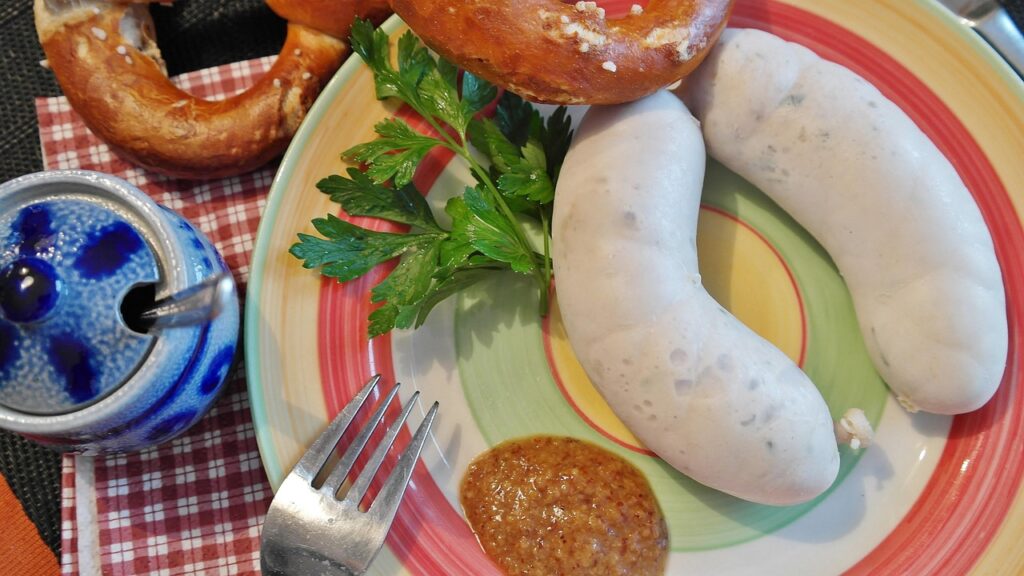
What matters for a shopper is that Develey is not just one jar. The company owns Löwensenf and Bautz’ner outright, and its own product-collection page sorts its range by heat: sweet (“Original Münchner Weißwurst Senf”), medium-hot, hot, plus an American-style yellow mustard and a mustard caviar, all made from mustard seeds, water, salt and vinegar with no animal products3. Its 100 ml Weißwurstsenf tube, priced at €0.99 in Germany, is the primary-source definition of what that word actually means: a sweet, low-heat mustard built specifically for Weißwurst and Leberkäse, not a separate style from “Bayerischer Süßer Senf,” which Develey’s own copy treats as the same product under a second name1.
The Weißwurstsenf tube’s own ingredient list is worth reading once, since it explains why the mustard tastes the way it does: drinking water, brown sugar, mustard seeds, spirit vinegar, caramelized sugar syrup and spices, described on the product page as “a nostalgic blend of subtle sweetness and gentle spiciness” that also works “with Leberkäse, salmon and fondue.” That is a wider job description than most American shoppers expect from a single jar of mustard1.
Löwensenf: the Düsseldorf name Develey now owns
Löwensenf’s own site states plainly that the brand has stood “since 1903,” though a more detailed founding story, sometimes told with a Metz origin and a later move to Düsseldorf, is not something Löwensenf’s own pages confirm, and neither is it something Develey’s own company history mentions2. I would treat the 1903 date as solid, since it comes from the brand’s own homepage, and leave the rest of the story alone until a primary source actually says it.
What is confirmed and current is the US shelf price. Amazon US lists Löwensenf Extra Hot Mustard, a 9.3-ounce jar, at $8.35 with a 4.4-star average across more than 1,100 ratings; Löwensenf Bavarian Sweet Mustard, 10.05 ounces, at $8.73 with a 4.7-star average; and a Düsseldorfer Löwensenf Extra Scharf 200 ml tube at $15.005. A discontinued six-pack listing also turns up in a search but shows as currently unavailable, so do not chase that one.
Resi says The Löwensenf Bavarian Sweet Mustard is a fair stand-in if a store has run out of Händlmaier, and I would rather see it in your cart than a plain American yellow mustard next to a Weißwurst. It is not what I actually keep in my own fridge, though, and I will get to that in a minute.
Bautz'ner and Kühne: two more real houses, not imitators
Bautz’ner Senf & Feinkost, based in Bautzen in Saxony, is also part of the Develey group, and its own site lists three classic mustards by heat and pairing: a medium-sharp style shown with grilled bratwurst, a sharp style with meatballs and potato salad, and a spicy-sweet style with chicken legs, describing its mustards as something that “shouldn’t be missing from any grilling party”6.
Kühne, a vinegar-and-mustard specialist with a company history it describes as “over 130 years” long, sells one of the widest ranges of any German mustard maker: a creamy-mild hot dog mustard, a Bavarian-style sweet mustard, a medium-sharp mustard it calls its bestseller, a coarse grain mustard, an herb mustard, and even jalapeño and habanero versions, sold in glass, tube and squeeze-bottle formats7. Notably, Kühne’s own product page also sells a genuine Dijon mustard, described in-house as “strong, clear and aromatic,” as a separate, distinctly labeled item, which is a German maker’s own admission that Dijon and German-style mustard are not the same recipe wearing two labels7.
Between Bautz’ner and Kühne, a shopper gets two genuinely different personalities rather than two versions of the same jar: Bautz’ner leans into grilling-party pairings with meat and potato salad by name, while Kühne treats mustard as one ingredient among many in a much larger vinegar-and-condiment business. Neither is trying to be Händlmaier’s sweet mustard, and neither should be judged against it.
Händlmaier: the one Resi actually buys
Händlmaier, based in Regensburg, was founded in 1910 by master butcher Karl Händlmaier and his wife Johanna as a butcher shop; Johanna is credited with creating the sweet Bavarian mustard recipe in 1914, the mustard eaten today principally with Weißwurst and Leberkäse4. Ownership stayed inside the family for generations, though the market-share figures sometimes quoted for the brand were not independently confirmed on Händlmaier’s own site and are left out here rather than repeated as fact.
What is confirmed is the US price: Händlmaier’s Sweet Bavarian Mustard, 13.4 ounces, sells on Amazon US for $14.99 with a 4.6-star average across 963 ratings as of September 20264.
Resi says Händlmaier’s is so good I could eat it by itself, straight from the jar with a spoon, and nothing else has come close since. It is the one I pack for camping trips, and it is always a favorite among the friends I bring it to. Nothing compares.
Thomy: not on this list for a reason
Thomy shows up on some grocery shelves next to the real German houses, but it is not a Bavarian mustard, and it is not even a German one; it belongs to a different country’s condiment shelf entirely. If a recipe or a store display treats Thomy as an authentic German option, that is a labeling shortcut worth ignoring; buy one of the five houses above instead.
Frequently Asked Questions
Is Löwensenf owned by Develey?
Yes. Löwensenf is a subsidiary of Develey, which also owns Bautz’ner. All three are separate labels sold as distinct products.
What is the difference between Weißwurstsenf and Bavarian sweet mustard?
Nothing, according to Develey’s own product copy. The two names describe the same sweetened, low-heat mustard made to pair with Weißwurst and Leberkäse.
Which German mustard is closest to Dijon?
None of the classic Bavarian sweet mustards are, since Dijon is sharper and unsweetened. Kühne sells an actual Dijon mustard as a separate product line if that specific style is what you want.
Is Thomy a German mustard brand?
No. Thomy is not a Bavarian or German mustard house and should not be treated as one when you are shopping for the real thing.
What does Händlmaier's sweet mustard cost in the US?
Amazon US lists the 13.4-ounce jar at $14.99 as of September 2026, with a 4.6-star average across 963 ratings.
Is Bautz'ner mustard Bavarian?
No. Bautz’ner is based in Bautzen, in Saxony, though it is now part of the same Develey group that owns the Munich-founded Develey brand and the Düsseldorf-based Löwensenf.
Where can I buy Löwensenf in the US?
Amazon US carries several Löwensenf varieties, including the Bavarian Sweet Mustard and the Extra Hot, both with current listed prices and thousands of combined customer ratings.
Is Develey's mustard the same as Weißwurstsenf?
Yes. Develey’s own product page treats “Original Münchner Weißwurstsenf” and “Bayerischer Süßer Senf” as two names for the same sweet, low-heat mustard, made with mustard seeds, water, brown sugar, spirit vinegar and caramelized sugar syrup.
Related Articles
 Cooking Bavarian in North America: Where to Buy the Ingredients and the Tools That MatterPantry and tools
 German Mustard vs Dijon, and the Best SubstitutePantry and tools
 Weißwurst: How to Eat Bavaria’s White Sausage (Skin, Mustard and the Noon Rule)Food
 Bavarian Sweet Mustard: What It Is, How to Buy It, How to Make ItFood
 The German Pantry: Staples to Stock for Bavarian CookingPantry and tools
 What Is Leberkäse? No Liver, No Cheese, and How Munich Eats ItFood
 German Grocers That Ship in the US and CanadaPantry and tools
Sources
- Bavarian Roots — Develey USA. Accessed 2026-09-26.
- Löwensenf — Löwensenf. Accessed 2026-09-26.
- Senf Collection — Develey. Accessed 2026-09-26.
- Händlmaier’s Sweet Bavarian Mustard, 13.4 oz — Amazon.com. Accessed 2026-09-26.
- Löwensenf German Mustard — Amazon.com. Accessed 2026-09-26.
- Senfklassiker — Bautz’ner. Accessed 2026-09-26.
- Senf — Carl Kühne KG. Accessed 2026-09-26.