In brief
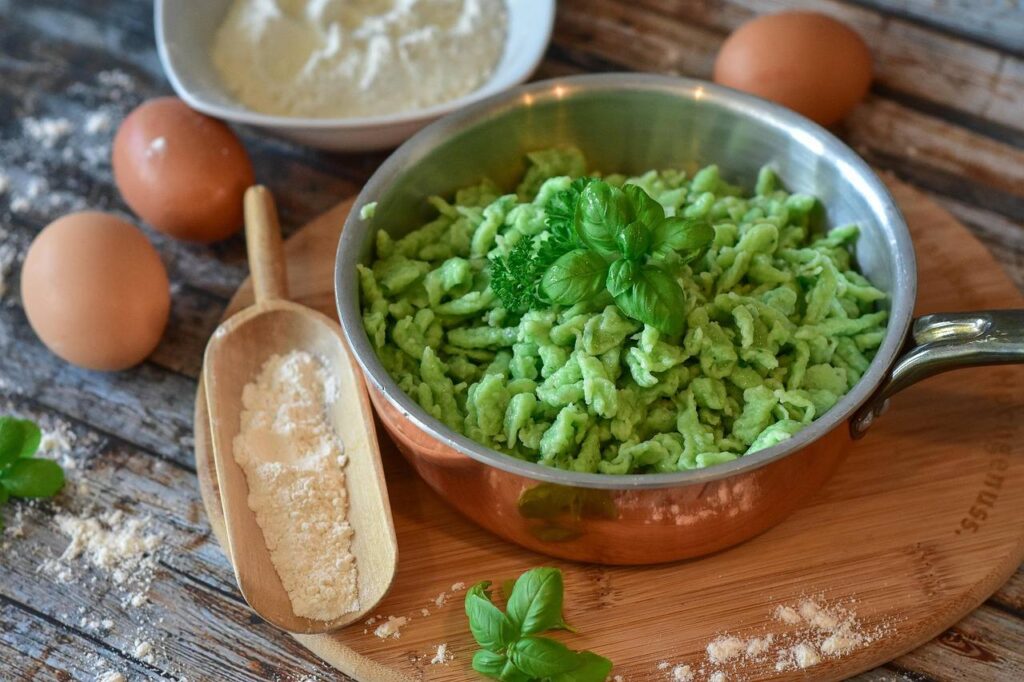
Spätzle, the soft egg noodle under half the roasts in Bavaria, is legally Swabian, not Bavarian: “Schwäbische Spätzle / Schwäbische Knöpfle” carries its own EU protection, and the protected zone is the entire state of Baden-Württemberg plus Bavaria’s own Schwaben administrative district. That district happens to include the Allgäu, which is the one honest bridge between the noodle and the state that eats the most of it. The batter is only egg, flour, water and salt, and it can be shaped four different ways, from a $89.50 stainless press to a plain colander.
Disclosure: some links on this page are affiliate links, marked by the products, tours and hotels they name. As an Amazon Associate, bavarianbistro.com earns from qualifying purchases. A purchase through these links may earn the site a commission at no cost to you, and it never affects what is recommended. How this works. Product prices and availability shown are as of the date stated and can change; the Amazon price at checkout applies.
Order Spätzle anywhere in Bavaria and nobody will tell you it is not a Bavarian dish, because at the table it might as well be. The paperwork disagrees. This page settles what the law actually protects, where Bavaria’s own real claim to the noodle comes from, and the four ways to make it, from the cheapest tool in the pantry to the one I would actually buy. It belongs in my guide to Bavarian food next to the other dishes Bavaria eats constantly without technically owning.
Swabian by law
The registered name is “Schwäbische Spätzle / Schwäbische Knöpfle,” an EU Protected Geographical Indication registered on 8 March 2012, and Swabian is not a loose regional gesture here, it is the legal boundary of the protection1. The zone covers the whole of Baden-Württemberg, the German state next door, plus one specific slice of Bavaria: the administrative district of Schwaben, Bavarian Swabia1. Everywhere else in Bavaria, including Munich, sits outside the protected zone entirely, no matter how often the noodle turns up on a Munich menu.
That distinction only matters for a producer trying to sell packaged noodles under the protected name. Nobody is checking papers at a beer hall table, and a Munich kitchen making its own Spätzle from scratch is not breaking any law, just serving a dish that legally belongs to the state next door.
Where Bavaria's real claim comes in
Bavarian Swabia is not a technicality invented to make the map work. It is the Allgäu, the alpine corner of the state where Spätzle genuinely is a home-grown dish rather than a borrowed one, most famously folded into Kässpatzle, the Allgäu’s own cheese-and-onion version. My Kässpatzle page covers that dish specifically, and it is the one place on this whole menu question where Bavaria and Spätzle are not actually in conflict.
Everywhere else, Spätzle sits on a Bavarian plate the same way Schnitzel does: adopted so completely that asking about its legal home feels almost rude. Nobody in a Munich beer hall is going to turn away a bowl of it over a jurisdiction question, and neither would I.
The batter, and four ways to shape it
Spätzle batter is short on ingredients and long on technique: egg, flour, water, a pinch of salt, beaten until it turns thick and elastic and just barely pourable, thicker than pancake batter and thinner than dough. Every regional argument about the noodle happens after this point, in how the batter gets from bowl to boiling water.
- The press. A hopper loaded with batter, worked by a lever that pushes it through a plate of round holes straight into the pot. It is the fastest method for a home cook and the most consistent in noodle size.
- The hopper or slider. A flat, perforated tray that sits over the pot and gets worked back and forth by hand, sliding batter through its holes without a lever. Slower than a press, less to clean.
- The board and scraper. The old way: batter spread thin on a wet wooden board, then cut into the water in strips with a knife or a metal scraper, working from the edge inward. It takes practice to get an even noodle and most people’s first batch looks nothing like their tenth.
- The colander. A wide-holed colander held over the pot, with the batter pushed through the holes using a spatula or the back of a spoon. It needs no special tool at all, which makes it the method worth learning even if you eventually buy a press.
Whichever method makes the noodle, cooking it is the same two minutes for all of them. Spätzle is done the moment it floats to the surface of the boiling water, which for a fresh batch is usually ninety seconds to two minutes after it hits the pot; fish it out with a slotted spoon rather than draining the whole pot at once, since a second batch is often still going in behind it. Toss the drained noodles straight into melted butter so they do not clump, or, if you are aiming for the Allgäu’s own version, layer them in a pan with grated cheese and caramelized onion and let the cheese melt through before serving, which is the whole idea behind Kässpatzle.
Resi says Buy the Goldspatz Spätzle Press No. 2190. It is stainless steel, locks onto the pot rim so it does not slide around while you work, and turns out an evenly sized noodle a board and scraper takes years to match; it runs $89.50 on Amazon as of September 2026, and its one real limit is that it is built for a home batch, not a crowd, so cooking for a dozen means running it in two rounds. The same maker also sells a board-and-scraper version for anyone who wants to learn the older method first.
My Spätzle makers compared page goes deeper into the press, hopper and board options side by side if you are choosing between tools rather than techniques.
None of this is mandatory. Dried, boxed Spätzle exists on North American shelves and in German grocers that ship, and it is a real shortcut for a weeknight, not a lesser noodle by default; my German grocers that ship page has the retailers that carry it. What it will not give you is the slightly rough, irregular edge that a hand-shaped batch has, the texture that actually holds gravy in its dips and folds rather than sliding off. For a Sunday roast, I make the batter myself. For a Tuesday, I do not feel remotely guilty about the box.
Frequently Asked Questions
Is Spätzle Bavarian or Swabian?
Swabian by law. Its EU protection is registered under the Swabian name, and the protected zone is Baden-Württemberg plus Bavaria’s own Schwaben district, not the whole of Bavaria.
Does any part of Bavaria have a legitimate claim to Spätzle?
Yes, the Allgäu, which sits inside Bavaria’s Schwaben district and is genuinely within the protected zone, most visibly in the local dish Kässpatzle.
What is Spätzle made of?
Just egg, flour, water and salt, beaten into a thick, elastic batter, with no leavening involved.
What is the easiest way to make Spätzle at home without special equipment?
A wide-holed colander held over a pot of boiling water, with the batter pushed through using a spatula.
Is a Spätzle press worth buying?
If you make it more than occasionally, yes. It shapes a more even noodle faster than a board and scraper, at the cost of one more single-purpose tool in a drawer.
Is Spätzle the same as German egg noodles in general?
Spätzle is a specific style, thicker and more irregular than a rolled and cut noodle, made by pushing or dropping soft batter directly into boiling water rather than rolling and slicing a firmer dough.
How long does fresh Spätzle take to cook?
About ninety seconds to two minutes once it hits boiling water. It is done as soon as it floats to the surface.
Can you make Spätzle without any special tool?
Yes. A wide-holed colander and a spatula shape it just as well as a dedicated press, only slower and messier.
Related Articles
 Bavarian Food: The Dishes, How Munich Eats Them, and What to Cook at HomeFood
 Bavarian vs German Food: What Is Actually DifferentFood
 The Bavarian Foods with EU Protection: Breze, Obazda, Rostbratwurst, Bier and MoreFood
 Kässpatzle: The Allgäu’s Cheese Noodles, Onions and AllFood
 Spätzle Makers Compared: Press, Hopper, Board or ColanderPantry and tools
 Knödel: Bread Dumplings, Potato Dumplings and Which Goes with WhatFood
 Sauerbraten: The Marinated Pot Roast, Where It Comes From and How Bavaria Serves ItFood
 Schweinebraten: Bavaria’s Pork Roast with Dark Beer GravyFood
Sources
- Schwäbische Spätzle / Schwäbische Knöpfle — UK Government protected food and drink names register. Accessed 2026-09-26.
- Goldspatz Spaetzle Maker & Potato Press for Round Spaetzle — Amazon.com. Accessed 2026-09-26.