In brief
Bavaria’s sausages are not one family, they are several, sorted by city and by casing: Weißwurst is poached veal from Munich, Nürnberger Rostbratwurst is a marjoram-heavy grilling sausage with its own EU protection, and Regensburger is a smoked, boiled sausage its own city calls “Knacker”. Franconia runs a separate bratwurst tradition of its own, from the Fränkische Bratwurst to the cabbage-studded Krautwurst. Leberkäse is a baked meat loaf with, officially, no liver in it at all. “Wienerle” has no official Bavarian definition on the record, and “Knackwurst” turns out to just be Regensburg’s own nickname for its own sausage, not a separate type.
Disclosure: some links on this page are affiliate links, marked by the products, tours and hotels they name. As an Amazon Associate, bavarianbistro.com earns from qualifying purchases. A purchase through these links may earn the site a commission at no cost to you, and it never affects what is recommended. How this works.
Ask a Bavarian to explain the difference between a Weißwurst and a Bratwurst and you will get an answer, possibly an opinionated one. Ask about Regensburger versus Knackwurst and you may get a shrug, because the two words are closer to synonyms than most menus let on. This page sorts Bavaria’s sausages the way they actually divide, by city, by casing and by cooking method, as part of my guide to Bavarian food, so you can order with some confidence instead of pointing at the menu.
The sausages, side by side
Cooking method and casing tell you more about a Bavarian sausage than its name does, so here is the shape of the family before the detail.
| Sausage | Region | Cooking | How it’s served |
|---|---|---|---|
| Weißwurst | Munich | Poached | Peeled or sucked from the casing, with sweet mustard and a pretzel, only in the morning |
| Nürnberger Rostbratwurst | Nuremberg, Franconia | Grilled | “Drei im Weggla,” three in a split roll, or with sauerkraut |
| Regensburger | Regensburg, Oberpfalz | Smoked, then boiled | Hot or cold, or diced into Bavarian sausage salad |
| Fränkische Bratwurst | Franconia | Pan-fried, grilled or smoked | With sauerkraut and potato salad, or “Eizwiggte,” wedged into a roll |
| Ansbacher Bratwurst | Ansbach, Franconia | Pan-fried | With sauerkraut, black bread or potato salad |
| Krautwurst | Franconia | Pan-fried fresh, or smoked | Fresh with potatoes, smoked as a bread spread |
| Leberkäse | Bavaria-wide | Baked in a loaf | Warm with potato salad and a fried egg, or cold in a roll |
Source: GenussErbe Bayern, the Bavarian State Ministry’s specialties register123456.
Weißwurst
Munich’s white sausage is poached, never grilled, made from veal, pork belly, cooked veal head meat, egg white and a seasoning built on parsley, onion, mace and lemon, in a pork casing about 12 centimeters long1. It is the one sausage on this list you are not supposed to eat past noon, a custom left over from the days before refrigeration when it had to be sold and eaten the same day it was made. I cover the whole ritual, mustard and all, on my Weißwurst page.
Nürnberger Rostbratwurst
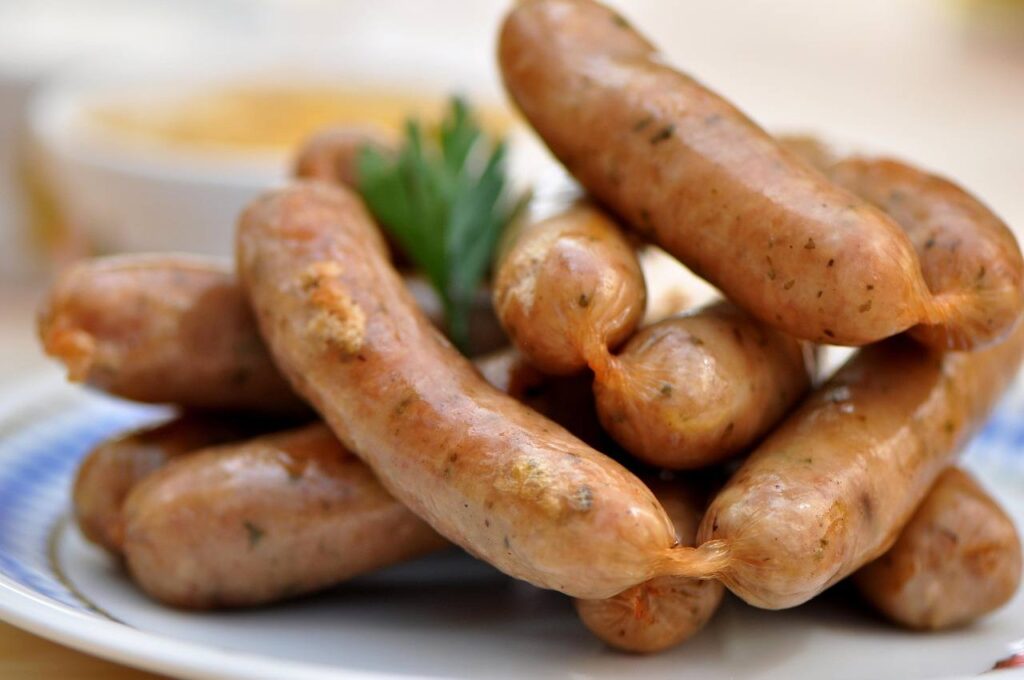
Nuremberg’s contribution is the smallest sausage with the most paperwork: pork meat and pork belly seasoned mainly with marjoram, plus pepper, mace, ginger, cardamom and lemon powder, stuffed into a thin sheep casing about two centimeters across. “Nürnberger Bratwürste” and “Nürnberger Rostbratwürste” have held their own EU Protected Geographical Indication since July 2003, meaning every step of production has to happen inside the city itself, and the register traces the sausage’s documented history back to 13132.
Order it the classic way and you get “drei im Weggla,” three sausages in a split roll, usually with sauerkraut, farmer’s bread, potato salad or horseradish2. My Nürnberger Rostbratwurst page has the rest of that history.
Regensburger
Regensburg’s own register entry gives its sausage two other names on the record, Rengschbuaga and Knackwurst, and notes, with some amusement, that locals mostly call it “Knacker” even when Regensburger is exactly what they mean. It was invented in the second half of the 19th century by an inventor nobody can name, and its own city offers two competing theories for the name: the cracking sound the casing makes when you bite into it, or an older dialect word for the nape of the neck, from a claim that neck meat once went into the recipe3.
It is a smoked, then boiled sausage, about 10 centimeters long, made from finely ground lean meat and pork stuffed into a beef casing, eaten hot or cold, and a popular ingredient in Bavarian sausage salad, dressed with vinegar, oil, mustard and diced onion3. Unlike the Nürnberger’s own entry, its page makes no mention of any EU protection, which is the closest thing to a “no” that the register offers.
The Franconian Bratwurst family
Franconia runs its own bratwurst tradition, distinct from both Nuremberg’s protected sausage and Bavaria’s Weißwurst. The Fränkische Bratwurst is about 15 centimeters long, made from pork shoulder with a generous hand of marjoram, black pepper, salt and a pinch of nutmeg, and it is eaten without mustard, either with sauerkraut and potato salad or wedged into a split roll called a Weckla, a serving style with its own name, “Eizwiggte”4.
The Ansbacher Bratwurst, tied to the city of Ansbach, uses only lean pork shoulder and well-marbled pork belly, seasoned with salt, pepper, allspice and marjoram, and is traditionally pan-fried rather than grilled over an open flame, a local quirk its own register calls out specifically; the town has run a guided “Bratwurstführung” tasting tour built around the sausage since 20115.
Krautwurst folds shredded, cooked cabbage into a liver-sausage base, up to a third of the mix, a household-slaughter tradition meant to stretch the meat supply, and it is served fresh and pan-fried or smoked and spread on bread6.
Leberkäse
Despite the name, Bavaria’s own register is blunt: there is no liver in Bavarian Leberkäse. It is a baked loaf of finely ground beef, fatty pork, fat and seasoning, baked until the outside crisps into the prized “Scherzel,” the crispy end piece regulars ask for by name7. Served warm with potato salad and a fried egg, or cold and thin in a halved roll as Leberkäs Semmel, it is street food and a sit-down dish at once. My Leberkäse page covers both versions properly.
The dish has an origin story, too: the same register traces it to the 18th century, after Elector Karl Theodor inherited Bavaria in 1778 and brought his own butcher along from Mannheim, who is credited with developing the recipe within a few years of arriving7.
Wienerle and Knackwurst: the two names that trip people up
Here is where a glossary has to admit its limits. “Wienerle” does not appear anywhere on Bavaria’s own specialties register, and a direct search of that register turns up nothing under the name; no official Bavarian source defines it as a distinct product, so treat any technical claim about it as unsourced until one turns up. “Knackwurst” fares differently but not the way most menus imply: the register does not treat it as a separate sausage at all. It is simply the Regensburger’s own nickname, used by the people of Regensburg for their own local sausage, not a generic type sold elsewhere under that name3. Whether a “Knackwurst” on a US grocery shelf means the same thing is its own question, and not one Bavaria’s own register answers either way.
Resi's favorites
Resi says My own favorite Bavarian sausages are the “Rostbratwürstl,” small fried pork sausages about the size of a finger, and the “Wienerle.” I could always count on a heavenly “Leberkäs Semmel” with sweet mustard whenever I got hungry running errands, and I still think of it as the original Bavarian fast food.
Where to buy German sausages in North America
Weißwurst crosses the Atlantic well because it is sold frozen and pre-cooked, and the same mail-order houses that carry it usually carry the rest of the lineup too. Stiglmeier Sausage Co., in Wheeling, Illinois, ships a wide bratwurst range direct from its own site, including a Stiglmeier Nuernberger Bratwurst, listed as “Nuernberger Bratwurst #462,” a pork-and-veal sausage in sheep casing at $9.65 for about a pound, roughly nine to ten links, shipped frozen8.
Germandeli.com, based in Huntington Beach, California, lists Bavarian-style sausages by mail alongside the pretzels and mustard that go with them, with a “Useful Shipping Info” link on its own site for the regions it serves9.
The Taste of Germany carries a similar Bavarian sausage lineup and flags every perishable item as shipped under its own stated perishables policy, calculated at checkout10.
Resi says If I only had one order to place, it would be Stiglmeier’s Nuernberger Bratwurst, the closest thing to Nuremberg’s own sausage that ships to a US mailbox at $9.65 a pound as of September 2026. The honest limit is the casing: it comes in a natural sheep casing that can split if you thaw it too fast, so give it a slow day in the refrigerator rather than a shortcut on the counter.
Frequently Asked Questions
What is the difference between Bratwurst and Weißwurst?
Bratwurst is grilled or pan-fried; Weißwurst is poached and never touches a grill. Weißwurst is also a Munich-specific sausage eaten only in the morning, while Bratwurst varieties are made and eaten across Bavaria and Franconia all day.
Is Knackwurst the same as Regensburger?
In Bavaria, yes. Regensburg’s own specialties register lists Knackwurst as a local nickname for its Regensburger, not a separate sausage.
What is Wienerle?
A term used for a small pale sausage in parts of Bavaria, but it has no dedicated entry on Bavaria’s own specialties register, so no official specification exists to point to.
Does Leberkäse actually contain liver?
No. Bavaria’s own register states plainly that there is no liver in Bavarian Leberkäse; the name is a historical quirk, not a description of the ingredients.
Which Bavarian sausage has EU protection?
The Nürnberger Rostbratwurst, protected since 2003. Regensburger does not carry the same EU protection.
Can I buy real Bavarian sausages in the US?
Yes, frozen and shipped by mail-order specialists such as Stiglmeier, Germandeli.com and The Taste of Germany, all of which carry Bavarian-style bratwurst and Weißwurst.
What sausage is used for "drei im Weggla"?
The Nürnberger Rostbratwurst, three sausages served in a split bread roll, Nuremberg’s classic way of eating it.
What is a Franconian Bratwurst seasoned with?
Marjoram is the dominant spice across the Franconian bratwurst family, alongside black pepper, salt and, in some versions, a pinch of nutmeg or allspice.
Related Articles
 Bavarian Food: The Dishes, How Munich Eats Them, and What to Cook at HomeFood
 Weißwurst: How to Eat Bavaria’s White Sausage (Skin, Mustard and the Noon Rule)Food
 Nürnberger Rostbratwurst: The Finger-Sized Sausage with Its Own EU ProtectionFood
 What Is Leberkäse? No Liver, No Cheese, and How Munich Eats ItFood
 Bratwurst in Bavaria: The Regional Varieties and How Each Is CookedFood
 Bratwurst vs Knockwurst: What Is the Difference?Food
 German Grocers That Ship in the US and CanadaPantry and tools
 Cooking Bavarian in North America: Where to Buy the Ingredients and the Tools That MatterPantry and tools
Sources
- Münchner Weißwurst — GenussErbe Bayern. Accessed 2026-09-24.
- Nürnberger Rostbratwürste — GenussErbe Bayern. Accessed 2026-09-24.
- Regensburger — GenussErbe Bayern. Accessed 2026-09-26.
- Fränkische Bratwurst — GenussErbe Bayern. Accessed 2026-09-26.
- Ansbacher Bratwurst — GenussErbe Bayern. Accessed 2026-09-26.
- Krautwurst — GenussErbe Bayern. Accessed 2026-09-24.
- Bayerischer Leberkäse — GenussErbe Bayern. Accessed 2026-09-24.
- Nuernberger Bratwurst #462 — Stiglmeier Sausage Co., Inc. Accessed 2026-09-26.
- Deli Sausages — Germandeli.com. Accessed September 2026.
- The Taste of Germany Weisswurst & Pretzel Meal Kit — The Taste of Germany. Accessed September 2026.