In brief
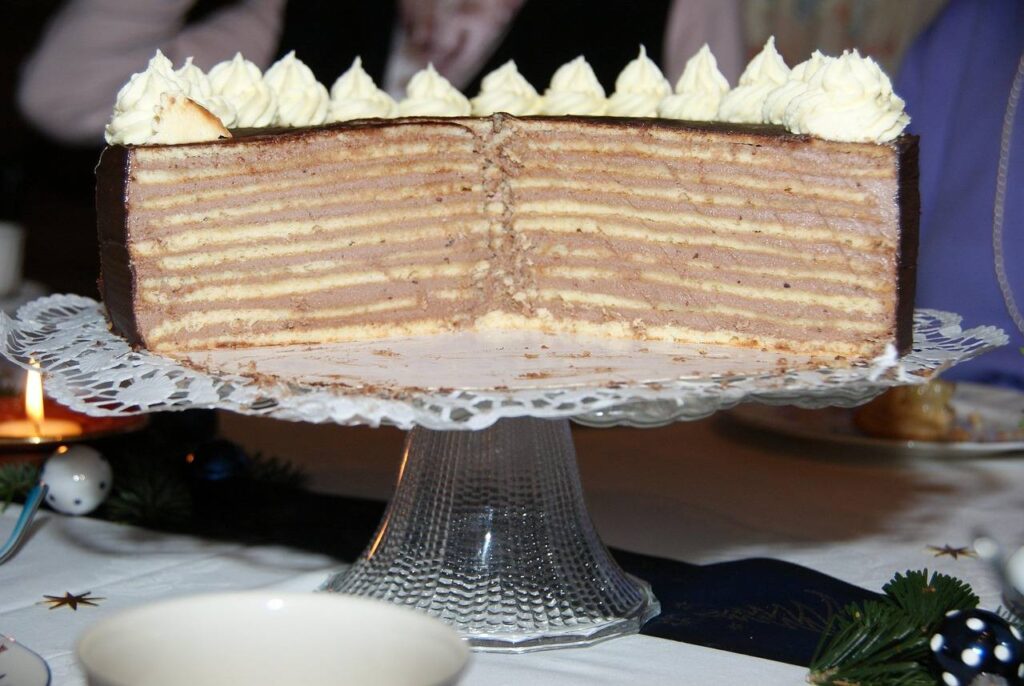
Prinzregententorte is a Munich sponge cake, a Biskuittorte, built from thin alternating layers of sponge and chocolate cream and finished with a chocolate glaze. Bavaria’s own culinary heritage register credits court pastry chef Julius Rottenhöfer with creating it and dedicating it to Prince Regent Luitpold of Bavaria. It was originally built with eight sponge layers, one for each of Bavaria’s administrative districts at the time, though the register itself notes the cake may today be baked with seven, since the Palatinate has not been part of Bavaria since the Second World War. Baking eight thin, even layers at home is easier with three matching 8-inch pans, and a set of three Wilton aluminum pans lists for $45.45 as of September 2026.
Disclosure: some links on this page are affiliate links, marked by the products, tours and hotels they name. As an Amazon Associate, bavarianbistro.com earns from qualifying purchases. A purchase through these links may earn the site a commission at no cost to you, and it never affects what is recommended. How this works. Product prices and availability shown are as of the date stated and can change; the Amazon price at checkout applies.
If you have looked at a slice of Prinzregententorte on a Munich dessert menu and tried to count the stripes: you were not imagining the effort, and you were probably undercounting. This cake is one of the more deliberately engineered entries in my guide to Bavarian food, a dessert where the number of layers was, at least once, an actual piece of civic symbolism rather than a bakery flourish.
What is actually on the plate
Bavaria’s culinary heritage register describes Prinzregententorte as a Biskuittorte, a sponge cake, built from thin layers, each about half a centimeter, alternating sponge with a chocolate cream filling, and finished with a chocolate glaze over the top and sides1. It is not a single tall sponge simply sliced into rounds; the layers are meant to be baked thin individually, which is most of why this cake has a reputation for being fussy to make well. The chocolate cream between the layers is what carries the flavor, since the sponge itself is kept fairly plain on purpose, the same way a good Biskuit is meant to be a vehicle rather than the main event.
The pastry chef and the regent
The register names the cake’s creator plainly: court pastry chef Julius Rottenhöfer, who made it and dedicated it to Prince Regent Luitpold of Bavaria1. Luitpold ruled as regent rather than king for most of his time in charge, standing in for his nephew Ludwig II and later Ludwig’s brother Otto, both of whom were declared unfit to rule. A cake named for a regent rather than a king is a small detail, but it tells you this dessert belongs to a specific, documented moment in Bavarian court history rather than to folklore nobody can pin down, which already puts it ahead of a few other dishes on this site.
Why eight layers, and why some are seven
The layer count was not arbitrary. The register states that the cake originally had eight sponge layers, each one symbolizing one of Bavaria’s administrative districts at the time: Upper Bavaria, Lower Bavaria, Swabia with Neuburg, the Upper Palatinate with Regensburg, Upper Franconia, Middle Franconia, Lower Franconia, and the Palatinate1. That last one is the catch. The Palatinate stopped being part of Bavaria after the Second World War, and the register says so directly, adding that “the Prinzregententorte may today also be baked with seven layers” as a result1. So if you count a slice in a Munich bakery and come up one layer short of the number in this article’s title, the bakery has not shorted you; it has simply kept up with Bavaria’s borders, which is a more thoughtful excuse than most bakeries bother to give.
Making a version at home
There is no single official home recipe in the register, so this is the shape of the process rather than a set of fixed measurements. You bake several thin sponge rounds, either in individual pans one at a time or two or three at once if your oven and pans allow it, and let each one cool completely before stacking. A chocolate buttercream or ganache goes between every layer, thin enough not to overwhelm the sponge but firm enough to hold the stack upright once it is assembled. The whole cake gets chilled to firm up the filling, then coated in a smooth chocolate glaze poured over the top and allowed to run down the sides. The hardest part is not any single step; it is keeping eight layers roughly the same thickness so the finished cake stands level instead of leaning.
- Bake several thin sponge rounds and let each cool completely.
- Spread a thin, even layer of chocolate cream or ganache on each round.
- Stack the layers, checking that the stack stays level as you go.
- Chill the assembled cake until the filling firms up.
- Pour a smooth chocolate glaze over the top and let it run down the sides.
Baking several thin, matching layers is much easier with more than one pan of the same size going at once. A set of three 8-inch aluminum Wilton cake pans lists for $45.45 as of September 2026, which turns an eight-layer cake into three baking rounds instead of eight2.
Resi says Do not attempt this cake with one pan and a lot of patience; you will be there all afternoon and the layers will not match. Three matching pans cut the baking into a manageable number of rounds, and a kitchen scale to portion the batter evenly between them will do more for how level your finished cake looks than any amount of careful stacking afterward. The honest limit: even with the right pans, this is not a first-time-baker cake, so make something simpler first if layer cakes are new to you.
Frequently Asked Questions
How many layers does a Prinzregententorte have?
Traditionally eight, one for each of Bavaria’s administrative districts at the time it was created. Bavaria’s own heritage register notes it may also be made with seven layers today, since one of those districts, the Palatinate, is no longer part of Bavaria.
Who is the Prinzregententorte named after?
Prince Regent Luitpold of Bavaria, who ruled as regent rather than king. The cake was created and dedicated to him by court pastry chef Julius Rottenhöfer.
What is between the layers?
A chocolate cream filling, spread thin between each sponge layer, with the whole cake finished in a chocolate glaze.
Is Prinzregententorte the same as a Sachertorte?
No. A Sachertorte is a single or double-layer chocolate cake with apricot jam and a chocolate glaze; Prinzregententorte is defined by its many thin layers rather than a jam filling.
Why did the layer count change?
Bavaria’s culinary heritage register explains that the original eight layers symbolized the state’s eight administrative districts, and since the Palatinate left Bavaria after the Second World War, the cake is sometimes made with seven layers instead.
Can I make Prinzregententorte with fewer pans?
Yes, but you will need to bake in more rounds, letting each pan cool before reusing it, since the layers need to be thin and even rather than a few thick ones sliced apart.
Related Articles
 Bavarian Food: The Dishes, How Munich Eats Them, and What to Cook at HomeFood
 Kaiserschmarrn: The Torn Pancake Bavaria Borrowed from AustriaFood
 Dampfnudel: Bavaria’s Steamed Yeast Dumpling, Cooked in MilkFood
 Bavarian Desserts: Bayrisch Creme, Kaiserschmarrn, Dampfnudel and the RestFood
 Zwetschgendatschi: The Bavarian Plum Sheet Cake of Late SummerFood
 How to Read a Bavarian Menu: 60 Words from Brezn to ZwetschgendatschiFood
Sources
- Prinzregententorte — Genussorte Bayern, Bavarian State Ministry of Food, Agriculture and Forestry (Kompetenzzentrum für Ernährung). Accessed 2026-09-26.
- Wilton Aluminum Round Cake Pan, Made Without PFAS, 8 x 3 in (Pack of 3) — Amazon.com. Accessed 2026-09-26.