In brief
Bavarian desserts split cleanly into imports and natives. Kaiserschmarrn and Apfelstrudel are Austrian dishes that ended up on Bavarian menus anyway, Dampfnudel and Prinzregententorte are documented in Bavaria’s own culinary records, and Bayrisch Creme is the one dish Munich’s city guide calls the only genuinely native dessert on its own list. A yeast-dough plum cake called Zwetschgendatschi is an Augsburg specialty made only in late summer, when the right plums ripen. A stretched, deep-fried dough called Schmalznudel or Auszogne shows up at weddings and church-dedication festivals across all seven Bavarian districts. This page is the map to all of them, with a link to the full story on each.
Disclosure: some links on this page are affiliate links, marked by the products, tours and hotels they name. As an Amazon Associate, bavarianbistro.com earns from qualifying purchases. A purchase through these links may earn the site a commission at no cost to you, and it never affects what is recommended. How this works. Product prices and availability shown are as of the date stated and can change; the Amazon price at checkout applies.
If you have stood in front of a Bavarian bakery case trying to work out which of the six unfamiliar cakes and dumplings is actually worth ordering: this page exists so you do not have to guess. It sits under my guide to Bavarian food as the dessert-specific map, sorting what is genuinely Bavarian from what the region simply borrowed and never gave back.
The desserts, at a glance
| Dessert | What it is | Full page |
|---|---|---|
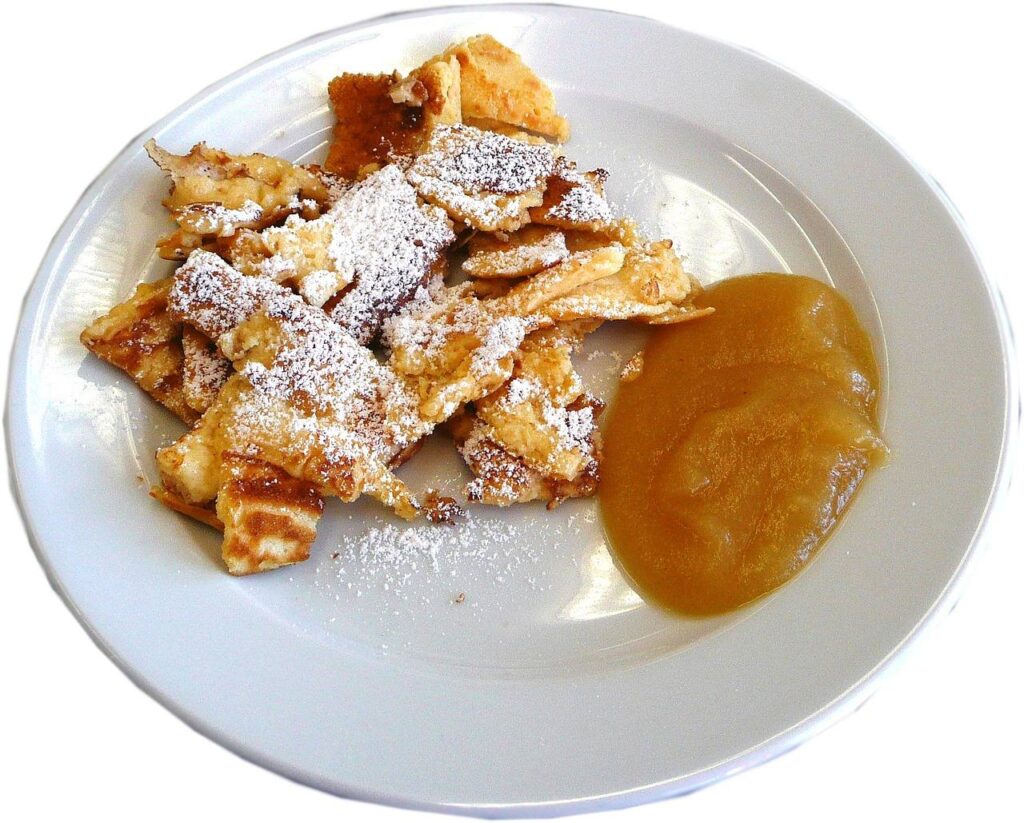
| Kaiserschmarrn | A torn, sugared pancake, Austrian by origin, served with applesauce | Kaiserschmarrn |
| Dampfnudel | A yeast dumpling steamed in milk, found in all seven Bavarian districts, documented since 1811 | Dampfnudel |
| Apfelstrudel | A hand-stretched apple pastry with Ottoman-Viennese roots, on nearly every Bavarian menu | Apfelstrudel |
| Prinzregententorte | Munich’s layered sponge and chocolate cake, made for Prince Regent Luitpold | Prinzregententorte |
| Zwetschgendatschi | Augsburg’s late-summer yeast-dough plum sheet cake | Zwetschgendatschi |
| Schmalznudel / Auszogne | Fried dough stretched paper-thin, made for weddings and Kirchweih | Auszogne and Schmalznudel |
| Bayrisch Creme | A milk, egg yolk, sugar, whipped cream and gelatin custard; the one on this list that is actually Bavarian | No dedicated page yet |
Source: muenchen.de1 for Kaiserschmarrn and Bayrisch Creme; Bavaria’s culinary heritage register2456 for Dampfnudel, Prinzregententorte, Zwetschgendatschi and Schmalznudel; 196 Flavors3 for Apfelstrudel.
Borrowed from Austria, and welcomed anyway
Two of the biggest names on a Bavarian dessert menu did not start in Bavaria at all. Munich’s own city tourism guide says Kaiserschmarrn “originated in Austria,” a torn pancake served with applesauce that Bavaria adopted without ever claiming to have invented it1. Apfelstrudel goes back further still, to Ottoman pastries related to baklava, before settling into Central European kitchens and becoming a fixture on Bavarian tables by a completely different route3. Neither dish has an entry in Bavaria’s own culinary heritage register, which tracks specialties the state considers its own, and that absence is itself a small piece of evidence: Bavaria keeps official paperwork on the dishes it claims, and these two are not on it.
Documented as Bavarian, on paper
Dampfnudel and Prinzregententorte sit on the other side of that line. Bavaria’s heritage register finds Dampfnudel, a yeast dumpling steamed in milk, across all seven of the state’s administrative districts, and traces a written recipe back to an 1811 household cookbook2. Prinzregententorte has an even more specific paper trail: the register credits court pastry chef Julius Rottenhöfer with creating it for Prince Regent Luitpold, originally with eight sponge layers, one for each of Bavaria’s districts at the time, a number the register itself says may now be seven since the Palatinate left Bavaria after the Second World War4.
Augsburg's plum cake, once a year
Zwetschgendatschi belongs to a narrower window than anything else on this page. The register describes it as a yeast-dough sheet cake, specifically an Augsburg specialty, made only in late summer because it depends on late-ripening Zwetschgen plums5. The dough is meant to be “not too thick and not too thin,” densely covered with plum quarters and finished with cinnamon, and served lukewarm with a little whipped cream5. The name itself comes from “datschen,” a South German word for pressing or flattening something down, which is exactly what the plum quarters do to the dough as they bake into it5. Augsburg takes enough pride in the cake that its own residents are nicknamed “Datschiburger” after it, a detail the register records without apparent irony5.
The fried dough with a strange folk story attached
Schmalznudel, also called Auszogne, Knienudeln, Kniekrapfen or Küchle depending on the region, is a fried-dough pastry whose dough is traditionally stretched over the knee until it is paper-thin, then deep-fried in lard until golden6. It is found across all seven Bavarian districts and is traditionally made for festive occasions: weddings, communions and Kirchweih, the church-dedication festivals that give a lot of Bavarian villages their excuse for a party6. The register also records a folk claim tied to the pastry, that the dough was once believed to have been stretched over women’s bare skin to enchant men, quoted in the original as “the lard pastry was believed to drive men wild with love”6. That is folklore the register itself records rather than history it verifies, and I am repeating it here exactly that way: as a story people told, not as something that happened.
Bayrisch Creme: the one that is actually Bavarian
Of everything on this page, only one dessert is native to Bavaria by a source I trust. Munich’s city tourism guide describes Bayrisch Creme, Bavarian cream, as a cream made of milk, egg yolk, sugar, whipped cream and gelatin, and calls it the lightest of the desserts it covers1. The same guide is specific that, unlike Kaiserschmarrn and the other dishes it lists, Bayrisch Creme actually originated in Bavaria1. This site does not have a full page on it yet; when it does, this table will link straight to it.
Resi says If you only have room for one dessert on a Bavarian menu and want to eat something the region can actually claim as its own without an asterisk, order the Bayrisch Creme. Everything else on this page is wonderful and none of it is embarrassed about being borrowed, adopted or invented for a regent instead of a peasant, which is honestly more interesting than if it had all sprung from one village.
If you want exact measurements
Most of the sources behind this page describe what a dish is and where it came from rather than handing over a full recipe with fixed quantities, which is why the pages on this site give you methods more often than they give you cup measurements dressed up as tradition. If you want a book that goes the other way, with full ingredient lists and both US and metric measurements, “Baking Just Like Oma: Traditional German Recipes for the Home Baker” by Gerhild Fulson lists for $21.99 as of September 2026 and includes an Apfelstrudel recipe among its sixty traditional German bakes7.
How to actually order
None of this requires memorizing a family tree of Bavarian pastry history before you sit down. If you want the safest, least controversial choice, Kaiserschmarrn or Apfelstrudel will be on almost every menu and neither will surprise you. If you want the dish with the deepest paper trail, order the Dampfnudel and enjoy knowing it has been written down since 1811. If you want a small piece of trivia to bring up at the table, Prinzregententorte’s shrinking layer count, tied to a border that moved after the Second World War, is a better dinner-table story than most tourists manage. And if a bakery case happens to have Zwetschgendatschi in it, that is a seasonal signal worth acting on immediately, since it means late summer plums are in, and the cake will not be there in November.
Frequently Asked Questions
What is the most Bavarian dessert?
By Munich’s own city tourism guide, Bayrisch Creme is the one dessert on its list that actually originated in Bavaria rather than being adopted from elsewhere.
Is Kaiserschmarrn Bavarian?
No. It originated in Austria and became common on Bavarian menus afterward, according to Munich’s city tourism guide.
What is the oldest documented Bavarian dessert?
Dampfnudel has the earliest written record on this list, with a documented recipe from an 1811 household cookbook.
What dessert is only available in late summer?
Zwetschgendatschi, Augsburg’s plum sheet cake, is made only in late summer, when the Zwetschgen plums it depends on are ripe.
What is the difference between Schmalznudel and Auszogne?
They are the same pastry under different regional names, along with Knienudeln, Kniekrapfen and Küchle, depending on where in Bavaria you order it.
Which of these desserts has the most layers?
Prinzregententorte, traditionally built with eight thin sponge layers, one for each of Bavaria’s historic administrative districts.
Are any of these desserts seasonal?
Zwetschgendatschi is the clearest example, tied to late-summer plums. The others are generally available year-round on Bavarian menus.
Related Articles
 Bavarian Food: The Dishes, How Munich Eats Them, and What to Cook at HomeFood
 Kaiserschmarrn: The Torn Pancake Bavaria Borrowed from AustriaFood
 Dampfnudel: Bavaria’s Steamed Yeast Dumpling, Cooked in MilkFood
 Apfelstrudel: Why It Is on Every Bavarian Menu, and How the Pastry Is StretchedFood
 Prinzregententorte: Munich’s Eight-Layer Chocolate Cake and the Regent It HonorsFood
 Zwetschgendatschi: The Bavarian Plum Sheet Cake of Late SummerFood
 How to Read a Bavarian Menu: 60 Words from Brezn to ZwetschgendatschiFood
Sources
- Bavarian cuisine: These dishes have tradition — muenchen.de (Munich city tourism). Accessed 2026-09-26.
- Dampfnudel — Genussorte Bayern, Bavarian State Ministry of Food, Agriculture and Forestry (Kompetenzzentrum für Ernährung). Accessed 2026-09-26.
- Austrian Apfelstrudel — 196 Flavors. Accessed 2026-09-26.
- Prinzregententorte — Genussorte Bayern, Bavarian State Ministry of Food, Agriculture and Forestry (Kompetenzzentrum für Ernährung). Accessed 2026-09-26.
- Augsburger Zwetschgendatschi — Genussorte Bayern, Bavarian State Ministry of Food, Agriculture and Forestry (Kompetenzzentrum für Ernährung). Accessed 2026-09-26.
- Auszogne — Genussorte Bayern, Bavarian State Ministry of Food, Agriculture and Forestry (Kompetenzzentrum für Ernährung). Accessed 2026-09-26.
- Baking Just Like Oma: Traditional German Recipes for the Home Baker — Amazon.com. Accessed 2026-09-26.