In brief
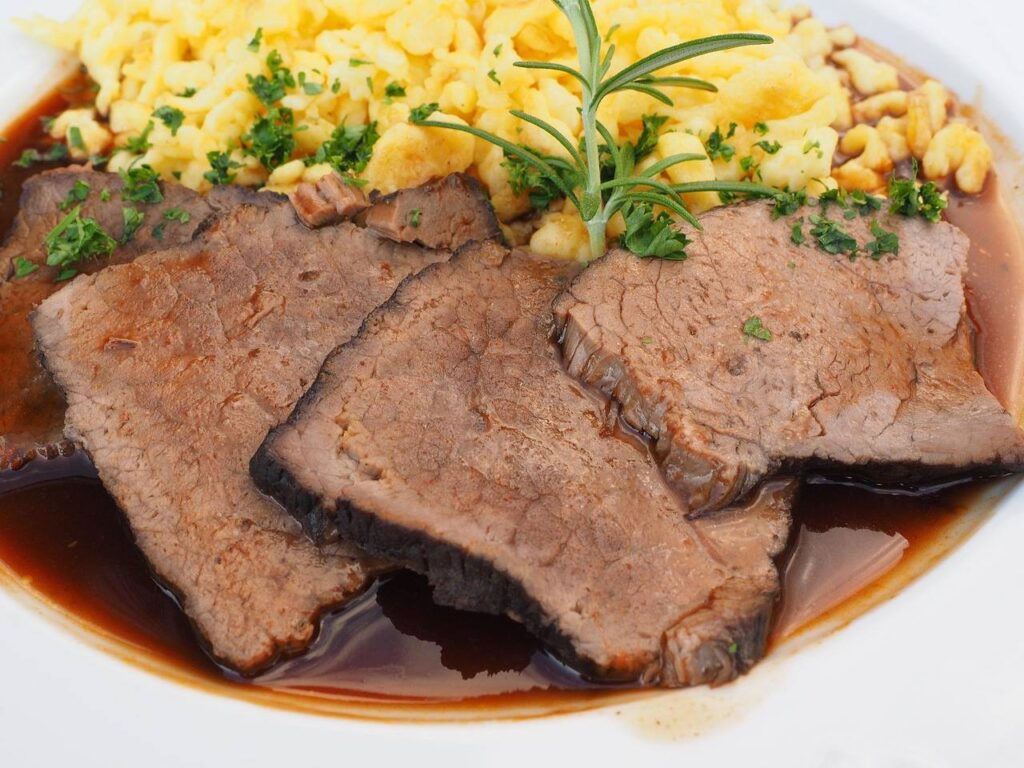
Sauerbraten is a beef roast marinated for days in vinegar or sour wine until it turns tender and faintly sweet-sour, and it belongs to the Rhineland, not Bavaria, at its root. It shows up on Bavarian menus anyway, usually in the Franconian style, which drops the Rhineland’s raisins for gingerbread-spiced cookies instead. A popular story credits Julius Caesar with inventing it for Roman Cologne, and the source repeating that story calls it “largely unsubstantiated” in the same breath. Marinate it three to four days, and a good heavy pan does more for the result than any specific recipe.
Disclosure: some links on this page are affiliate links, marked by the products, tours and hotels they name. As an Amazon Associate, bavarianbistro.com earns from qualifying purchases. A purchase through these links may earn the site a commission at no cost to you, and it never affects what is recommended. How this works. Product prices and availability shown are as of the date stated and can change; the Amazon price at checkout applies.
If Sauerbraten is on the menu at a Bavarian restaurant, you might reasonably assume it belongs to Bavaria the way Weißwurst does. It does not, and knowing that changes nothing about whether to order it, only about which region to thank. This page covers where the pot roast actually comes from, how the version served near Bavaria differs from the one served on the Rhine, and how to marinate one at home without pretending it is more authentically Bavarian than it is. It sits alongside my guide to Bavarian food as one of several borrowed dishes that dominate the menu anyway.
Where it actually comes from
Sauerbraten’s roots are in the Rhineland, though Westphalia and the Saarland both claim it strongly as well, and the base idea long predates modern Germany: medieval cooks marinated tough cuts of meat in vinegar or sour wine, which tenderized it and helped it keep before refrigeration existed1. That is the real, unglamorous origin. A more colorful story says Julius Caesar sent vinegar-marinated beef to Roman soldiers in Cologne, and that this is where the dish began; the very source that repeats this legend flags it as “largely unsubstantiated,” which is a polite way of saying nobody should build a menu description around it1.
Not one Sauerbraten, several
What gets served under the name “Sauerbraten” changes markedly by region, and the differences are not cosmetic. The Rhineland’s own version, Rheinischer Sauerbraten, leans sweet-sour with raisins and sugar-beet syrup in the marinade, and it is served with potato dumplings and apple compote on the side. Franconian Sauerbraten, the version most likely to turn up near Bavaria, since Franconia is itself part of the state of Bavaria, skips the raisins entirely and gets its spice instead from gingerbread or Printen-style spiced cookies crumbled into the gravy, landing spicier and less sweet, usually with bread dumplings and red cabbage. A third version from Saxony adds plum jam and pairs with Bohemian dumplings, so ordering it in three different German regions means, in a real sense, ordering three different dishes wearing the same name1.
How Bavaria actually eats it
On a Bavarian menu, Sauerbraten behaves like Schnitzel and Rouladen, a dish absorbed from elsewhere so completely that most diners never think to question its address. Franconia’s spicier, gingerbread-leaning style is the one you are most likely to meet in a Bavarian beer hall, paired with a bread dumpling that mops up the gravy and a side of braised red cabbage rather than the Rhineland’s apple compote. My Rouladen page covers the beef dish it most often sits next to on the same menu, and my Bavarian potato salad page is the side I would actually order alongside it, whatever the menu suggests.
The marinade, in outline
This is my method, built from how German kitchens generally handle a tough roast, not a claim to any single region’s authentic recipe. Marinate a chuck or rump roast three to four days in the refrigerator, submerged in a mix of red wine vinegar, water, sliced onion, a bay leaf or two, whole peppercorns, juniper berries and a couple of cloves, turning the meat once a day so every side gets equal time in the acid. Longer than four days starts breaking the texture down rather than just tenderizing it; less than two barely does anything.
Pat the roast dry, brown it hard on all sides in a heavy pot, then braise it low and slow in a strained portion of the marinade plus fresh stock until a fork goes in without a fight, usually three to four hours. Thicken the braising liquid at the end, off the heat, with crushed gingerbread or a spoonful of gingersnap crumbs if you want the Franconian lean, or with a few raisins if you would rather go Rhineland. Either way, the pot doing the browning and the braising matters more than which spice you pick.
Sauerbraten is one of the few roasts that genuinely improves overnight. Cool the meat in its gravy, refrigerate the whole pot, and reheat gently the next day; the acid keeps working on the fibers even after the braise is done, and the gravy has time to settle into something rounder than it tasted straight off the stove. That makes it a better dish to serve to guests than to eat the same night you cook it, which is the opposite of most roasts.
If you want the pan built for it
A heavy pot holds heat evenly through hours of low braising, which a thin one simply cannot do without scorching the bottom. A Lodge Pre-Seasoned Cast Iron Skillet, 10.25 inches, handles the initial hard sear on all sides of the roast better than most nonstick pans manage, and it moves straight into a low oven or onto a stovetop simmer for the braise itself; it lists at $24.90 on Amazon as of September 20262. Its one real limit for this particular dish is size: a large chuck roast fills a 10.25-inch skillet edge to edge, so a genuinely big roast wants a proper Dutch oven with a lid instead, and I would size up rather than crowd the pan.
Resi says Buy the pan you will actually use again, not a specialty roaster that spends fifty weeks a year in a cupboard. A cast iron skillet earns its keep on weeknights; a dedicated Sauerbraten pot mostly earns dust.
Frequently Asked Questions
Is Sauerbraten a Bavarian dish?
No. It comes from the Rhineland, though it appears on nearly every Bavarian menu in a Franconian style that differs from the original.
How long should you marinate Sauerbraten?
Three to four days in the refrigerator is the range that tenderizes the meat without breaking down the texture too far.
What is the difference between Rhineland and Franconian Sauerbraten?
The Rhineland version uses raisins and sugar-beet syrup for a sweeter marinade and serves it with apple compote; the Franconian version replaces the raisins with gingerbread or spiced-cookie crumbs for a spicier gravy and serves it with red cabbage.
Did Julius Caesar really invent Sauerbraten?
No credible evidence supports it. The story is a popular legend, and even the sources that repeat it call it unsubstantiated.
What do you serve with Sauerbraten?
Potato dumplings and apple compote in the Rhineland style, or bread dumplings and red cabbage in the Franconian style more common near Bavaria.
What cut of beef works best for Sauerbraten?
A chuck or rump roast, both tough enough to benefit from a multi-day acid marinade and a long, slow braise.
Can you make Sauerbraten ahead of time?
Yes, and it is better for it. The gravy and the meat both round out overnight in the refrigerator, so cooking it a day before serving is a genuine improvement, not just a convenience.
Is Sauerbraten the same as pot roast?
It is a specific kind of pot roast, defined by the multi-day vinegar or wine marinade before braising, which an ordinary American pot roast skips entirely.
Related Articles
 Bavarian Food: The Dishes, How Munich Eats Them, and What to Cook at HomeFood
 Bavarian vs German Food: What Is Actually DifferentFood
 Rouladen: The Rolled Beef Dish on Every Bavarian Menu That Is Not BavarianFood
 Bavarian Potato Salad: Vinegar and Broth, Never MayonnaiseFood
 Browning Meat: The Flavor-Building Step Behind Goulash, Stews and RoastsFood
 Knödel: Bread Dumplings, Potato Dumplings and Which Goes with WhatFood
 Sauerkraut vs Bayrisch Kraut: Fermented Cabbage and Braised Cabbage Are Different DishesFood
 The Bavarian Foods with EU Protection: Breze, Obazda, Rostbratwurst, Bier and MoreFood
Sources
- Why Does Sauerbraten Taste So Different in the Rhineland Compared to Franconia or Saxony? — Germany Shop. Accessed 2026-09-26.
- Lodge Pre-Seasoned Cast Iron Skillet, PFAS-Free, 10.25 Inches — Amazon.com. Accessed 2026-09-26.