In brief
Oktoberfest opens with two processions, not one. On opening Saturday, the Parade of the Landlords and Breweries kicks off the festival right before the mayor taps the first keg at noon. The next day, Sunday, the Trachten- und Schützenzug, the Costume and Riflemen’s Parade, brings thousands of folk groups through the city center to the Theresienwiese, more than 8,600 of them in 2026. Both processions are free to watch from the street, and they are the closest thing Oktoberfest has to a red carpet before the beer starts flowing.
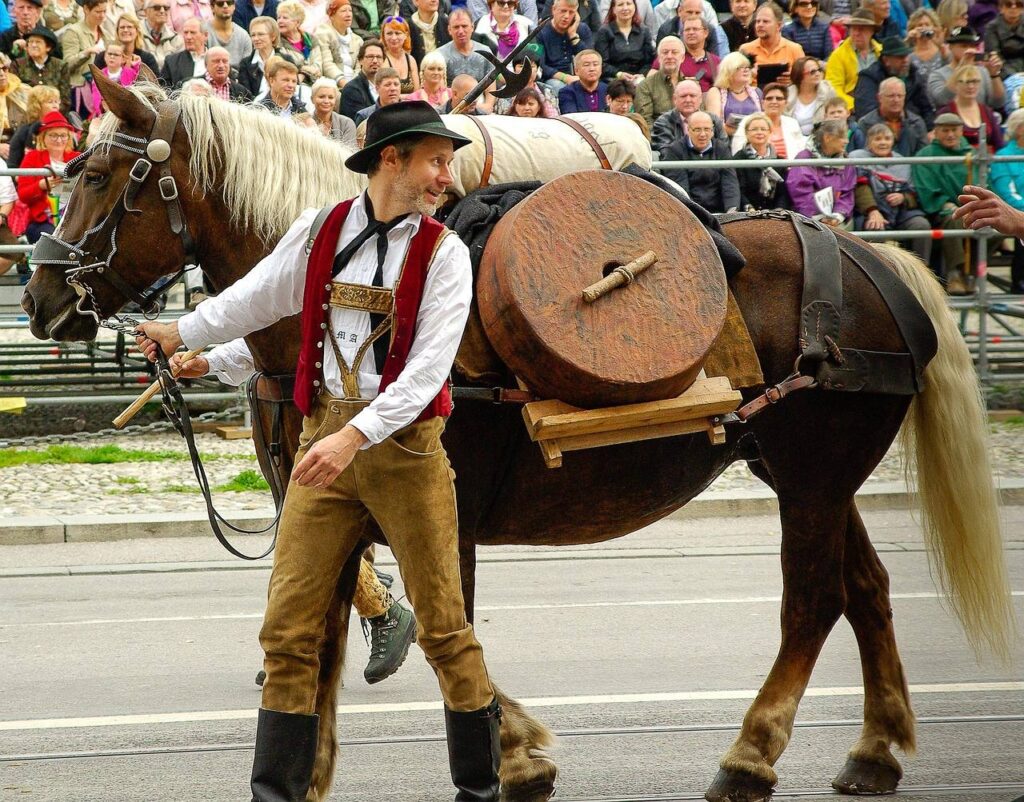
The two biggest crowds outside the tents all festival happen in the festival’s first 24 hours, and neither of them involves a beer mug. Munich opens Oktoberfest with a pair of parades, one on Saturday and one on Sunday, and if you are only in town for the first weekend, watching them costs nothing and asks nothing more of you than a spot on the curb. This page covers both, and it hands off to my complete guide to Oktoberfest in Munich for everything that happens once the tents are actually open.
Saturday: the Parade of the Landlords and Breweries
The festival’s own opening act is the Parade of the Landlords and Breweries, billed on the festival’s calendar as the “official kick-off” to Oktoberfest, and it runs on opening Saturday1. The name tells you who is in it: the tent operators, the “landlords” in the old sense of the word, and the breweries that supply them, making their way through the city to the Theresienwiese ahead of the crowd that will spend the next two to three weeks drinking what they brought. It is a working parade in the oldest sense: these are the people who will be pouring your beer, announcing in public that the festival is, functionally, about to start. The mayor’s tapping ceremony follows at noon the same day, and my dates and calendar page has the exact timing each year.
Sunday: the Costume and Riflemen's Parade
The larger and more elaborate of the two runs the next day. The Trachten- und Schützenzug, literally the Costume and Riflemen’s Parade, sends “thousands of folklorists” through Munich’s city center on the first Sunday of the festival, Schützen being the traditional marksmen’s and shooting clubs the parade is named for1. The 2026 edition, held September 20, drew more than 8,600 participants, a scale that makes it one of the largest processions of its kind anywhere in Europe2. This is the parade to see if you want the dirndls and lederhosen you associate with Oktoberfest in one place at one time, worn by people from clubs and villages across Bavaria who take the tradition seriously enough to march in it. The tradition itself reaches back further than the beer tents do in some respects, and my Oktoberfest history page covers how the festival’s older customs took shape.
From the parade to the first Maß
The Saturday parade is not a stand-alone event; it is the lead-up to the moment the whole festival is waiting for. The tents open at nine that morning, but no beer is served in any of them until the mayor completes the tapping ceremony at noon and twelve gunshots are fired in front of the Bavaria statue, the signal that tells every tent at once that the beer can start flowing3. So the sequence on opening Saturday runs parade, tapping, gunshots, beer, in that order, and arriving for the parade means you are also in place for the exact moment the festival legally begins. The tapping ceremony itself, including the mayor’s own record for the fewest strikes, is its own small piece of history, and my Oktoberfest history page and the complete guide both cover what happens once those twelve shots are fired.
Where to stand
Neither parade requires a ticket or a reservation; you watch from the public street along the route, and arriving early for a curb spot works the same way it would for any city parade. The route runs through Munich’s center toward the Theresienwiese, and the closer you get to the grounds themselves, the denser the crowd gets as the parade nears its endpoint and the day’s other festivities. A spot earlier along the route, away from the immediate approach to the tents, generally means more breathing room and a clearer view for the same free price of admission.
The rest of the festival's calendar of events
The two big processions are not the only scheduled events layered onto the daily business of drinking beer. A landlords’ concert billed as the musical highlight of the festival runs on the second Sunday, an ecumenical Mass for the fairground’s own workers is held midweek in the Marstall tent, and a round of gun salutes at the Bavaria statue marks the finale on the festival’s last day1. None of these carry the scale of the two opening-weekend parades, but they are worth knowing about if your visit happens to land on one of those dates, and they are the same gun-salute tradition, on a smaller scale, that once told the other tents the mayor had tapped the first keg.
Getting to and from the parade routes
Both parades move through central Munich before ending at the Theresienwiese, and the same U-Bahn and S-Bahn lines that carry the festival’s daily crowds get considerably busier on the two parade days, particularly as the Sunday procession approaches the grounds. Arriving by transit rather than on foot from a distant hotel is the difference between watching a parade and missing the start of one; my getting to Oktoberfest page covers which station to use and why driving is not the answer on any day of the festival, parade or not.
Resi says Watch the Sunday parade even if marching bands are not usually your idea of a morning out. It is the one time all festival that Oktoberfest looks like the postcard, dirndls and all, rather than like a very large, very loud beer garden, and once the parade passes and the crowd turns toward the tents, the tapping ceremony from the day before has already handed things off to the part everyone actually came for.
Frequently Asked Questions
What time is the Oktoberfest opening parade?
The Parade of the Landlords and Breweries runs on opening Saturday morning, timed to arrive at the Theresienwiese before the mayor’s noon tapping ceremony.
What is the Trachten- und Schützenzug?
The Costume and Riflemen’s Parade, held the first Sunday of the festival, in which thousands of folk costume groups, marksmen’s clubs and bands march through Munich’s city center to the Theresienwiese.
Do you need tickets to watch the Oktoberfest parades?
No. Both parades are free to watch from the public street along their routes.
How many people march in the Sunday costume parade?
More than 8,600 participants took part in the 2026 edition.
Is the Saturday parade the same as the tapping ceremony?
No. The parade brings the tent operators and breweries to the grounds; the tapping ceremony, when the mayor opens the first keg, follows immediately after at noon.
Which parade should I watch if I can only see one?
The Sunday Costume and Riflemen’s Parade is larger and more visually distinctive, with the traditional dress most visitors picture when they think of Oktoberfest.
Related Articles
 Oktoberfest in Munich: Dates, Tents, Reservations, What to Wear and What It CostsOktoberfest
 Oktoberfest Dates: 2026, 2027 and Why It Starts in SeptemberOktoberfest
 Oktoberfest History: From a Royal Wedding in 1810 to Six Million VisitorsOktoberfest
 What to Wear to Oktoberfest, and Whether You Have ToOktoberfest
 The Best Days and Hours to Go to OktoberfestOktoberfest
 Oktoberfest for First-Timers: What Nobody Tells YouOktoberfest
 Getting to Oktoberfest: U-Bahn, S-Bahn, Walking and Why Not to DriveOktoberfest
Sources
- Events at Oktoberfest — oktoberfest.de, City of Munich. Accessed 2026-09-24.
- Oktoberfest news — oktoberfest.de, City of Munich. Accessed 2026-09-24.
- Oktoberfest tapping and opening ceremony — oktoberfest.de, City of Munich. Accessed 2026-09-26.