In brief
Garmisch-Partenkirchen is Bavaria’s Olympic winter-sports town, host of the 1936 Winter Games, and the gateway to the Zugspitze, Germany’s highest peak. The town also holds the Partnach Gorge and the Olympic ski jump, the Olympiaschanze, both listed among its own attractions. The double name is not decoration: Garmisch and Partenkirchen are two joined halves of one town, and which half you base yourself in changes what is a short walk and what is not.
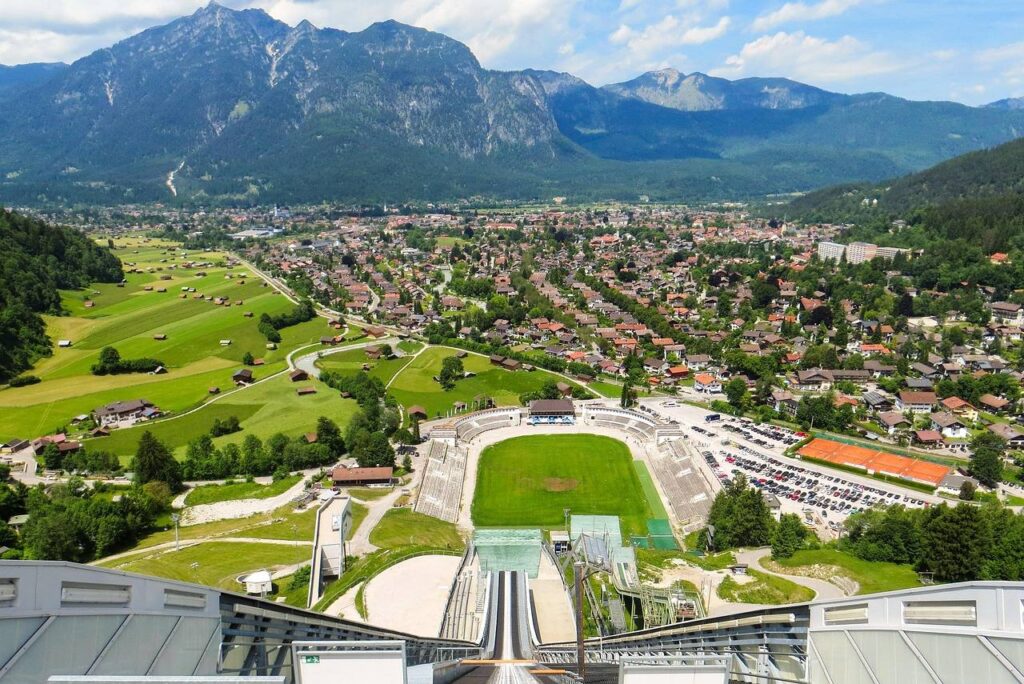
Say the name once and you have said two town names, because that is what it is. Garmisch-Partenkirchen carries a hyphen because it is two market villages that share a station, a ski jump and an Olympic history, and most visitors never sort out which half they actually walked through. This page is the overview; the mountain itself gets its own page, and both are one stop on the longer route in Bavaria by train.
What the town is known for
Garmisch-Partenkirchen hosted the 1936 Winter Olympics, and that history is still the shorthand for the place: its own tourism site describes it as Bavaria’s Olympic winter-sports town and the gateway to the Zugspitze1. Three things anchor a visit here, and they are not interchangeable errands you rush through on one afternoon. The Zugspitze ascent, by cogwheel train or cable car, is the headline reason most people come at all, and I cover the choice between the two routes on its own page. The Partnach Gorge and the Olympic ski jump are both listed among the town’s own attractions, with a live webcam kept on the Olympiaschanze itself1. I was not able to confirm the gorge’s opening season or an admission price from a source I could fetch this session, so I am leaving those specific numbers out rather than guess; check locally before you plan around them.
Garmisch side or Partenkirchen side
The honest answer is that the town’s own site does not draw a hard line between the two halves for a visitor’s purposes1. My opinion, then, rather than a measured fact: the Garmisch side sits closer to the Zugspitze valley station, which matters most if the mountain is your first-morning priority, while the Partenkirchen side carries more of the older, arcaded streets that make a good evening walk after a day on the peak. Neither half is a long taxi ride from the other; this is one town with one train station, not two separate bases you need to choose between for the whole trip.
Resi says If the Zugspitze is the actual point of your visit, put your first night on the Garmisch side and start the cogwheel train the moment it opens, before the crowds catch up. If you have a second night and nowhere urgent to be in the morning, move toward the Partenkirchen side instead and spend it on the older streets rather than the mountain view, which you have already seen by then.
The Partnach Gorge and the ski jump
Both sit inside the town’s own list of attractions, alongside the Zugspitze itself1. The Olympiaschanze, the Olympic ski jump, is the more photographed of the two, and the town keeps a live webcam trained on it, a small sign of how much the 1936 Games still anchor local identity1. Beyond that, I do not have sourced specifics on visiting hours, admission or the gorge’s exact trail length for this article, and I would rather tell you that plainly than invent a number that sounds authoritative and is not.
A base, not just a mountain stop
Most itineraries treat Garmisch-Partenkirchen as a name attached to the Zugspitze ticket and nothing more, which undersells the town. It sits close enough to Mittenwald that the two make an easy pairing on the same regional-rail day, one for the mountain and the museum-grade violin workshops, the other for the gorge and the ski jump. If you are building a longer Alpine leg rather than a single day trip, I would put Garmisch-Partenkirchen and Mittenwald on consecutive days rather than trying to rush both into one, since the Zugspitze alone can absorb a full morning before you have seen anything else in town.
The 1936 Olympics left more than the ski jump behind; the whole town still organizes its identity around that winter, which is part of why the Olympiaschanze gets a permanent webcam rather than being treated as a minor local landmark1. It is worth a look even if ski jumping has never interested you, if only to see how completely one Games can define a place ninety years on.
Getting there
Garmisch-Partenkirchen sits on Bavaria’s regional rail network, and the Bayern-Ticket covers the regional trains and nearly all local bus lines statewide on a single ticket, starting at €34 for one traveler in second class2. I could not confirm an exact journey time from Munich Hauptbahnhof from a source I fetched myself, so I am leaving that figure out; check a live timetable before building your day around it.
Frequently Asked Questions
Is Garmisch-Partenkirchen one town or two?
Administratively one town, formed of two historically separate market villages, Garmisch and Partenkirchen, which share a train station and the same Olympic history.
What is Garmisch-Partenkirchen known for?
Hosting the 1936 Winter Olympics, and today for being the base town for the Zugspitze, Germany’s highest peak, along with the Partnach Gorge and the Olympic ski jump.
Should I stay in Garmisch or Partenkirchen?
Neither half is far from the other. If the Zugspitze is your priority, the Garmisch side sits closer to the valley station; if you want more time on older streets in the evening, the Partenkirchen side has more of that character.
Is the Partnach Gorge open year-round?
The gorge closes for weather and maintenance at short notice, so check the town’s site for the current opening before you plan a visit around a specific date.
How do I get to the Zugspitze from Garmisch-Partenkirchen?
The cogwheel train departs directly from the valley station in town; a separate cable car departs from Eibsee, a short distance away. Both are covered on the same round-trip ticket.
Can I see the Olympic ski jump up close?
It is one of the town’s listed attractions, with the town keeping a live webcam trained on it for those who want a preview before visiting.
Is Garmisch-Partenkirchen a day trip or an overnight from Munich?
It works as a long day trip if the Zugspitze is your only goal, but an overnight gives you time for the gorge, the ski jump and the older streets without rushing the mountain.
Related Articles
 Bavaria by Train: Day Trips from Munich and a Week Without a CarBavaria
 Zugspitze: Cogwheel Train or Cable Car?Bavaria
 Mittenwald and the Alps by Train: Violins, the Karwendel and the BorderBavaria
 The Bayern-Ticket: One Day of Regional Trains for a Group, ExplainedBavaria
 One Week in Bavaria by TrainBavaria
 Bavaria or Austria for a First Alpine Trip?Bavaria
 The Best Time to Visit Bavaria, Month by Month, from the Climate RecordsBavaria
Sources
- Garmisch-Partenkirchen Tourism — Garmisch-Partenkirchen Tourism. Accessed 2026-09-27.
- Bayern-Ticket — Deutsche Bahn. Accessed 2026-09-27.