In brief
Passau calls itself the Dreiflüssestadt, the three-rivers city, for the spot where the Danube, the Inn and the Ilz meet in three visibly different colors. Its skyline is St. Stephen’s Cathedral, home to an organ built in 1928 with 208 registers, then the largest church organ in the world; it has since grown to 233 registers and 17,974 pipes. A restoration is underway on the historic instrument through 2028, so check before you plan a visit around hearing the whole thing. Give it a half day: the river viewpoint, the cathedral, and a walk through the Altstadt above the Inn is enough to say you have seen Passau properly.
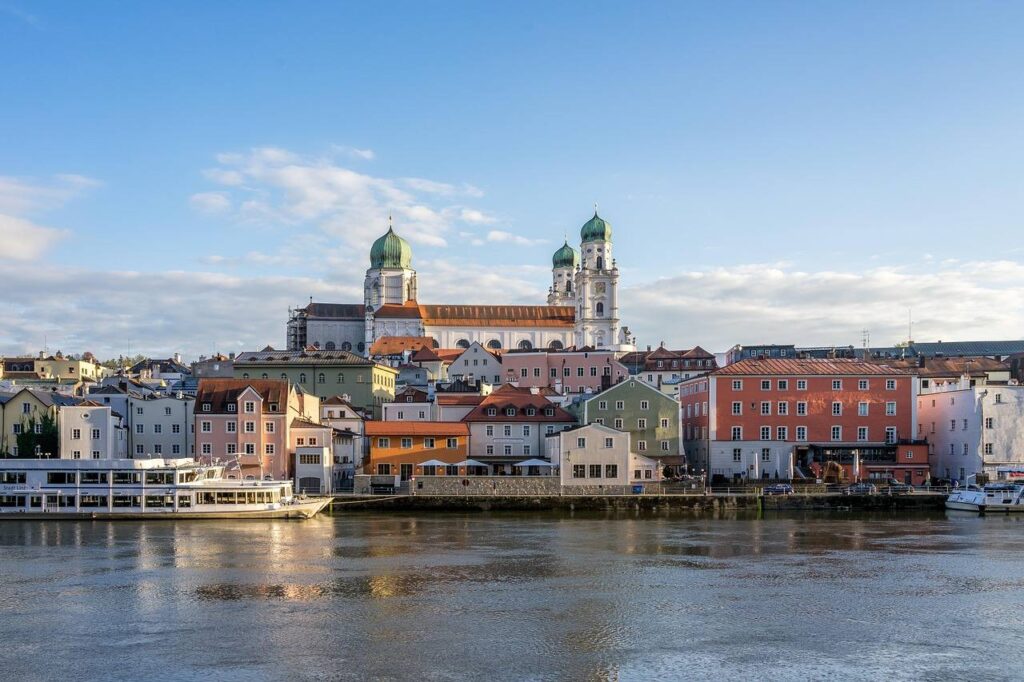
Passau does not try to be Munich’s rival the way Regensburg or Nuremberg sometimes do; it is a border town, three rivers wide, that has spent centuries as the last stop before Austria rather than a destination anyone was racing toward. That is most of its appeal. It sits at the eastern edge of the day trips covered in my guide to Bavaria by train, close enough to fold into a longer loop through Regensburg if you have a few days rather than one.
Where three rivers become one
The whole geography of the town is the postcard: the Danube arrives pale and wide, the Inn joins from the Alps a cleaner blue-green, and the smaller, darker Ilz slips in from the Bavarian Forest, and for a stretch downstream you can genuinely see the three currents running side by side before they mix1. The viewpoint locals call the Dreiflusseneck, the three-rivers corner, is the place to stand for it, at the tip of the Altstadt peninsula where all three rivers converge.
Resi says Every river town in Bavaria claims a view worth the walk. Passau is one of the few where the claim is literally true and not just a brochure line: you are standing on the only spot in the country where three rivers of three different colors are running past you at once, before the Danube swallows the other two and carries on toward Vienna.
The cathedral and its organ
St. Stephen’s Cathedral dominates the Altstadt skyline, and the thing worth knowing before you go in is the organ. The diocese’s own account is specific: the instrument was completed in 1928 with 208 registers, built at the time as the largest organ in the world, and it has grown since to 233 registers sounding through 17,974 pipes2. That is a genuinely large number of pipes for one building, and it is why organ concerts here have been a fixture of a Passau visit for a century. A historic restoration of the organ is running through 2028, which as of September 2026 means the full instrument is not always playable, so anyone timing a trip around hearing it should check the cathedral’s own listings before booking anything2.
I will not tell you it is still the largest organ in the world, because nobody’s own page says that anymore, and a claim this specific is not one I repeat without the diocese saying it in the present tense. What is true, and sourced, is the history: built as the record-holder, grown considerably since, and still one of the largest church organs anywhere.
Walking the old town
Above the Inn, the Altstadt climbs in the tight, tall-housed way most of Bavaria’s river towns do, Italian-flavored in its pastel facades from the centuries when Passau’s bishops answered to money and trade routes as much as Rome. It rewards walking without a fixed list: narrow lanes, the cathedral square, the riverside promenades along both the Danube and the Inn sides of the peninsula, and glimpses of the fortress, the Veste Oberhaus, on the hill across the water.
The fortress across the water
Across the Danube from the Altstadt, the Veste Oberhaus sits on the hill that once let Passau’s prince-bishops keep an eye on their own town from a safe distance, which tells you something about how that relationship usually went. It is a proper fortress rather than a palace, built and rebuilt over centuries as the seat of church power that ran Passau for most of its history, and the walk up doubles as the best angle on the three-rivers view, looking down rather than standing at river level. If the Altstadt below feels crowded with day-trip boats in high season, the fortress side of the water rarely does.
Getting there from Munich
Passau sits at the far eastern edge of Bavaria, past Regensburg on the way to the Austrian border, which makes it the longest of the classic Munich day trips and the one most worth pairing with an overnight if your schedule allows it. It falls under the regional-rail network that the Bayern-Ticket covers, the same ticket that makes sense for Regensburg and Nuremberg, and it is also a common stop on the river cruises that run the Danube toward Vienna, for anyone arriving by boat rather than by train. Either way, the Altstadt is a short walk from the station, flat until the streets start climbing toward the cathedral.
What to skip if you only have an afternoon
Passau’s own tourism material leans on the river view and the cathedral as the two things nobody should miss, and that assessment holds up: they are a short walk from each other, so there is no real trade-off to make1. If you are coming from Munich for the day, that pairing plus lunch in the Altstadt is a full and reasonable use of the time, without trying to also fit in a boat trip on the rivers, which is its own half day again.
Frequently Asked Questions
What is Passau known for?
The point where the Danube, Inn and Ilz rivers meet in visibly different colors, and St. Stephen’s Cathedral, home to one of the largest church organs in Europe.
How many pipes does the Passau Cathedral organ have?
17,974, across 233 registers, in an instrument first completed in 1928 with 208 registers.
Is the Passau Cathedral organ the largest in the world?
It was built in 1928 as the largest organ in the world at the time; it has grown since, and the cathedral’s own materials no longer make that claim about today’s instrument.
Can you tour the cathedral organ during the restoration?
A restoration of the historic organ is underway through 2028, and it affects when the full instrument can be heard, so check the cathedral’s own listings before planning a visit around it.
Is Passau worth a day trip from Munich?
Yes, for the river viewpoint and the cathedral together, which sit close enough to combine in a half day; a full day lets you add the Altstadt at a slower pace.
Where do the three rivers actually meet?
At the Dreiflusseneck, the tip of the Altstadt peninsula, where you can see the Danube, Inn and Ilz running alongside each other before they merge.
Is Passau close to Austria?
Yes. It sits at Bavaria’s eastern border, and its history as a trade and church town owes a great deal to that position.
Related Articles
 Bavaria by Train: Day Trips from Munich and a Week Without a CarBavaria
 Regensburg Day Trip from Munich: Worth It, and How to Do It by TrainBavaria
 Nuremberg Beyond the Christmas Market: The Castle, the Rally Grounds, Courtroom 600 and the SausageBavaria
 The Bayern-Ticket: One Day of Regional Trains for a Group, ExplainedBavaria
 One Week in Bavaria by TrainBavaria
 Bavaria in Winter: What Is Open, What Is Closed, What Is Worth the ColdBavaria
Sources
- Passau tourism, official site — Tourismus Passau. Accessed 2026-09-27.
- The organ in Passau Cathedral — Diocese of Passau, bistum-passau.de. Accessed 2026-09-27.