In brief
The Munich Glockenspiel plays every day at 11 a.m. and 12 noon, with a third show at 5 p.m. from March to October and a quieter night show at 9 p.m. It runs in the tower of the town hall on Marienplatz, with 43 bells and two scenes, a 1568 ducal wedding on the upper level and the coopers’ dance below. Watching costs nothing, and the spot to aim for is a little way back from the façade, not directly under the tower. On Good Friday it stays silent all day.
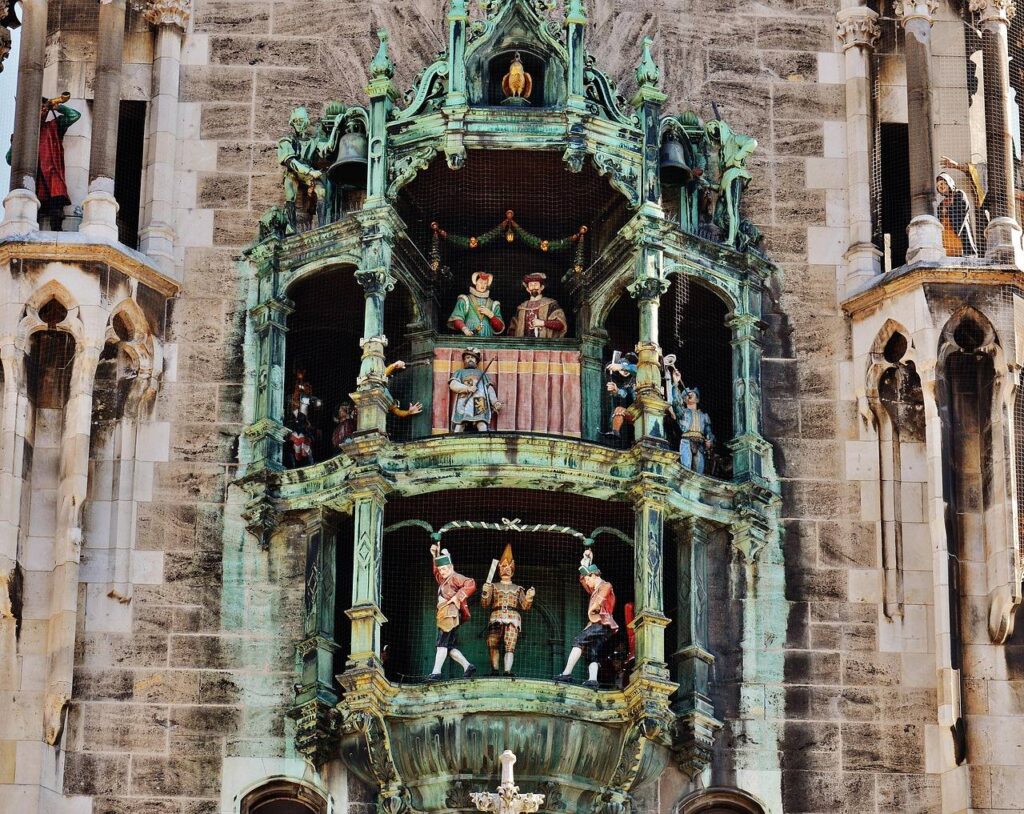
Shortly before eleven, Marienplatz fills with people tilting their heads back at exactly the same angle and holding it there. They are not watching a bird. They are waiting for a town hall to perform, on a timer, the one trick it has. This page settles when it performs, what you are looking at once it starts, and where to stand so that you see the figures rather than a great deal of masonry. It belongs to my first-trip guide to Munich, where it sits with the other things a first visit tends to include.
The show times
Four times a day, depending on the season. The midday pair is the one everybody knows, and the 9 p.m. show is the one almost nobody plans for1.
| Show | When |
|---|---|
| Morning | Daily at 11 a.m. |
| Midday | Daily at 12 noon |
| Afternoon | Daily at 5 p.m., March through October only |
| Night | Daily at 9 p.m. |
Source: muenchen.de1.
Two things can make the table wrong on the day you go. On Good Friday the Glockenspiel stays silent all day, and the city’s page adds that times can change for maintenance, technical work or events on Marienplatz1. If your trip is built around this one show, look at the page the morning of, because a stage for a festival on the square is the sort of thing that moves a show.
What the figures actually do
The tower plays two scenes, one above the other, and both are stories Munich tells about itself.
The upper level is the wedding of Duke Wilhelm V and Renate of Lorraine in February 1568, which included a jousting tournament on Marienplatz in which the Bavarian knight wins. I would like to report some suspense, but the Bavarians wrote the script. The lower level is the Schäfflertanz, the coopers’ dance: the city’s page links it to barrel makers dancing for a population frightened by plague after an epidemic1. A Schäffler is a cooper, a maker of barrels, which is how a town ends up with a plague story on its town hall that finishes in a dance.
The mechanism is a carillon of 43 bells, powered by solar energy, and it was cleaned, retuned and refurbished in 2007, the first time in almost 100 years1. Forty-three bells for a town hall is a great deal of bell, and I mean that as a compliment.
The music changes with the month
The tower does not play the same tune all year. The city lists six programs of four pieces, assigned by month, and a program comes back in more than one month: the one that plays in October also plays in May1. Right now that means the “Bierwalzer”, the beer waltz, alongside “Prinz Eugen, der edle Ritter” and two folk songs. In Advent the program is different and ends with “Oh Tannenbaum”, so a December visit comes with a soundtrack you already know.
Only the 9 p.m. show breaks the pattern. It carries the night watchman, an angel and the Münchner Kindl, and for music it uses the night watchman’s call from Wagner’s “Die Meistersinger von Nürnberg” and Brahms’s lullaby1. The city describes it as often quieter and less well known than the midday performances, and that is the whole case for it: the same tower, a smaller crowd.
Where to stand
The good spot is not the obvious one. Stand a little way back from the town hall façade rather than directly beneath the tower, where you get the shows at a steep angle and the neck strain of a dentist’s chair. The city’s page names the center of the square, or slightly toward the Mariensäule, the column on the square, as the places for a photograph1. Arrive a few minutes before the hour, especially in peak season, because the people who arrived early have already taken the good spots.
It costs nothing to watch from the square1. That also means nobody is checking whether you came for the show or for the pretzels, and the square copes with both.
Resi says Worth ten minutes if you are already in the square, not worth a schedule. Come for the 11 a.m. or noon show because that is when you are likely to be there anyway, stand back from the façade, watch the knight win and move on. If you want the version with elbow room, go at nine in the evening, when the night watchman has the tower more or less to himself.
What to do before and after
In my view the show works best as a fixed point in a loose day rather than a destination, and Marienplatz is easy to build a day around. For lunch afterward, my Viktualienmarkt guide is where I would send you. If you are in Munich in Advent, the Glockenspiel competes with the market stalls for the same stretch of attention, and my page on Munich’s Christmas markets and Tollwood sorts out which one to prioritize.
Frequently Asked Questions
What time is the Glockenspiel in Munich?
Daily at 11 a.m. and 12 noon, with an extra show at 5 p.m. from March to October and a night show at 9 p.m.
Is the Munich Glockenspiel free?
Yes. You watch it from the square, and it costs nothing.
Does the Glockenspiel play in winter?
Yes, at 11 a.m., noon and 9 p.m. The 5 p.m. show runs only from March to October.
What does the Glockenspiel show?
Two scenes: a joust at the 1568 wedding of Duke Wilhelm V and Renate of Lorraine on the upper level, and the Schäfflertanz, the coopers’ dance, on the lower level.
How many bells does the Munich Glockenspiel have?
Forty-three, powered by solar energy.
Is the Glockenspiel silent on any day?
Good Friday, all day. Times can also change for maintenance, technical work or events on Marienplatz.
Where is the best place to watch the Glockenspiel?
A little way back from the town hall façade, in the center of the square or slightly toward the Mariensäule, not directly under the tower.
Related Articles
 Munich for a First Trip: What Is Worth It, What Is Not, and How the City WorksMunich
 The Viktualienmarkt: Munich’s Food Market and Its Beer GardenMunich
 Munich’s Christmas Markets: Marienplatz, Tollwood and the Neighborhood MarketsMunich
 Sundays in Munich: What Is Closed, What Is Open, and the One-Euro MuseumsMunich
 Nymphenburg or the Residenz? Which Munich Palace to See with One AfternoonMunich
 Munich Public Transport Explained: Zones, Tickets, the Deutschlandticket and the Bayern-TicketMunich
Sources
- Munich Glockenspiel — muenchen.de, City of Munich. Accessed 2026-10-13.