In brief
Obatzda, also spelled Obatzter, is Bavaria’s beer-garden cheese spread: ripe soft cheese mixed with butter, paprika and a splash of beer until it turns a deep orange, and the EU has its own rule about what “ripe soft cheese” is allowed to mean. The European Commission registered “Obazda”/”Obatzter” as a Protected Geographical Indication on 26 June 2015, unopposed, under Commission Implementing Regulation (EU) 2015/1002. Bavaria’s own culinary register specifies the cheese must be Camembert and/or Brie, optionally with Romadur, Limburger or fresh cheese added, and that this ripe soft cheese has to make up at least 50 percent of the finished spread, alongside butter, paprika and salt, with a little cream or milk for spreadability and a small amount of beer allowed for flavor. The dish is said to have emerged more than 150 years ago as a way to use up soft cheeses that had gone past their prime, before reliable refrigeration existed, and it is eaten spread on bread or scooped up with a pretzel, as part of a Brotzeit.
Disclosure: some links on this page are affiliate links, marked by the products and tours they name. A purchase through these links may earn the site a commission at no cost to you, and it never affects what is recommended. How this works.
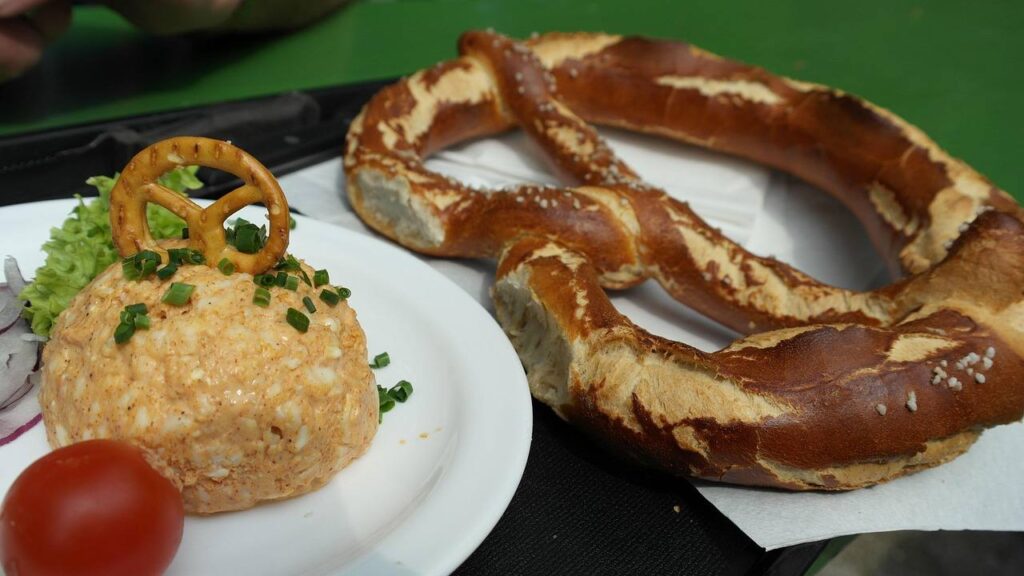
The color gives it away before the name does: a bowl the shade of a sunset, next to a pretzel on a beer-garden table. That is Obatzda, or Obatzter, or whatever the menu at your table happens to call it, and it was one of the Schmankerl, the delicacies, I loved most back in Munich, right up there with a warm potato salad and a fresh Brezn. Both names for it refer to the same spread, and both are registered with the European Union, which is more legal attention than most cheese dips ever get. This page is part of my guide to Bavarian food and covers what actually goes into it, why the EU cares, and how to make a version at home that meets the same 50 percent rule the official recipe does.
What Obatzda is, by the official rule
Bavaria’s own culinary heritage register is specific about what can be called Obatzda. The base is ripe soft cheese, either Camembert or Brie, and optionally Romadur, Limburger or a fresh cheese blended in alongside them, and that ripe soft cheese has to account for at least 50 percent of the finished product by weight. To it goes butter, paprika powder or extract for the color and the mild heat, and salt; cream or milk can be added for texture, and a small amount of beer is permitted for flavor1.
That 50 percent threshold is not a suggestion. It is the line the EU used when it decided what counts as genuine Obazda and what does not, which makes Obatzda one of the few spreads anywhere with a legally defined minimum cheese content.
Protected since 2015
The name “Obazda”/”Obatzter” was entered in the EU’s register of geographical indications as a Protected Geographical Indication under Commission Implementing Regulation (EU) 2015/1002, effective 26 June 2015. The regulation’s own text states that the name is “hereby entered in the register,” and it went through without objection, filed under Class 1.4, other products of animal origin2.
Resi says “Obazda” and “Obatzter” are both official names for the same registered product, so a menu using either spelling is not making a mistake, and the waiter is not testing you. The EU registered them together as equivalent, which is tidier than most spelling arguments in this business ever get, and possibly the only thing Brussels and a Bavarian beer garden have ever agreed on.
Where it comes from
The register places Obatzda’s emergence more than 150 years ago, during the period when Bavaria’s beer gardens were expanding and Bavarian producers first started making Camembert and Brie themselves. The underlying practice was practical rather than aspirational: before reliable refrigeration, soft cheeses that had gone past their prime needed a use, and mashing them with butter and paprika was that use. The register itself notes both cheeses taste increasingly savory as they age, which is exactly the point of an aged-cheese spread1.
One named figure gets credit for spreading the dish beyond Bavaria’s borders: Katharina Eisenreich, who ran the Bräustüberl at Weihenstephan, said to be the world’s oldest brewery, from 1920 to 1958, and is credited with popularizing the spread by serving it to the guests who came through that beer hall1. A dish invented to rescue cheese nobody wanted to throw away, served today by name at beer gardens across Bavaria, is not a bad life for a kitchen fix.
How to make it at home
This is one of the few recipes on this site with an official ingredient list behind it, so the method below follows the register’s own rule rather than a house variation1.
- Start with the cheese. Use ripe Camembert or Brie, or a mix, and make sure it comes to at least half the weight of your finished spread. A cheese that is a little past its peak, soft and pungent, is traditionally correct rather than a flaw.
- Mash, do not blend smooth. Combine the cheese with softened butter, paprika powder (or paprika extract) and salt, working it with a fork until it is spreadable but still has texture. A food processor will make it too uniform.
- Loosen it if needed. A spoonful of cream or milk helps if the mix is too stiff to spread.
- Add beer sparingly. A small splash, for flavor rather than volume, is permitted by the register; this is not the place to pour in a full glass.
- Serve with a pretzel and bread, and let it sit at room temperature for a few minutes before serving so the flavor and texture are what a beer garden would actually hand you.
Reduced to a spec sheet, it looks like this:
| Ingredient | Role | Minimum/limit |
|---|---|---|
| Camembert and/or Brie (optionally Romadur, Limburger, fresh cheese) | Base | At least 50% of finished product |
| Butter | Richness, spreadability | No stated minimum |
| Paprika powder or extract | Color, mild heat | No stated minimum |
| Salt | Seasoning | No stated minimum |
| Cream or milk | Texture (optional) | Small amount |
| Beer | Flavor (optional) | Small amount |
Source: Genussorte Bayern1.
Sourcing the cheese in North America
The cheese is the one ingredient worth being specific about, since it is the majority of what you are making. Camembert is sold in the US in individual wheels; one option is Le Chatelain Camembert, an 8.8-ounce French wheel described on its own listing as having a creamy texture and a light, salty flavor suited to gourmet pairings, as of September 20263.
Resi says A wheel that size, once you weigh in the butter and everything else, comfortably clears the 50 percent cheese threshold the official recipe calls for, so nobody from the EU is going to show up at your door. It is the one I would reach for first.
Fresh radishes, the other fixture of a Bavarian Brotzeit board, do not ship well and are easiest to source at a regular grocery store rather than a specialty importer; my Brotzeit page covers the rest of what typically sits next to the Obatzda bowl. A fresh pretzel matters more than any single ingredient here, since it is what most of the spread is going to end up on.
Frequently Asked Questions
Does Obatzda have to contain real Camembert?
Not exclusively, but ripe Camembert or Brie (with optional Romadur, Limburger or fresh cheese) has to make up at least 50 percent of the finished product under the official specification.
Is Obazda the same as Obatzter?
Yes. Both names were registered together as the same Protected Geographical Indication by the European Commission in 2015.
When did Obatzda get EU protection?
The registration became effective 26 June 2015, under Commission Implementing Regulation (EU) 2015/1002.
What gives Obatzda its orange color?
Paprika powder or paprika extract, mixed in with the cheese and butter.
Is beer actually an ingredient in Obatzda?
A small amount is permitted for flavor under the official register, though it is not a required ingredient and is not meant to be added in any real volume.
How old is Obatzda?
The register dates its emergence to more than 150 years ago, tied to the growth of Bavarian beer gardens and early domestic production of Camembert and Brie.
Related Articles
Sources
- Obatzda / Obatzter — Genussorte Bayern, Bavarian State Ministry of Food, Agriculture and Forestry. Accessed 2026-09-24.
- Commission Implementing Regulation (EU) 2015/1002 — EUR-Lex, Official Journal of the European Union. Accessed 2026-09-24.
- Le Chatelain Camembert Cheese, 8.8 oz — Amazon.com. Accessed 2026-09-24.