In brief
A Dirndl is four separate pieces worn together: a fitted bodice, a blouse underneath it, a full skirt, and an apron tied over the top. It comes in three standard lengths, mini, midi and long, and the fit that matters most is the bodice, snug but not gasping, with natural fabric and real buttons rather than a printed pattern and a zipper. At a Munich shop, a real one runs from about €199 at the budget end to over €2,000 for a formal velvet style. In North America, a handmade Dirndl from a specialist studio runs roughly $389 to $498, with free shipping over $250.
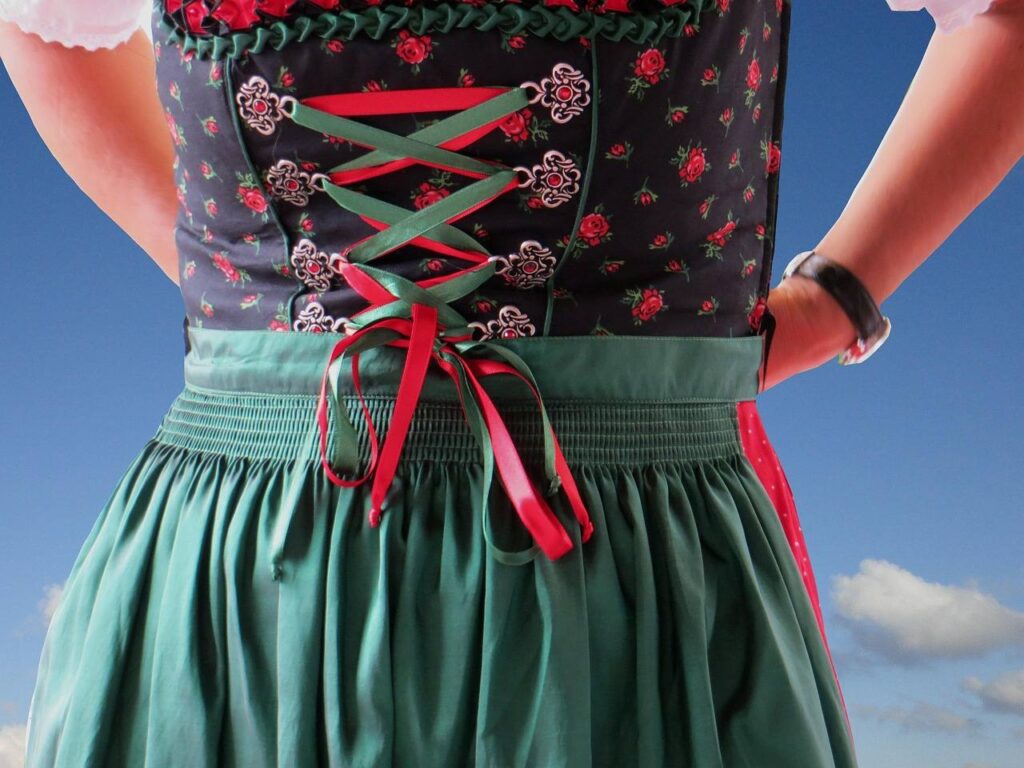
If you have shopped for a Dirndl online and been confused by why one listing calls itself a dress and another calls itself four separate garments: the second listing is more honest. A Dirndl is not a dress you zip into. It is a small wardrobe, worn as a system, and knowing the four pieces is the difference between putting one together correctly and just looking like you tried. This page is the detail version of what I cover briefly on the Trachten and customs pillar; come back there for the bow, the Lederhosen and the rest of the Bavarian year.
The four pieces
A Dirndl breaks down into a bodice, a blouse, a skirt and an apron, and each one is sold and fitted somewhat independently even when they arrive as a set1.
- Bodice (Mieder or Leiberl). The fitted, structured top half, usually with a low neckline, often patterned or embroidered. This is the piece that actually needs to fit; everything else is more forgiving.
- Blouse. Worn underneath the bodice, almost always white, generally with puffed sleeves that show at the shoulder and along the upper arm.
- Skirt. Full and wide, plain or patterned, in cotton, silk or another fabric, and the piece where length is decided.
- Apron. Worn over the skirt and tied at the waist with a bow, plain or patterned to complement rather than match the skirt exactly1.
None of the four pieces is optional. A bodice and skirt without the apron reads as unfinished, and a Dirndl without the blouse underneath is not really wearable in public, since the bodice alone is not built to be a top.
Lengths: mini, midi, long
North American retailers sell Dirndl in three standard lengths: mini, midi and long, alongside multiple colors and fabrics within each2. Long is the most traditional and most formal-looking option, midi splits the difference and works for most parties and beer gardens, and mini is the shortest and the one Bavarian retailers are quickest to warn against overdoing, since a mini dirndl that only covers the backside reads as costume rather than Tracht to the people who actually wear the real thing4. Munich’s own upscale retailers sell a further style split worth knowing about: a long, a midi, a sleeved (Ärmeldirndl) and a velvet (Samt-Dirndl) line, the last being the dressiest and priciest of the four5.
How it should fit
The bodice is the one piece a Munich shop assistant will actually check before letting you walk out the door: snug enough to hold its shape and support the front of the garment, not so tight that you cannot sit or reach comfortably. Munich’s own tourism office puts the buying priorities in this order: a proper bodice fit, natural fibers such as cotton, linen or wool, clean seams, and real buttons rather than printed ones3.
The blouse should sit under the bodice without bunching, and the apron should tie just above the hem of the skirt, not higher, since accessorizing beyond that point tends to look busier rather than more finished4. Skip chunky combat boots or over-the-knee boots with a Dirndl; pumps, ballet flats, lace-up ankle boots or Mary Janes suit the silhouette better4.
Resi says If you take one buying rule from this page, take this one: put your hand flat against the bodice front and sit down in the dress before you decide it fits. A Dirndl that looks perfect standing at a mirror and cuts into your ribs the moment you sit at a Biergarten table is a Dirndl you will regret by the second Maß.
What to avoid
A real Dirndl is natural fiber and stitched seams; a costume one is shiny polyester, sometimes with a plastic-look organza overlay, and a zipper doing the work real buttons should do4. Skip plain black-and-white combinations, since that reads as a beer-tent waitstaff uniform rather than a personal outfit, and skip neon colors entirely; bright, flashy shades have never been a Bavarian trend4. Beyond the dress itself, keep accessorizing minimal and do not forget the apron, which is not a decorative extra but one of the four required pieces4.
None of this means a Dirndl has to look severe. Embroidery on the bodice, a patterned skirt, a contrast blouse color: all of it is normal, and the retailers above sell dozens of variations on the same four-piece structure. The line these buying guides are drawing is between “personal outfit in natural fabric” and “printed novelty dress,” not between plain and decorated.
What it costs
Munich’s own shops span a wide range, and naming them is more useful than a vague “it depends.” Lodenfrey, in business since 1842, lists more than 400 Dirndl styles from €599 at the budget end up to €2,199 for the most elaborate velvet midi-Dirndl, with a mid-range band around €699 to €9995. Angermaier, a family-run Munich manufacturer, runs cheaper across the board, from €199 at the entry level to €599 for a designer collaboration piece, with most of its styles landing between €269 and €4096. Trachten Rausch, near the Theresienwiese, describes its own Dirndl pricing only in general terms, as “affordable” and “fair-priced,” without a published range, positioning itself at the value end of the market7.
Buying from North America
You do not need a trip to Munich to own a real one. Rare Dirndl, a women-owned studio in Chicago handmaking and importing Dirndl since 2010, sells current styles for roughly $389 to $498, ships within one to two days, offers free shipping over $250 and a free-alterations-reimbursement program, and keeps a physical studio in Lincoln Square by appointment8. If that is more than your budget allows, Lederhosen Store carries Dirndl as well as men’s wear, priced roughly $139.95 to $219.99 with free shipping over $299, which puts a real cotton or linen Dirndl within reach of a first-time buyer9.
Resi says Rare Dirndl is the one I would point a first-time American buyer toward. It is handmade rather than mass-produced, it comes with an actual sizing conversation instead of a guess, and the free-alterations program covers you if a US size chart and a German cut do not agree with each other, which they often do not.
Frequently Asked Questions
What are the four parts of a Dirndl?
A bodice (Mieder or Leiberl), a blouse worn underneath it, a full skirt, and an apron tied over the skirt with a bow.
What is the right length for a Dirndl?
Retailers sell mini, midi and long. Long is the most traditional and formal, midi suits most occasions, and mini is the shortest option and the one most likely to be read as costume if it is too short.
Does the apron have to match the dress?
No. It is meant to complement the skirt’s color or pattern rather than match it exactly.
How should a Dirndl bodice fit?
Snug enough to hold its shape and support the garment, but loose enough that you can sit down and reach comfortably. Try it sitting, not just standing.
What fabric is a real Dirndl made from?
Natural fiber: cotton, linen, silk or wool, depending on the formality. Shiny polyester or a plastic-look organza overlay is the tell of a costume version.
How much does a real Dirndl cost?
At Munich shops, roughly €199 to €599 for a mid-range piece, up to €2,199 for a formal velvet style at the top end. In North America, a handmade one from a specialist studio runs about $389 to $498.
Can I buy an authentic Dirndl in the US?
Yes. US-based studios and retailers sell handmade or imported Dirndl with domestic shipping, in the same natural fabrics and construction a Munich shop uses.
Is a mini dirndl acceptable?
It is sold and worn, but Bavarian retailers themselves warn against going too short; a mini that only covers the backside reads as costume rather than Tracht.
Related Articles
 Dirndl, Lederhosen and the Bavarian Year: Trachten and Customs ExplainedTrachten and customs
 What the Dirndl Bow Means (Left, Right, Center, Back), and Where the Rule Comes FromTrachten and customs
 Where to Buy a Real Dirndl in the US and Canada, and What Real MeansTrachten and customs
 Renting a Dirndl or Lederhosen in Munich: Shops, Prices, FitTrachten and customs
 Lederhosen: History, Types and What a Real Pair CostsTrachten and customs
 What to Wear to Oktoberfest, and Whether You Have ToOktoberfest
 Oktoberfest Costumes, Honestly Rated: From the $30 Costume Dirndl to the Real ThingParty
 Oktoberfest in Munich: Dates, Tents, Reservations, What to Wear and What It CostsOktoberfest
Sources
- What Is a Dirndl Dress: Decoding Tradition, Style and Everything In Between — eLederhosen. Accessed 2026-09-24.
- Dirndl Dress Collection — Traditional Lederhosen. Accessed 2026-09-24.
- Oktoberfest Outfits: Dirndl and Lederhosen — muenchen.de. Accessed 2026-09-24.
- Common Dirndl Mistakes — Lederhosen Store. Accessed 2026-09-24.
- Damen Trachten: Dirndl — Lodenfrey. Accessed 2026-09-24.
- Damen: Dirndl — Angermaier. Accessed 2026-09-24.
- Trachten Rausch — Trachten Rausch. Accessed 2026-09-24.
- Rare Dirndl — Rare Dirndl. Accessed 2026-09-24.
- Lederhosen Store — Lederhosen Store. Accessed 2026-09-24.