In brief
A Maibaum is a stripped and decorated spruce or fir that Bavarian villages raise in the market square on or around May 1, and choosing, cutting, decorating and guarding it takes weeks of a village’s time before anyone even lifts it upright. Most stay standing for about six years before they are replaced, though one village, Ludenhausen in the Landkreis Landsberg, re-erects a brand-new tree every single May 1 instead. A painted Maibaum has to be guarded for weeks beforehand, because a rival village stealing it is part of the custom, and Ludenhausen dodges the risk by felling its replacement only a week ahead of time. A separate and rowdier version of the same idea happens every Whit Monday in Rottenstuben, where young men grease their hands and feet with pitch and race each other up a bare pole to the first wreath, about ten meters up, in front of roughly 2,000 people chanting them on. Munich has its own, much tamer version at the Viktualienmarkt, standing there since 1962 and repainted blue and white every few years.
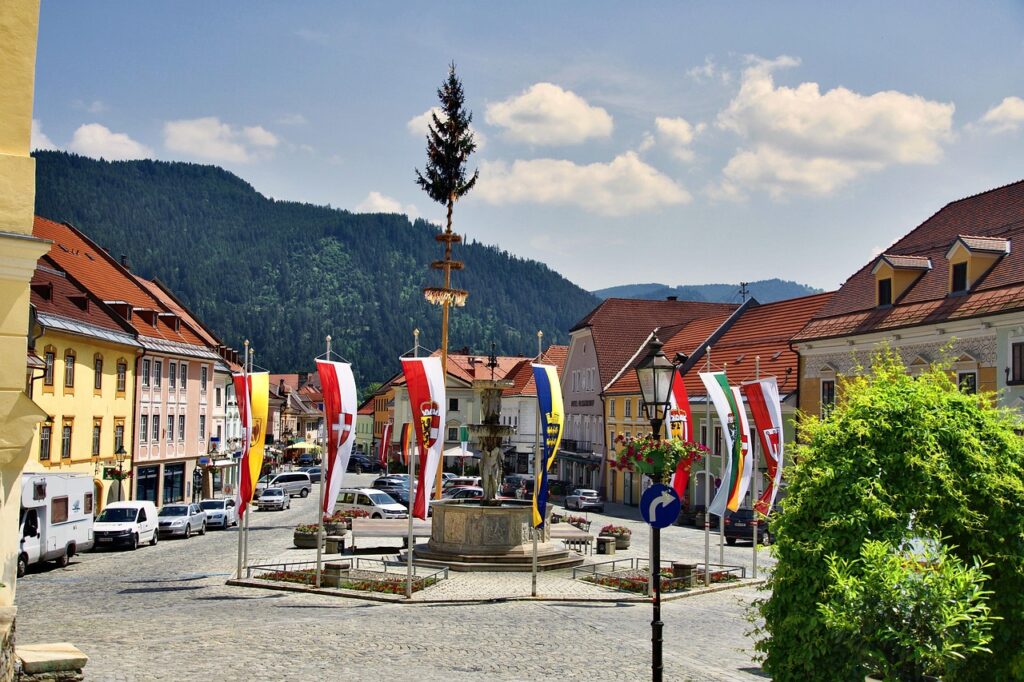
If you drive through a Bavarian village in early May and find a fully grown tree standing in the market square, stripped bare except for a crown of green at the top, its trunk wound in spiral stripes of blue and white, hung with wooden emblems of the local trades and clubs: nobody left it there by accident. The whole village put it up on purpose, and it is entirely possible the village next door is already planning how to take it. It is one of the calendar customs on my Bavarian Trachten and customs page, and it is the one where village pride does the most visible work.
Choosing, cutting and guarding the tree
Bavaria’s own tourism board is blunt about what a Maibaum actually costs a village in effort: “Setting up a maypole is a joyful event. Yet the organisation involved in selecting a tree, cutting, transporting, decorating, guarding then finally erecting it all takes time, money and hard work.”1 None of that is decorative language. Somebody has to pick the right spruce or fir, fell it, get it into the village square, strip and paint it, hang the guild emblems and wreaths, and then watch it, because a decorated Maibaum left unattended is an invitation.
Six years, more or less, with one exception
Most Bavarian maypoles last “up to six years” before a village replaces them1. One village breaks the pattern entirely: Ludenhausen, in the Landkreis Landsberg, is the only village that raises a brand-new tree every May 1 rather than reusing one for years. According to the tourism board’s account, Ludenhausen has also never actually had its tree stolen, despite legendary attempts, including one where the would-be thieves from a neighboring village “were caught in the act by Farmer Mengle” and two more failed raids that “threw long, dark shadows over the relationship” between the villages involved1. Ludenhausen manages this partly by timing: rather than guarding a painted tree for weeks, the village fells its new one only about a week before raising it.
Painted trees mean guard duty
That timing detail matters because it points at the real reason most villages don’t do what Ludenhausen does: a painted, decorated Maibaum has to be guarded for weeks before it goes up, precisely because it is a target1. This is the part of the custom that gets the most attention, and for good reason: a village that lets its tree get stolen has lost something visible, in front of everyone, for as long as the tree stays gone. What exactly a successful theft costs the losing village, in practical terms, is not something I could confirm from an official source, and Bavarians in different regions will tell you three different versions of the rule with three different degrees of confidence. Treat any specific “pay this many kegs to get it back” story you hear locally as local color, not statute.
The climbing version: Rottenstuben on Whit Monday
Maypole guarding is about keeping a tree from leaving. A related but separate custom in eastern Bavaria is about getting up one that is already standing. At Rottenstuben, young men smear pitch onto their hands and feet for grip and race each other up a bare pole to reach the first wreath, roughly ten meters off the ground, an event held every year on Whit Monday in front of around 2,000 spectators who chant “Hauruck, Hauruck” as they climb2. It is not the same event as a village’s May 1 Maibaum raising, and it is not something every village does, but it is built on the same nerve: a pole, an audience, and young men proving something in public.
Resi says The tree is the least interesting part of this custom. What I find funny is how seriously grown adults take guarding a fifty-foot spruce from another village of grown adults, for weeks, over what amounts to bragging rights. I would not schedule a Bavarian road trip around catching a raising, because there is no single date and no central calendar; I would just keep my eyes open in early May and consider it a bonus if I passed through the right village on the right afternoon.
Where a visitor is likely to see one
Because Maibaum raisings are organized village by village around May 1, there is no single master schedule a visitor can check the way you would for Oktoberfest. If you are travelling through rural Bavaria in the days around the first of May, a village square with a fresh, brightly painted trunk lying beside a crowd, or already standing with its crown of branches at the top, is the sign to slow down.
Munich itself keeps a permanent, low-drama version of the same tradition at the Viktualienmarkt, the city’s food market. The first pole there went up on May 4, 1962, at the suggestion of the mayor at the time, and the market has replaced it every few years since, painted in the same blue and white3. It functions less like a village’s guarded prize and more like a landmark and meeting point at the center of the market, with events held around its base through the year3. It is a fine consolation if your visit does not line up with a village’s own May 1, and it does not require guard duty from anyone but the market itself.
Frequently Asked Questions
What is a Maibaum?
A Maibaum is a spruce or fir that a Bavarian village strips of its lower branches, decorates with paint and wooden emblems representing local trades and clubs, and raises in the village square on or around May 1.
Why do Bavarian villages steal each other's maypoles?
Stealing a rival village’s guarded, decorated maypole before it can be raised is a long-standing rivalry custom. The exact terms for getting a stolen tree back vary by telling and were not something I could confirm from an official source, so take any specific version you hear as local folklore rather than a fixed rule.
How long does a Maibaum stay up before it is replaced?
Most last around six years. Ludenhausen in the Landkreis Landsberg is the exception, raising a completely new tree every May 1 instead of reusing one.
Has any village's Maibaum never been stolen?
Ludenhausen’s tourism-board account describes its tree as never successfully stolen, including at least two documented failed attempts by neighboring villages.
What happens at Rottenstuben on Whit Monday?
Young men coat their hands and feet in pitch and climb a bare pole to reach the first wreath, about ten meters up, while roughly 2,000 spectators watch and chant them on. It is a separate custom from the village Maibaum raising, held on a fixed date each year.
Is there a Maibaum in Munich itself?
Yes, at the Viktualienmarkt, standing there in some form since 1962 and repainted blue and white every few years. It is a landmark rather than a rivalry target.
When exactly is a village's Maibaum raised?
On or around May 1, but each village sets its own date and there is no central public calendar, so a visitor has to be in the right place at the right time rather than plan around it.
Related Articles
 Dirndl, Lederhosen and the Bavarian Year: Trachten and Customs ExplainedTrachten and customs
 The Bavarian Year: Fasching to Christkindlmarkt, Month by MonthTrachten and customs
 Fasching: Bavaria’s Carnival Season and What Happens in MunichTrachten and customs
 Almabtrieb and Viehscheid: When the Cows Come Down the MountainTrachten and customs
 Schuhplattler and Blasmusik: Bavaria’s Slap Dance and Brass BandsTrachten and customs
 Bavaria the Free State: The Lion, the Flag, the Seven Regions and What Freistaat MeansTrachten and customs
 Bavaria by Train: Day Trips from Munich and a Week Without a CarBavaria
Sources
- The maypole in Bavaria — bavaria.travel, Bavarian Tourism Board. Accessed 2026-09-26.
- Willi Gschneidner: maypole climbing — bavaria.travel, Bavarian Tourism Board. Accessed 2026-09-26.
- Viktualienmarkt — muenchen.de, City of Munich. Accessed 2026-09-26.