In brief
Auszogne, also called Schmalznudel, Knienudeln or Kniekrapfen depending on which part of Bavaria you are standing in, is a fried-dough pastry stretched thin in the center and left thick at the edge, then deep-fried in lard until golden. The name literally means “pulled” or “stretched out,” which describes the shape rather than the flavor. It shows up at weddings, communions and Kirchweih festivals across all seven Bavarian districts, and at one particular stand near Munich’s Viktualienmarkt on an ordinary morning. It is not the same pastry as a doughnut, mostly because nobody bothers making it round.
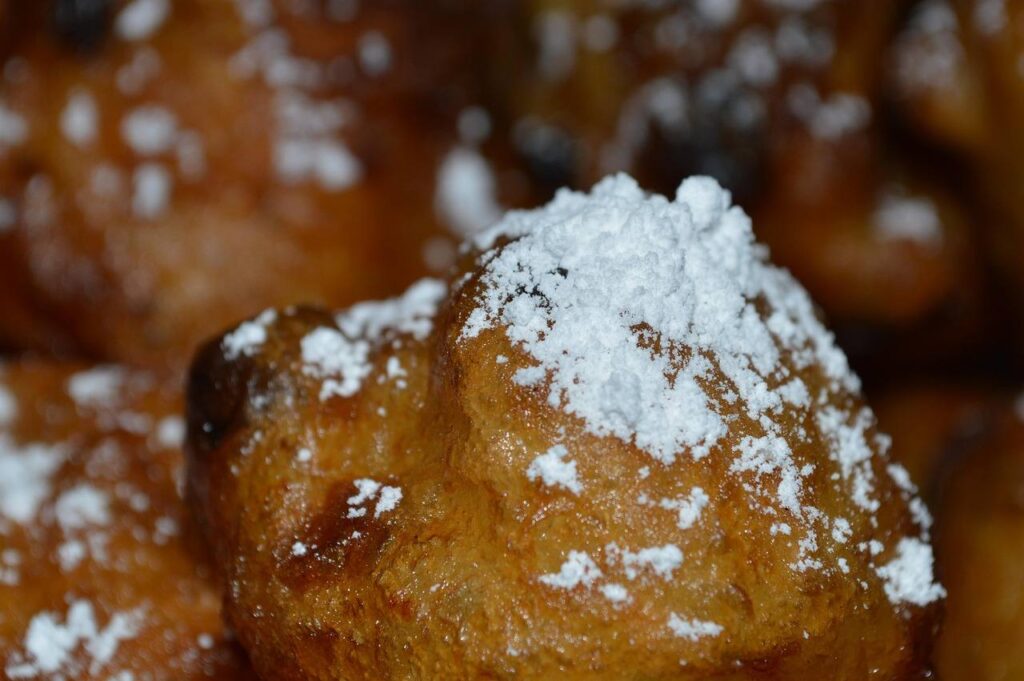
If you have walked past a small stand near the Viktualienmarkt early in the morning and seen a line for something that looks like a flattened, uneven doughnut with no hole: that is breakfast, and the shape is not a mistake. Munich’s fried-dough pastry is supposed to look stretched and a little ragged, thin as paper in the middle and thick and chewy at the rim, and that unevenness is the entire technique. It belongs on my guide to Bavarian food next to the other things Bavaria fries in the morning and does not apologize for.
What it actually is
Bavaria’s own register of regional specialties describes this as a traditional fried-dough pastry known by at least three names depending on the region: Auszogne, Knienudeln or Kniekrapfen, and in some places simply Küchle1. Whatever it is called locally, the technique is the same: a yeasted dough is stretched, traditionally over the knee, until the center is paper-thin, while the outer ring stays thick. The whole thing then goes into hot lard until it turns golden1.
That contrast between the fragile, almost translucent middle and the chewy, doughnut-thick rim is what makes it recognizable on sight. A machine-cut, uniformly round doughnut is the opposite idea; this pastry is deliberately uneven, because the thin center is meant to crisp and blister while the thick edge stays soft.
Where the name comes from
“Auszogne” is Bavarian dialect for “pulled out” or “stretched,” and it names the technique rather than a place or a person, unlike Zwetschgendatschi’s tie to Augsburg. The register notes it turns up under different names in different corners of Bavaria, which is normal for a pastry old enough to predate anyone standardizing what to call it, and common enough that all seven Bavarian districts claim a version of it1.
Resi says The register also records a folk tale about this pastry that is worth repeating precisely because it is a legend and not a fact: an old belief that the lard pastry, once stretched thin, was pressed against bare skin to enchant men into falling in love with the baker. It is a charming story about a stretchy pastry, nothing more, and I would not want anyone repeating it as if the ministry of agriculture just confirmed a Bavarian love spell.
When you actually see it
This is festival food as much as it is breakfast. The register lists weddings, communions and Kirchweih, the church-dedication festivals that dot the Bavarian calendar, as the traditional occasions for it1. That is also why it survives at all: a pastry this labor-intensive, stretched by hand rather than rolled by machine, tends to stick around at the events where a village or a parish is already cooking in bulk, even after it stops being an everyday breakfast.
The Munich shop everyone means when they say "Schmalznudel"
Ask a Munich local where to get one and most will point you toward a small, well-known stand near the Viktualienmarkt that has been informally nicknamed “Schmalznudel” after the pastry itself, to the point that people use the nickname as the shop’s name. I was not able to confirm current hours or prices for it directly this session, so I will not print numbers I have not seen with my own eyes. What is well established is the type of place it is: a stand-up counter near the market, frying the pastry to order, in the same tradition the Bavarian register describes, and it is the kind of stop that works best if you are already at the Viktualienmarkt in the morning and can simply walk up and see what the day’s line looks like.
Resi says If a shop this specific and this well known has not updated its own hours in a way anyone outside Munich can check, that tells you something too: go early, because a fried-dough stand living on foot traffic and word of mouth is not the kind of place with a call-ahead line, and the fry oil does not wait for stragglers.
Making it at home, in outline
This is a method, not a strict recipe, described in my own words; nothing here needs a citation because none of it is a specific measurement or a historical claim.
- Make an enriched yeast dough. Flour, egg, a little sugar, butter and yeast, kneaded smooth and left to rise until doubled, similar in richness to a doughnut dough.
- Divide and stretch, don’t roll. Pull each portion of dough outward from the center by hand, working it thinner in the middle while leaving a thicker, unstretched rim. This is the step the name refers to, and the one a rolling pin will not replicate.
- Fry in hot fat. Traditionally lard, which is what gives the pastry its name and its particular richness; a neutral oil works but changes the flavor. Fry until the thick edge is golden and the thin center has blistered and browned in spots.
- Drain and dust. Lift onto paper towels, then dust with powdered sugar while still warm.
Serve it the way it shows up at a Kirchweih: warm, with coffee, and no fork.
Frequently Asked Questions
What is the difference between Auszogne and Schmalznudel?
They are the same pastry under different regional names. Auszogne, Knienudeln, Kniekrapfen and Schmalznudel all describe fried dough stretched thin in the center and fried in lard; which name you hear depends on where in Bavaria you are.
Is Schmalznudel a doughnut?
Not really. A doughnut is typically uniform and round, sometimes with a hole. This pastry is deliberately uneven: paper-thin in the middle, thick and chewy at the rim.
Why is it called Auszogne?
The Bavarian dialect word means “pulled out” or “stretched,” describing how the dough is worked by hand before frying, traditionally stretched over the knee.
Where can I get a Schmalznudel in Munich?
A well-known stand near the Viktualienmarkt is informally called “Schmalznudel” after the pastry. It is worth checking current hours locally before you go, since this page could not confirm them.
When do Bavarians eat this pastry?
It appears at weddings, communions and Kirchweih festivals across all seven Bavarian districts, in addition to being sold as an everyday fried-dough breakfast in Munich.
Can I make Auszogne without lard?
Yes, a neutral oil will fry it, but lard is part of where the name and the traditional flavor come from, so the result will taste different from the original.
Related Articles
 Bavarian Food: The Dishes, How Munich Eats Them, and What to Cook at HomeFood
 The Viktualienmarkt: Munich’s Food Market and Its Beer GardenMunich
 Zwetschgendatschi: The Bavarian Plum Sheet Cake of Late SummerFood
 Dampfnudel: The Steamed Yeast Dumpling with the Salty CrustFood
 Kaiserschmarrn: The Torn Pancake Bavaria Borrowed from AustriaFood
 The Bavarian Breakfast: Weißwurst, Pretzel, Sweet Mustard and a Morning Wheat BeerFood
 Bavarian Desserts: Bayrisch Creme, Kaiserschmarrn, Dampfnudel and the RestFood
Sources
- Auszogne — Genussorte Bayern, Bavarian State Ministry of Food, Agriculture and Forestry (Kompetenzzentrum für Ernährung). Accessed 2026-09-27.