In brief
Lederhosen come in three lengths sold as separate lines by Munich retailers: kurze (short, above the knee), Kniebundhose (to just below the knee) and long. Traditional calf-warmers called Loferl are worn against bare skin, with a deliberate gap left between the knit and the shoe; wearing socks underneath is a modern deviation the Trachtenverband itself calls out. The shoe underneath is a Haferlschuh, a side-laced leather shoe that started as rural workwear. There is no dress code at Oktoberfest, so none of this is required, but Munich’s own guidance is clear about what separates a real outfit from a costume one: natural leather, real stitching, not glue.
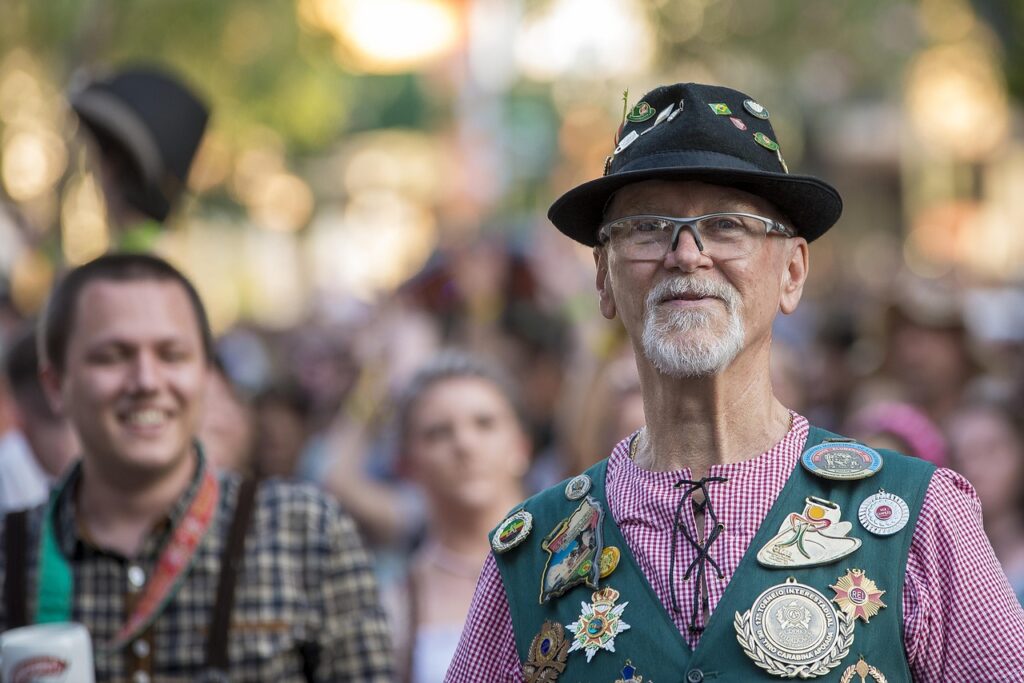
If you have bought Lederhosen, or been handed a pair for a party, and are now looking at socks, a shirt and a pair of shoes with no idea which combination is normal and which one marks you as a tourist: this page is the assembly instructions Bavaria never bothers to write down because everyone already knows them. I cover the leather itself, what it costs and where it came from on the Trachten and customs pillar; this page is just about wearing it correctly once you own it.
Kurze or Kniebund
Munich retailers sell three lengths as genuinely separate product lines, not just size variations of the same garment. The kurze Lederhose, sometimes called Krachlederne, ends just above the knee and is usually worn with braces, finished with a small two-to-three-centimeter cuff at the hem. The Kniebundhose extends past the knee and closes there with a band or lacing, chosen for a dressier look or cooler weather. Long Lederhosen are the third, less common option1. For a beer hall or an Oktoberfest tent, kurze is the standard choice; Kniebund reads slightly more formal and is more forgiving in early autumn evenings when a Munich beer garden can turn cold fast.
The shirt
The shirt worn with Lederhosen is plain or subtly checked, tucked in, and deliberately unremarkable next to the leather and the braces doing the visual work. Retailers sell it as part of a complete outfit rather than something to overthink on its own; Trachten Rausch, for one, bundles Lederhosen with a shirt and socks as a set and applies a discount for buying the pieces together rather than piecemeal6. If you already own the Lederhosen and just need the shirt, buying a plain button-down in a neutral color solves it without needing a specialty purchase.
Loferl and socks
Loferl, also called Stutzn or Beinhösl, are knitted calf-warmers found across the entire Alpine and pre-Alpine region, and traditionally they are worn against bare skin, with a deliberate gap of visible skin left between the top of the Haferlschuh and the bottom of the knit2. That gap is not an accident; the Trachtenverband itself describes it as part of the handcrafted look the whole garment is going for. Wearing socks underneath the Loferl is a real and fairly common choice today, but it is explicitly called out by the Trachtenverband as a modern deviation from the authentic style, not the original way of wearing them2. If bare-calf October weather is not appealing, wearing socks is not going to get you thrown out of anywhere; it is simply not the traditional version.
Haferlschuhe
The shoe underneath is the Haferlschuh, a side-laced leather shoe that began as ordinary work footwear for the rural population of the eastern Alpine region and is now the standard shoe worn with men’s Lederhosen23. My full page on Haferlschuhe and Loferl covers sizing and where to buy them; the short version here is that they are meant to be sturdy and low-heeled, not a dress shoe standing in for the real thing.
Straps, and a regional note on suspenders
Braces, or Träger, hold up the kurze and Kniebund styles and are part of the visual identity of the outfit as much as a practical fastener. In the Tölzer Land region specifically, the suspenders are traditionally elaborate and hand-embroidered, often stitched by family members, a level of handwork that marks the wearer’s specific home region to anyone who knows what they are looking at4. That is a regional detail rather than a universal rule; a plain leather brace is standard and correct nearly everywhere else.
Resi says Nobody is going to quiz you on regional embroidery patterns at an Oktoberfest party in North America, so do not let that detail talk you out of buying a pair. Get the fit right, get real leather, and the braces will look correct by default.
What tourists get wrong
There is no dress code at Oktoberfest, and street clothes are perfectly normal in the tents alongside Tracht5. Where people go wrong is not in skipping the outfit; it is in buying a bad version of it. Munich’s own guidance is specific: prioritize natural leather over anything synthetic, check that the stitching is even and clean at the stress points, and avoid glued rather than stitched Lederhosen, which feel rubbery and never break in the way real stitched leather does5. A high price alone is not proof of quality either; a mid-range goat or cowhide pair, properly stitched, is a perfectly good choice for someone who is not going to wear it every weekend.
If you are buying a pair from North America
Lederhosen Store carries men’s Lederhosen priced roughly $159.95 to $219.95, including deerskin among its premium options, with free shipping on orders of $299 or more7. That price range puts a genuinely leather, properly stitched pair within reach without a trip to Munich or a Munich-sized budget. Pair it with a plain shirt you likely already own, a set of Loferl and a pair of Haferlschuhe, and the whole outfit is done without needing another specialty purchase beyond the shoes.
Resi says If you are only going to own one pair, spend the extra money to get real leather rather than the glued costume version. A stitched leather pair breaks in and gets better with age; a costume pair looks like exactly what it is by the second wearing.
Frequently Asked Questions
Should I wear kurze or Kniebund Lederhosen?
Kurze, the short style ending above the knee, is the standard choice for a beer hall or an Oktoberfest tent. Kniebundhose, extending past the knee, reads slightly more formal and suits cooler weather.
Do you wear socks with Lederhosen?
Traditionally, Loferl are worn against bare skin. Wearing socks underneath is common today but is a modern departure from the original style, not the historically authentic way of wearing them.
What shoes go with Lederhosen?
Haferlschuhe, a side-laced leather shoe that started as rural workwear and is now the standard shoe for the outfit.
What shirt do you wear with Lederhosen?
A plain or subtly checked button-down shirt, tucked in, kept deliberately simple so the leather and the braces stand out.
Do you have to wear Lederhosen to Oktoberfest?
No. There is no dress code, and ordinary street clothes are worn in the tents alongside Tracht.
How do you tell real Lederhosen from a costume pair?
Real leather rather than a synthetic material, even and clean stitching at the stress points, and stitched rather than glued construction. Glued Lederhosen feel rubbery and do not improve with age.
Are suspenders required with Lederhosen?
Braces are standard with the short and knee-length styles and are part of how the outfit is meant to look, though the elaborate hand-embroidered version is a regional Tölzer Land detail rather than a universal requirement.
Related Articles
 Dirndl, Lederhosen and the Bavarian Year: Trachten and Customs ExplainedTrachten and customs
 Lederhosen: History, Types and What a Real Pair CostsTrachten and customs
 Haferlschuhe and Loferl: The Shoes and Socks That Finish the OutfitTrachten and customs
 Renting a Dirndl or Lederhosen in Munich: Shops, Prices, FitTrachten and customs
 What to Wear to Oktoberfest, and Whether You Have ToOktoberfest
 Oktoberfest Costumes, Honestly Rated: From the $30 Costume Dirndl to the Real ThingParty
 Oktoberfest in Munich: Dates, Tents, Reservations, What to Wear and What It CostsOktoberfest
Sources
- Herren Trachten: Lederhosen — Lodenfrey. Accessed 2026-09-24.
- Loferl: Herkunft und Bedeutung — Trachtenverband Bayern. Accessed 2026-09-24.
- Loferl: Herkunft und Bedeutung — Stockerpoint. Accessed 2026-09-24.
- Trachten im Tölzer Land — Tölzer Land. Accessed 2026-09-24.
- Oktoberfest Outfits: Dirndl and Lederhosen — muenchen.de. Accessed 2026-09-24.
- Trachten Rausch — Trachten Rausch. Accessed 2026-09-24.
- Lederhosen Store — Lederhosen Store. Accessed 2026-09-24.