In brief
The Hofbräuhaus is the beer hall every visitor has heard of, but it is only one of six Munich breweries allowed to pour at Oktoberfest, and the other five all run beer halls of their own. Augustiner-Bräu, the oldest of the six, traces its brewing back to 1328 and still serves its Helles from a wooden barrel at its own Bräustuben on Landsberger Straße. Paulaner runs its Bräuhaus at Kapuzinerplatz, open as early as 9 a.m. on weekends, and Löwenbräukeller’s Festsaal alone seats up to 2,000 under one roof at Nymphenburger Straße. The Hofbräuhaus itself keeps the latest kitchen and the latest last call of the group, open daily from 11 a.m. to midnight with the kitchen shutting at 10 and drinks served until 11:30. Which one is worth your evening depends on what you actually want from a beer hall, and that is what the rest of this page sorts out.
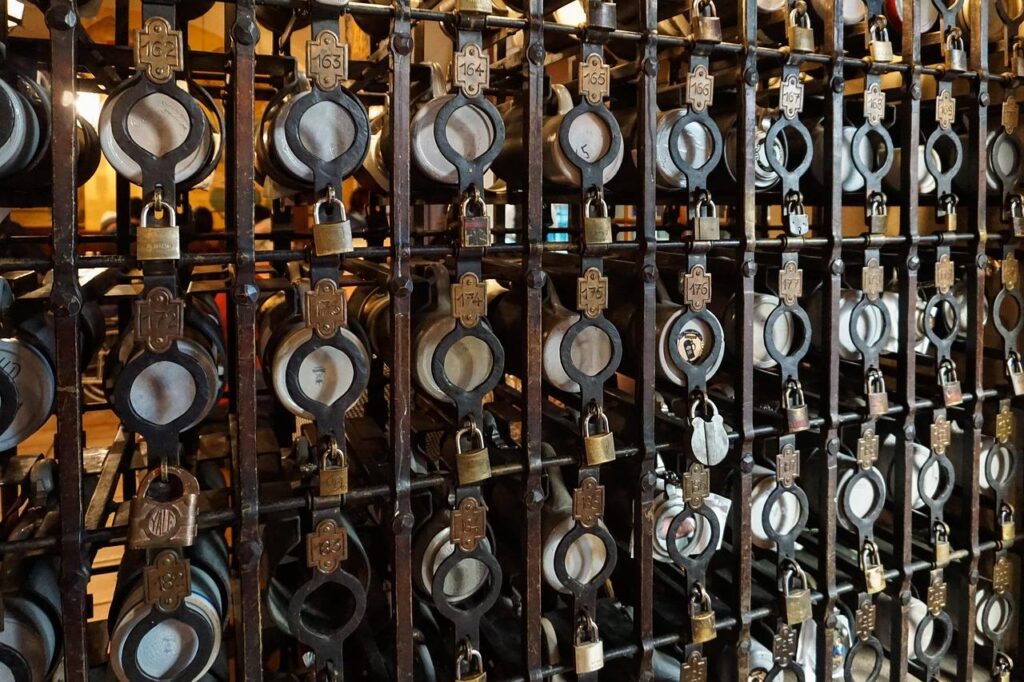
Everybody who plans a Munich trip already knows the Hofbräuhaus by name, usually before they know a single other thing about the city. That is not an accident; it has been open to the public since 1828 and has spent two centuries being the one beer hall foreigners hear about first. It is also not the only one, and in some ways not even the most interesting one. Munich’s other five Oktoberfest breweries, Augustiner, Hacker-Pschorr, Löwenbräu, Paulaner and Spaten, each have a beer hall or brewhouse of their own in the city, several of them older or quieter than the Hofbräuhaus and none of them full of tour groups on a Tuesday afternoon. This page is the rest of the lineup, for anyone whose one guaranteed evening in Munich should not automatically go to the busiest room in town. It belongs alongside my guide to Bavarian beer, and if you already know you want the Hofbräuhaus specifically, my page on whether it’s worth it is the one to read next.
The six breweries, and why only six pour at Oktoberfest
Munich limits Oktoberfest to beer from six breweries: Augustiner, Hacker-Pschorr, Hofbräu, Löwenbräu, Paulaner and Spaten. The festival’s own rule is that only “established and reputable traditional Munich breweries” qualify, a standard that keeps the roster to companies brewing under both the old Munich Purity Law of 1487 and the 1906 German one, and since 2022 the beer itself, “Oktoberfestbier,” carries EU Protected Geographical Indication status and can legally only be brewed inside Munich1. Every one of the six runs at least one beer hall or brewhouse in the city where you can drink that same beer year-round, not just during the two and a half weeks of the Wiesn.
This page covers the four halls a visitor is most likely to actually walk into: the Hofbräuhaus, Augustiner, Paulaner and Löwenbräu. Hacker-Pschorr and Spaten both brew under the same Oktoberfest rule and pour at their own tents every September, but neither runs a single flagship beer hall in the old town the way the other four do, so they are a smaller part of a first visit unless you are chasing every one of the six specifically.
Augustiner-Bräu: the oldest, and the wooden barrel
Augustiner traces itself to 1328, when Augustinian monks began brewing near Munich’s cathedral, making it the oldest of the six by a wide margin; the private company that runs it today took shape in 1829 under the brewer Anton Wagner2. What sets Augustiner apart on tap is not history but delivery: its Helles is still served “in the traditional wooden barrel,” which the brewery calls the oldest reusable container in the world, and the malt for it comes from Augustiner’s own historic barn malthouse rather than an outside supplier. The brewery’s Munich home is at Landsberger Straße 31-35, and Augustiner-Keller, its own beer garden and Bräustuben complex a short walk from the main train station, pours that same barrel-conditioned Helles alongside the stronger Edelstoff.
Paulaner Bräuhaus: the one that opens for breakfast on weekends
The Paulaner Bräuhaus am Kapuzinerplatz keeps the widest hours of the group: 11 a.m. to 11 p.m. Monday through Thursday, until midnight on Friday, and open from 9 a.m. on Saturday and Sunday, which puts it in range for a late Bavarian breakfast rather than only an evening Maß3. It sits at Kapuzinerplatz 5, a few tram stops from the old town rather than in the middle of the tourist crush, and describes its own approach as combining “Bavarian tradition with fresh ideas” in the kitchen. It is the closest thing on this list to a neighborhood beer hall, run by the same brewery that hands the first Salvator of the year to Bavaria’s minister-president every spring.
Löwenbräukeller: the biggest room
Löwenbräukeller occupies what used to be the Löwenbräu brewery’s own grounds at Nymphenburger Straße 2, and it is built at a different scale than the others on this list. The complex holds anywhere from 10 to 2,300 people depending on the room booked, with the main Festsaal alone seating up to 2,000 under one roof; there is also a Bräustüberl for something closer to a normal dinner, and a self-service beer garden outside4. It keeps long hours too, 11 a.m. to 11 p.m. Sunday through Thursday and to 11:30 on Friday and Saturday, with the kitchen open until 10:30 daily. If you want the scale of a beer hall without a single tour bus parked outside, this is where Munich itself tends to hold its own large functions.
The Hofbräuhaus: still the one everyone means
None of this is to talk you out of the Hofbräuhaus, which earns its reputation on its own terms. Duke Wilhelm V founded it in 1589 purely to supply the royal court, and it stayed a private ducal brewery until King Ludwig I opened it to the public by decree in 1828; the current Schwemme, the big tavern hall at the historic Platzl site, reopened in 1897 after a renovation, even though the beer itself has been brewed at Riem since 19885. It is open daily from 11 a.m. to midnight, with the kitchen closing at 10 and last call at 11:30, and its Schwemme, Bräustüberl, Wirtsgarten and Festsaal rooms between them handle a crowd no other single hall on this list quite matches. It is also, by its own description, “the world’s most famous tavern,” which is exactly why a Saturday night there feels less like a Munich evening and more like a very good theme park.
Beer hall or beer garden: the short version
A beer hall is indoors, keeps its own kitchen open into the evening, and serves its own food, no bring-your-own arrangement involved. A beer garden is outdoors, closes earlier under Bavaria’s noise rules, and, at a genuine one, lets you bring your own Brotzeit and pay only for the beer. Neither is better; a beer hall is the better call on a cold or wet night, and a beer garden wins every time the weather cooperates. My full comparison goes through the difference in more detail if you are choosing between the two for a single evening.
Resi says I would send a first-timer to Augustiner-Keller before the Hofbräuhaus, not because the Hofbräuhaus is not worth seeing, but because Augustiner’s wooden-barrel Helles is the better beer and you will not spend twenty minutes finding a seat. See the Hofbräuhaus too. Just do not let it be the only one.
If you want a guide to walk you between two of these instead of finding them yourself, the one I checked is the Beer and Brewery Tour in Munich, run by munich walk tours Ralph Luenstroth. It is 3.5 hours, starts at Marienplatz, and includes a one-hour visit to the Paulaner Brewery with admission and the brewing process explained, followed by an hour at the Hofbräuhaus, plus two 0.5-liter beers per person and the public transportation between stops. It was $54.58 a person as of September 26, 2026, rated 4.4 from 160 reviews, with free cancellation up to 24 hours ahead6. One reviewer noted the brewery portion is a smaller show brewery rather than the full working plant, which is worth knowing going in.
Frequently Asked Questions
Is the Hofbräuhaus the biggest beer hall in Munich?
Not by seating that either venue has published. Löwenbräukeller’s Festsaal alone holds up to 2,000, and the Hofbräuhaus has not confirmed a single seating figure for its Schwemme, though it describes serving over 3,500 regular patrons across its rooms.
What is the oldest beer hall brewery in Munich?
Augustiner-Bräu, tracing its origins to 1328, well over two centuries before the Hofbräuhaus was founded in 1589.
Do all six Oktoberfest breweries have their own beer hall in Munich?
Each has at least one hall, brewhouse or keller in the city; this page covers Augustiner, Paulaner, Löwenbräu and the Hofbräuhaus, the four with the most visitor-facing halls.
Is Augustiner beer different from the others?
Its Helles is served from a wooden barrel rather than a pressurized keg, which Augustiner presents as a point of difference in how the beer is delivered rather than brewed.
Can you get breakfast at a Munich beer hall?
The Paulaner Bräuhaus opens at 9 a.m. on weekends, making it the most realistic option for a late Bavarian breakfast among the halls on this page.
Do beer halls take reservations?
Some do for groups; the Hofbräuhaus asks parties of four or more to reserve, while walk-in seating is first-come on the ground floor.
Do Hacker-Pschorr and Spaten have their own beer halls too?
Both brew under the same Oktoberfest rule as the other four, but neither runs a single flagship beer hall in Munich’s old town on the scale of the Hofbräuhaus, Augustiner, Paulaner or Löwenbräu, which is why they are not covered in detail on this page.
Related Articles
 Bavarian Beer, Explained: Styles, Breweries, Beer Halls and Beer GardensBeer
 Is the Hofbräuhaus Worth It? An Honest Look at Munich’s Most Famous Beer HallBeer
 Beer Hall or Beer Garden? How Munich’s Two Beer Cultures Differ and Which to PickBeer
 Munich’s Big Six Breweries: What Each One Is Known For and Which to VisitBeer
 Munich Beer Gardens: The Big Ones, the Quiet Ones and How to ChooseBeer
 How Big Is a Maß? Bavarian Beer Sizes in Ounces, ExplainedBeer
 Munich Beer Tours Compared: Brewery Tours, Beer Hall Crawls and Beer Garden Bike RidesBeer
Sources
- The six Munich breweries at Oktoberfest — oktoberfest.de, City of Munich. Accessed 2026-09-24.
- Augustiner-Bräu — Augustiner-Bräu. Accessed 2026-09-26.
- Paulaner Bräuhaus am Kapuzinerplatz — Paulaner Bräuhaus. Accessed 2026-09-26.
- Löwenbräukeller — Löwenbräukeller. Accessed 2026-09-26.
- Hofbräuhaus history; Hofbräuhaus am Platzl — Hofbräuhaus München. Accessed 2026-09-24 and 2026-09-26.
- Beer and Brewery Tour in Munich — Viator, product 28222P5, operator munich walk tours Ralph Luenstroth. Accessed 2026-09-26.