In brief
The Hofbräuhaus is not a recreation of a historic beer hall, it is one: founded in 1589 by Bavarian Duke Wilhelm V to supply the ducal court, and opened to the public by King Ludwig I in 1828. It is also one of only six Munich breweries permitted to pour at Oktoberfest, alongside Augustiner, Hacker-Pschorr, Löwenbräu, Paulaner and Spaten, under a rule requiring “established and reputable traditional Munich breweries” brewing under both the 1487 Munich and 1906 German purity laws. Today it opens daily from 11 a.m. to midnight, with the kitchen closing at 10 p.m. and last call at 11:30 p.m. Downtown Munich beer prices, the benchmark the city uses to judge whether tent prices are reasonable, ran €7.70 to €13.40 per liter as of the 2026 review, which is the honest band to expect at the Hofbräuhaus itself. Whether it is “worth it” depends on what you are asking it to be: a genuine 437-year-old institution, yes; a quiet, undiscovered local spot, no, and it has not claimed to be one since Ludwig I threw the doors open in 1828.
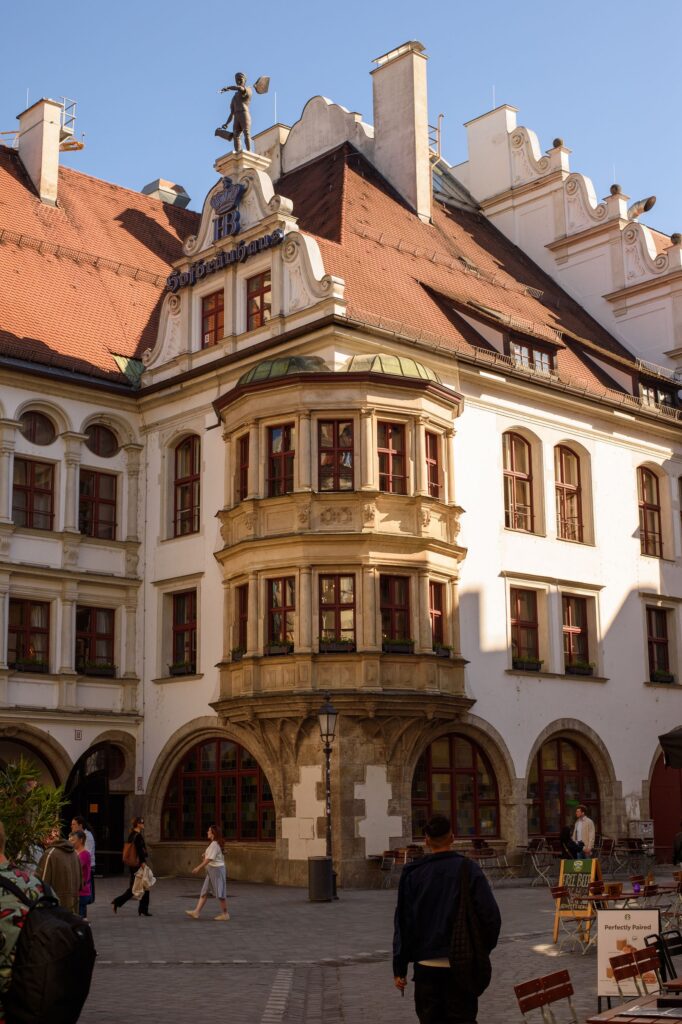
Every list of “things to do in Munich” puts the Hofbräuhaus near the top, and every list of “overrated tourist traps” puts it in the same spot, sometimes within the same paragraph. Both are reacting to the same fact: it is famous, it is central, and on any given evening it is completely full of people working through the exact same list. This page is part of my Bavarian beer guide, and I am going to try to separate what is actually true about the Hofbräuhaus from what people just repeat about it because repetition sounds like consensus. For how it stacks up against an outdoor beer garden, see beer hall or beer garden.
What the Hofbräuhaus actually is
Duke Wilhelm V founded the Hofbräuhaus in 1589 to brew for the Bavarian ducal court, under the Reinheitsgebot from the outset, and it stayed a court operation for nearly 250 years until King Ludwig I opened it to the public by royal decree in 1828; the “HB” trademark, the crest you now see on the mugs, followed in 18791.
Brewing at the original Platzl site ended in 1896, and the renovated Schwemme, the tavern hall tourists picture when they hear the name, reopened on 9 February 1897. Brewing later moved to Haidhausen, into what is now the Hofbräukeller, and then in 1988 to Munich’s Riem district — the historic Platzl tavern itself never moved1.
The name “Staatliches Hofbräuhaus” is not a marketing flourish. It reflects that the brewery is owned by the Bavarian state, and it is formally listed under that name as one of the six breweries allowed to pour at Oktoberfest2.
Resi says “Staatliches Hofbräuhaus” and “Hofbräukeller” are two different addresses with the same brewery behind them, and I still meet people who assume they are rivals. The Platzl tavern is the famous one; the Hofbräukeller in Haidhausen is where the brewing itself once relocated to, and it now runs as its own beer hall and garden, quieter than its more photographed sibling. “Staatliches” means the state still owns the place Ludwig I gave to the public back in 1828, and Bavarians, in my experience, have never quite gotten over losing him: they still miss their king, they just prefer to do the missing with a full mug in hand.
A history longer than the building's crowds suggest
The Hofbräuhaus has a habit of showing up at moments in Bavarian history that have nothing to do with tourism. During the Thirty Years’ War, on 17 May 1632, it reportedly handed over 23,168 liters of beer in an effort to dissuade occupying Swedish troops from plundering Munich1. That is not a founding-era detail from a plaque. It is a specific, dated transaction from a brewery that was still 200 years away from selling its first beer to an ordinary member of the public.
| Fact | Detail |
|---|---|
| Founded | 1589, by Duke Wilhelm V, for the ducal court |
| Opened to the public | 1828, by King Ludwig I |
| “HB” trademark registered | 1879 |
| Original Platzl brewing ended | 1896; Schwemme reopened 1897 |
| Brewing relocated | To Haidhausen, then to Riem in 1988 |
| Oktoberfest status | One of six permitted breweries, as “Staatliches Hofbräuhaus” |
| Hours | Daily 11 a.m.–midnight, kitchen to 10 p.m., last call 11:30 p.m. |
Source: Hofbräuhaus1; oktoberfest.de2.
The Oktoberfest connection
Only six Munich breweries are permitted to serve at Oktoberfest at all: Augustiner, Hacker-Pschorr, Hofbräu, Löwenbräu, Paulaner and Spaten. The rule, per Oktoberfest’s own site, restricts pouring rights to “established and reputable traditional Munich breweries,” complying with both the Munich Purity Law of 1487 and the German Purity Law of 1906, and since 2022 “Oktoberfestbier” itself carries EU Protected Geographical Indication status and may only be brewed in Munich under its specification2. Being one of six is not a small distinction, and it is the reason the Hofbräuhaus name shows up on a tent at the Wiesn every September as well as on the Platzl building the rest of the year.
What it costs and what that buys you
The city of Munich does not set beer prices anywhere, including at the Hofbräuhaus, but it does review Oktoberfest tent prices “to ensure they are reasonable,” using downtown Munich prices as its benchmark. As of the 2026 review, those downtown prices ran €7.70 to €13.40 per liter, the honest range to expect at a central, brand-name Munich beer hall, above what a neighborhood beer garden charges and below what an Oktoberfest tent charges during the festival itself, where a 2026 Maß runs €14.80 to €15.9034. You are not paying a tourist markup so much as a central-Munich, famous-address markup, the same one you would pay for a table at any landmark restaurant in any capital city.
The honest trade-off
The Hofbräuhaus draws a genuine mix: regulars, Bavarians on a night out, and a steady current of visitors working through the same list you are. That mix is not a flaw in the place, it is what a 437-year-old public tavern in the middle of a major tourist city looks like. What you get for putting up with the crowd is the real thing, an oldest continuously operating beer-hall brand in Munich, run under the same purity law it started with, in a hall that has occupied the same address since before the United States existed. What you give up is a quiet corner and a table nobody else wanted.
If quiet is what you are after, the beer gardens guide and the other beer halls page both have calmer options that are just as historically real: Augustiner’s own beer garden and Paulaner’s Bräuhaus on Kapuzinerplatz carry comparable pedigree with a fraction of the foot traffic, simply because their names travel less well outside Germany. None of that makes the Hofbräuhaus a mistake to visit once. It makes it a first stop rather than a whole trip.
Resi says My honest verdict: an hour, once, to see what the fuss traces back to, and then go find the beer garden that actually suits how you like to spend an evening. The Hofbräuhaus is worth it as a landmark. It is not worth it as your only Munich beer memory, and nobody who actually works there would tell you otherwise if you had the nerve to ask them on a Saturday night.
Frequently Asked Questions
When was the Hofbräuhaus founded?
In 1589, by Bavarian Duke Wilhelm V, originally to supply the ducal court.
When did the Hofbräuhaus open to the public?
In 1828, by royal decree of King Ludwig I.
Is the Hofbräuhaus one of the six Oktoberfest breweries?
Yes. It is listed as the “Staatliches Hofbräuhaus,” one of six Munich breweries permitted to pour at Oktoberfest under the Munich Purity Law of 1487 and the German Purity Law of 1906.
What are the Hofbräuhaus opening hours?
Open daily 11 a.m. to midnight, with the kitchen closing at 10 p.m. and last call at 11:30 p.m., by the brewery’s own description.
What does "Staatliches Hofbräuhaus" mean?
It means the brewery is state-owned, by the Free State of Bavaria; the name distinguishes it in Oktoberfest’s official list of the six permitted breweries.
Is the Hofbräuhaus more expensive than other Munich beer halls?
It sits within the general downtown Munich price band the city uses as its benchmark, €7.70 to €13.40 per liter as of 2026, rather than at Oktoberfest-tent prices, which run higher during the festival.
Related Articles
 Bavarian Beer, Explained: Styles, Breweries, Beer Halls and Beer GardensBeer
 Beer Hall or Beer Garden? How Munich’s Two Beer Cultures Differ and Which to PickBeer
 Munich’s Big Six Breweries: What Each One Is Known For and Which to VisitBeer
 Munich Beer Halls Beyond the Hofbräuhaus: Augustiner, Paulaner, Löwenbräu and the RestBeer
 Munich Beer Gardens: The Big Ones, the Quiet Ones and How to ChooseBeer
 Munich Beer Garden Rules: Bring Your Own Food, Never Your Own BeerBeer
 How Big Is a Maß? Bavarian Beer Sizes in Ounces, ExplainedBeer
Sources
- History — Hofbräuhaus. Accessed 2026-09-24.
- The six Munich breweries at Oktoberfest — oktoberfest.de, City of Munich. Accessed 2026-09-24.
- Beer price — oktoberfest.de, City of Munich. Accessed 2026-09-24.
- Beer prices 2026: breweries — muenchen.de, City of Munich. Accessed 2026-09-24.